Yazışma Adresi/Address for Correspondence: Dr. Necmi Baykan, Nevşehir Devlet Hastanesi, Acil Tıp Kliniği, Nevşehir, Turkey E-mail: [email protected]
Geliş tarihi/Received: 23.05.2018 Kabul tarihi/Accepted: 20.10.2018 Çevrimiçi yayın/Published online: 22.02.2019
ARAŞTIRMA / RESEARCH
Compliance to guidelines in in-hospital cardiopulmonary resuscitation
interventions: single-center experience
Hastane içi erişkin kardiyopulmoner resüsitasyon uygulamalarının kılavuzlara
uygunluk düzeyi: tek merkez deneyimi
Nail Çalışkan
1, Polat Durukan
2, Necmi Baykan
1, Nesıj Doğan Kaymaz
3,
Ferhan Elmalı
4, Cemil Kavalcı
51Nevşehir Devlet Hastanesi, Acil Tıp Kliniği, Nevşehir, Turkey
2Erciyes Üniversitesi Tıp Fakültesi, Acil Tıp Anabilim Dalı, Kayseri, Turkey 3Edirne Sultan 1. Murat Devlet Hastanesi, Acil Tıp Kliniği, Edirne, Turkey
4İzmir Katip Çelebi Üniversitesi, Biyoistatistik ve Tıbbi Bilişim Anabilim Dalı, İzmir, Turkey 5Başkent Üniversitesi Acil Tıp Anabilim Dalı. Ankara. Turkey
Cukurova Medical Journal 2019;44(2):402-409
Abstract Öz
Purpose: The aim of this study was to investigate standard of knowledge about adult cardiopulmonary resuscitation according to current guidelines and affecting factors among clinicians working at the Hospital of Erciyes University, Medicine School.
Materials and Methods: The study conducted on residences and subspecialty residences who accepted to participate and complete the survey. Overall 303 clinicians who accepted to participate and were accessible for completion of survey were recruited to the study. The survey included 2 sections. The first section included data regarding demographic characteristics and the second part included 20 multiple-choice items with one correct answer prepared based on 2010 American Heart Association
Cardiopulmonary Resuscitation and Emergency
Cardiovascular Care..
Results: Age, total duration of medical practice and residency positively affected standard of knowledge. Higher number of cardiopulmonary resuscitation performed within prior 6 months and defibrillation performance during cardiopulmonary resuscitation positively affected standard of knowledge. Post-graduate theoretical and practical training positively affect standard of knowledge.
Conclusion: Cardiopulmonary resuscitation trainings aiming clinicians should be standardized and updated as well as education during employment should be scheduled to provide access to such programs.
Amaç: Bu çalışmanın amacı Erciyes Üniversitesi Tıp Fakültesi Hastaneleri`nde görevli doktorların güncel kılavuzlara göre erişkin kardiyopulmoner resüsitasyon konusundaki bilgi düzeylerinin ve bunu etkileyen faktörlerin araştırılmasıdır.
Gereç ve Yöntem: Bu çalışma anket doldurmayı kabul eden asistan hekimler arasında gerçekleştirilmiştir. Çalışmamıza, kliniklerinde ulaşılabilen ve araştırmaya katılmaya rıza gösteren toplam 303 doktor dâhil edilmiştir. Veri toplama formları iki bölümden oluşmaktadır. Anketin ilk bölümünde demografik veriler ve ikinci bölüm seçeneklerinden sadece bir tanesi doğru olan, çoktan seçmeli, Amerikan Kalp Derneği’nin Kardiyopulmoner Resüsitasyon ve Acil Kardiyovasküler Bakım 2010 Kılavuzu temel alınarak hazırlanan 20 adet sorudan oluşturulmuştur.
Bulgular: Hekimlerin yaşları, toplam hekimlik ve toplam asistanlık süreleri bilgi düzeyini olumlu etkilemektedir. Son altı ay içerisinde uyguladıkları kardiyopulmoner resüsitasyon sayısının fazla olması ve kardiyopulmoner resüsitasyon esnasında defibrilasyon yapmış olmaları bilgi düzeylerini olumlu etkilemektedir. Mezuniyet sonrası dönemde alınan eğitimler hekimlerin bilgi düzeyini anlamlı olarak artırmıştır.
Sonuç: Hekimlere yönelik kardiyopulmoner resüsitasyon eğitim programları standardize edilmeli, güncellenmeli ve çalışanlara bu programların ulaştırılabilmesi için hizmet içi kurslar düzenlenmelidir.
Key words: Cardiopulmonary resuscitation, knowledge. Anahtar kelimeler: Kardiyopulmoner resüsitasyon, bilgi düzeyi
403
INTRODUCTION
Cardiopulmonary arrest is defined as sudden, complete and irreversible stop of circulatory and respiratory functions which are essential for maintaining life.1 Cardiopulmonary resuscitation (CPR) is the most important emergency intervention in cardiac arrest which is a life-threatening condition. Resuscitation has long been field of interest in research efforts and data on this topic has been periodically updated through guidelines published by international organizations. Thousands of people with sudden cardiac arrest have been survived by advances in CPR. The life saved by successful CPR attempts reveals benefits of CPR and how valuable is the time consumed and efforts made to achieve advances in CPR. Currently, it isn't only aimed to survive patients experiencing cardiopulmonary arrest but also to achieve health standards before arrest. Thus, knowledge and skills of healthcare providers on CPR is of importance.2
For this purpose, International Liaison Committee on Resuscitation including 7 international councils such as American Heart Association (AHA) and European Resuscitation Council (ERC) publishes guidelines by 5-years intervals in order to evaluate novel approaches and treatments, to propose common treatment and intervention strategies, and to provide CPR trainings.
It is essential to assess standard of knowledge about CPR, to compliance to current guidelines and international algorithms during and factors that affect degree of compliance among clinicians. This will allow identifying problems, causes of deficiencies in knowledge and failure to comply current guidelines if present, and recommendations to provide contemporary approaches and successful outcomes in this field.
The aim of this study was to assess standard of knowledge and compliance to guidelines regarding CPR among clinicians employed in clinical fields of medicine in Erciyes University, Medicine School.
MATERIALS AND METHODS
The study conducted on residences and subspecialty residences employed at Hospital of Erciyes University, Medicine School. The residences employed in pediatrics, child psychiatry, child surgery
and basic science departments were excluded. Data were collected between 07.02.2015 and 07.05.2015. The data were collected at workplaces of participants. The participants who accepted to participate were asked to complete a survey involving two sections. In addition, the participants were informed about aim of the study, which is to determine standard of knowledge on CPR and compliance to guidelines regarding choices about drugs, technique, evaluations and methods, and to identify factors that influence degree of compliance among clinicians who dealt with in-hospital cardiac arrest.
Overall 303 clinicians who accepted to participate and were accessible for completion of survey were recruited to the study. Data were found to be complete and sufficient for analysis in 275 of 303 surveys.
The survey included 30 questions and maximum time to complete survey was set as 25 minutes. It was not permitted to gather information from data sources or to answer questions together with other participants. We determined number of correct answers in the second section of survey. This study is a cross-sectional, descriptive study using a survey including 2 sections. The survey included 2 sections. The first section included data regarding demographic characteristics (age, gender), education (department employed, total duration of medical practice, total duration of occupation in the department, number of cardiopulmonary resuscitations performed within prior 6 months, whether defibrillation cardiversion was employed during cardiopulmonary resuscitation), history of education on cardiopulmonary resuscitation (theoretical and practical trainings at medicine school, postgraduate theoretical and practical trainings) and the way updating knowledge about cardiopulmonary resuscitation.
The second part included 20 multiple-choice items with one correct answer prepared based on 2010 American Heart Association Cardiopulmonary Resuscitation and Emergency Cardiovascular Care. These questions included 2 main domains including 7 questions from basic life support and 13 questions from advanced cardiac life support.
Study was started after the consent No. 2015/48, dated 23.01.2015, was acquired from the Non-invasive Ethics Committee of Faculty of Medicine of Erciyes University.
404
Statistical analysis
Data were analyzed by using IBM SPSS Statistics 22.0 (IBM Corp., Armonk, New York, USA). The data distribution was assessed by using Shapiro-Wilk test and Q-Q plots. Descriptive statistics are presented as count (n), percent (%), mean ± standard deviation and median (min-max). Mann Whitney U test was used to compare groups. Spearman's correlation analysis was used to assess relationship among numerical variables. A p value<0.05 was considered as statistically significant.
RESULTS
Of the participants, 118 (43%) were female whereas 157 (57%) were male. Mean age was a 28±3 year
among participants. The mean duration of medical practice was 4.1±3.1 years while mean duration of residency was 2.4±1.5 years.
When answers were assessed according to gender, it was found that median number of correct answers in BLS domain was 3.5 among female participants whereas 3 among male participants (p=0.505). Median number of correct answer in ACLS domain was 6 among female and male participants each (p=0.967). Median value for total number of correct answer was 10 in female and male participants each (p=0.586). No significant difference was detected in number of correct answers BLS and ACLS domains and total number of correct answers between female and male participants (Table 1).
Table 1. Comparison of correct answer numbers of physicians in terms of gender
Gender Median (min.-max.) p
Number of correct answers in BLS* Male 3 (1-7) 0.505
Female 3.5 (0-7)
Number of correct answers in ACLS** Male 6 (2-11) 0.967
Female 6 (1-11)
Number of total correct answers Male 10 (4-18) 0.586
Female 10 (4-17)
BLS: Basic life support, ALS: Advanced cardiovascular life support
There was a significant, weak correlation between age and number of correct answers in BLS (rho: 0.184; p=0.002) whereas significant, moderate correlations with total number of correct answers and number of correct answers in ACLS domain (rho: 0.243 and rho. 280; p<0.001) (Table 2). There was a significant, weak correlation between total duration of medical practice and number of correct answers in BLS (rho: 0.199; p=0.001) whereas significant moderate
correlations with total number of correct answers (rho: 0.285; p<0.001) and number of correct answers in ACLS (rho: 0.321; p<0.001) (Table 2). There was a weak correlation between duration of residency and number of corrects answers in BLS (rho: 0.025; p=0.683) whereas significant moderate correlations with total number of correct answers (rho: 0.254; p<0.001) and number of correct answers in ACLS (rho: 0.215; p<0.001) (Table 2).
Table 2. Relation between demographic data of physicians and total correct answer numbers
BLS correct ACLS correct Total number of
correct
rho P rho P rho P
Age 0.184 0.002 0.243 <0.001 0.280 <0.001
Duration of medical profession 0.199 0.001 0.285 <0.001 0.321 <0.001
Duration of residency 0.025 0.683 0.254 <0.001 0.215 <0.001
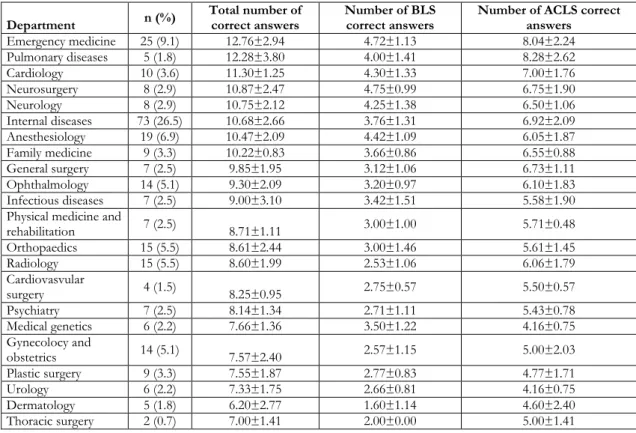
When participants were assessed according to departments employed, 117 participants (64%) were employed in medical branches whereas 98 (36%) were employed in surgical branches.mThe number of participants was higher in internal medicine department (73 participants; 26.5%); followed by
emergency medicine department (25 participants; 9.1%) and anesthesiology and reanimation department (19; %6.9). The highest achievement was performed by emergency medicine department; followed by chest department and cardiology department (Table 3).
405
Table 3. The distribution of the participants in terms of speciality and branches and the number of correct answers
Department n (%)
Total number of correct answers
Number of BLS correct answers
Number of ACLS correct answers Emergency medicine 25 (9.1) 12.76±2.94 4.72±1.13 8.04±2.24 Pulmonary diseases 5 (1.8) 12.28±3.80 4.00±1.41 8.28±2.62 Cardiology 10 (3.6) 11.30±1.25 4.30±1.33 7.00±1.76 Neurosurgery 8 (2.9) 10.87±2.47 4.75±0.99 6.75±1.90 Neurology 8 (2.9) 10.75±2.12 4.25±1.38 6.50±1.06 Internal diseases 73 (26.5) 10.68±2.66 3.76±1.31 6.92±2.09 Anesthesiology 19 (6.9) 10.47±2.09 4.42±1.09 6.05±1.87 Family medicine 9 (3.3) 10.22±0.83 3.66±0.86 6.55±0.88 General surgery 7 (2.5) 9.85±1.95 3.12±1.06 6.73±1.11 Ophthalmology 14 (5.1) 9.30±2.09 3.20±0.97 6.10±1.83 Infectious diseases 7 (2.5) 9.00±3.10 3.42±1.51 5.58±1.90
Physical medicine and
rehabilitation 7 (2.5) 8.71±1.11 3.00±1.00 5.71±0.48 Orthopaedics 15 (5.5) 8.61±2.44 3.00±1.46 5.61±1.45 Radiology 15 (5.5) 8.60±1.99 2.53±1.06 6.06±1.79 Cardiovasvular surgery 4 (1.5) 8.25±0.95 2.75±0.57 5.50±0.57 Psychiatry 7 (2.5) 8.14±1.34 2.71±1.11 5.43±0.78 Medical genetics 6 (2.2) 7.66±1.36 3.50±1.22 4.16±0.75 Gynecolocy and obstetrics 14 (5.1) 7.57±2.40 2.57±1.15 5.00±2.03 Plastic surgery 9 (3.3) 7.55±1.87 2.77±0.83 4.77±1.71 Urology 6 (2.2) 7.33±1.75 2.66±0.81 4.16±0.75 Dermatology 5 (1.8) 6.20±2.77 1.60±1.14 4.60±2.40 Thoracic surgery 2 (0.7) 7.00±1.41 2.00±0.00 5.00±1.41
When medical and surgical branches were compared, it was seen that number of correct answers was significantly higher among participants employed in medical branches than those employed in surgical branches (Table 4). Median number of correct answers was significantly higher in clinicians employed in departments with ICU than those employed in departments without; in clinicians performed >10 CPR than those performed <10 CPR within prior 6 months; in clinicians performed defibrillation than those performed no defibrillation during CPR; in clinicians provided theoretical and practical CPR training at medicine school than those provided no education; and in clinicians provided theoretical training alone at medicine school than those no education (Table 4).
Median total number of correct answers and median number of correct answers in BLS and ACLS were comparable among clinicians provided postgraduate training and those not (Table 4). The clinicians
reported that they updated their knowledge on CPR by: residency lessons (n=70; 25.4%), courses and seminars (n=20; 7.2%), congresses and symposiums (n=20; 7.2%) and self-teaching activities (n=167; %60.7). A significant proportion of participants (n=61; 22.1%) reported that they don't update their knowledge.
The median total number of correct answers and median numbers of correct answers in BLS and ACLS domains were found to be higher in clinicians updating their knowledge than those not updating but the difference didn't reach statistical significance (Table 4).
Median number of correct answers was significantly higher in clinicians provided postgraduate residency lesson than those didn't; in clinicians attended to postgraduate courses or seminars than those didn't; and in clinicians attended postgraduate training at congress than those didn't (Table 4).
406 Table 4. Comparison of participants in terms of variables
Characteristics Correct BLS p Correct ACLS p Total number of correct answers p median (min-maks) median (min-maks) median (min-maks) Department internal 4 (0-7) 0.006 7 (2-11) <0.001 10 (4-18) <0.001 surgical 3 (1-6) 6 (1-10) 9 (4-14) ICU* exists 4 (1-7) <0.001 7 (2-11) <0.001 11 (4-18) <0.001 Not exist 3 (0-7) 6 (1-9) 9 (4-14)
Performing CPR** in the last 6 months
<10 3 (0-7)
<0.001 6 (1-11) <0.001 9 (4-16) <0.001
>10 4 (1-7) 7 (3-11) 11 (5-18)
Defibrillation practice yes 4 (1-7) <0.001 7 (2-11) <0.001 11 (5-18) <0.001
no 3 (0-7) 6 (1-11) 8 (4-16)
Getting theoretical education in the medical faculty
yes 4 (1-7)
<0.001 7 (2-11) <0.001 11 (4-18) <0.001
no 3 (0-6) 5 (1-9) 7 (4-14)
Getting practical education in the medical faculty
yes 4 (1-7)
0.001 7 (2-11) <0.001 11 (4-18) <0.001
no 3 (0-6) 5 (1-9) 8 (4-14)
Getting external theoretical education in the medical faculty
yes 4 (2-7)
0.01 7 (2-11) 0.004 11 (6-18) 0.001
no 3 (0-7) 6 (1-11) 10 (4-17)
Getting external practical education in the medical faculty
yes 4 (1-7)
0.776 7 (2-11) 0.072 10 (6-18) 0.181
no 3 (0-7) 6 (1-11) 10 (4-17)
CPR information update yes 4 (0-7) <0.001 7 (1-11) <0.001 10 (4-18) <0.001
no 3 (1-5) 5 (2-11) 8 (4-15)
Getting an residency course yes 4 (1-7) <0.001 7.5 (2-11) <0.001 11.5 (6-18) <0.001
no 3 (0-7) 6 (1-11) 9 (4-16)
Postgraduate course/seminar yes 4 (1-7) 0.008 7 (4-11) <0.001 11 (6-18) <0.001
no 3 (0-7) 6 (1-11) 9 (4-16)
Congress yes 4 (3-7) 0.009 8 (3-11) <0.001 12 (7-18) <0.001
no 3 (0-7) 6 (1-11) 10 (4-16)
*ICU: Intensive care unit, **CPR: Cardiopulmonary resuscitation
DISCUSSION
CPR training has become increasingly widespread in our country and worldwide in order to achieve sequel-free recovery and to improve outcomes in cardiopulmonary arrest. It has been attempted to achieve best results by education at medicine school and post-graduate trainings.3 However, the individuals without formal CPR education at medicine school learn by "observe, see, learn" method. Thus, various techniques are being used and CPR isn't necessarily successful.4 CPR training is one of the most important trainings that should be given to students in medicine schools. Despite pioneering attempts by some universities, no sufficient time and interest on CPR training could be achieved yet.5 In our country, there is no clear data regarding sufficiency of such trainings and effectiveness of post-graduate trainings. However, there are some studies aiming to determine standard of knowledge among clinicians and healthcare providers on CPR.3
In general, our results are in agreement with those studies 3. In our studies, it was concluded that standard of knowledge on CPR and changes in current guidelines among clinicians. It was shown that th postgraduate training and following current guidelines are be primary factors that influences standard of knowledge about CPR.
In general, it has been emphasized that standard of knowledge on CPR and frequency of training are insufficient in studies on healthcare providers. Şener et al. assessed standard of knowledge about adult/pediatric CPR among nurses employed in a teaching hospital. Authors reported that success rate in the survey about standard of knowledge was 36.7% despite previous CPR training in 79.3% of nurses (including training within prior year in 62.1%). The success rate was increased to 68.3% in the same group after CPR training. It was reported that provision of CPR training and employment in surgical or medical branches didn't affect success rate
407 among nurses. Authors concluded that such training should be repeated by 6-month intervals.6
In a study by Kaan et al., outcomes of CPR and defibrillation courses were assessed in an university hospital. Only 1.9% of participants reported that they attended to a CPR or defibrillation course within prior year 7. Although CPR training is provided at medicine school, residents have insufficient knowledge about CPR due to lack of postgraduate or in-service trainings. In our study, rate of correct answers was 51% for BLS and 48% for ACLS while general success rate was 49%, indicating that standard of knowledge on CPR is low among clinicians in agreement with literature.
In our study, it was found that the gender didn't affect total number of correct answers in the survey. This finding is consistent to those reported by Şener et al. and supports the concept that being male or female doesn't affect standard of knowledge on CPR.3 In our study, a significant moderate correlation was observed between age and total number of correct answers. This finding showed that standard and currency of knowledge are proportional to age of clinician.
There was a significant correlation between total duration of medical practice and total number of correct answers. Again, it was also significantly correlated to total duration of residency. These findings are on contrary to those reported by Kıyan et al. who also reported that standard of knowledge was affected by total duration of medical practice and residency. The difference in our study may be explained the fact that senior residences in our study were provided a CPR training which was organized by Emergency Medicine, Anesthesiology and Reanimation, and Cardiology departments 3 years ago.
In the studies by Şener et al. (2006) and Uzun et al. (2012), the success rate was found to be higher among ED residences when compared to other departments.8,9 Our study also found higher standard of knowledge about CPR among ED clinicians. As ED clinicians are among those who are most commonly encountered to cardiac arrest, their theoretical knowledge about CPR is updated frequently.
In our study, the mean percentage of correct answers was 43.1% for 3 questions assessing awareness about changes in 2010 AHA guidelines when compared to
2005 guidelines. As similar, it was 55.3% in the question assessing order of resuscitation according to 2010 AHA guidelines. This indicated that significant proportion of clinicians are unaware that chest compression is now first intervention during resuscitation. Taken together, these findings suggest that clinicians don't follow changes in ERC and AHA guidelines which are revised by 5-years intervals and don't have sufficient training.
The finding that success rate was lower among clinicians who employed in departments without ward or ICU can be explained by the fact that this group of clinicians are far from clinical practice and current clinical guidelines. However, clinicians employed in departments without ward or ICU should update their basic knowledge about CPR which may be essential for all healthcare providers. The knowledge about an issue which has theoretical and practical components and is less frequently encountered can die over time due to lack of practice. In our study, standard of knowledge showed a linear increase among clinicians who performed more than 10 CPR within prior 6 months while it was significantly lower among those who didn't performed defibrillation. This can be explained by reinforcement and stability of knowledge by increasing practice. However, it should be kept in mind that standard of knowledge should be sufficient in clinicians who don't frequently encountered arrest in their clinical practice given the fact that they may deal with arrest during their clinical practice and social life.
In a study on primary care physicians (n=150) and residences of Atatürk University, Medicine School (165), a 30-item survey was used to assess knowledge about BLS. In this study, mean number of correct answers was 15.52±3.74 among primary care physicians whereas 16.53±3.57 among residences. It was suggested that the factors affecting success included place of employment, medicine school graduated and postgraduate training about BLS.10 Likewise, mean number of correct answers was found to be higher among clinicians who were provided CPR training before graduation.
The number of correct answers was significantly higher among clinicians who were provided theoretical and practical training when compared to those who were not. In the study by Kocalar and Bilir, it was concluded that training during education at medical school have positive contribution to
408 knowledge and skills of clinicians during their medical practice. Our study is in agreement with literature.
In our study, there was a correlation between postgraduate CPR training and total number of correct answer in parallel to studies in the literature. In a study by Şener et al., it was shown that postgraduate training is one of the major factors that affect standard of knowledge7. Thus, it is thought that effective, frequent and repeated postgraduate training can help to decrease wide success spectrum between gap and standard of knowledge. Our study also supports this opinion.
Standard of knowledge was found to be significantly higher among clinicians who reported that they updated their knowledge about CPR via residency lessons, courses and seminars, and congresses. The standard of knowledge didn't improve in clinicians who reported that they updated their knowledge by self-teaching attempts as significant as clinicians who reported that they updated their knowledge about CPR via residency lessons, courses and seminars, and congresses. However, it was found that standard of knowledge was significantly higher in these clinicians when compared to those never update their knowledge. This finding emphasizes the importance of systematic training after graduation and updating knowledge somewhat.
This study has some limitations including restricted sample and lack of assessment regarding practical skills. However, it is valuable that it showed insufficient standard of knowledge among clinicians employed in our hospital.
It is of importance to provide sufficient training about arrest, basic and advanced life support. There is no standard regarding CPR training in our country. In addition, CPR training before graduation appears as one of the most important factors affecting standard of knowledge among clinicians. Data regarding standard of knowledge on CPR among clinicians employed in our study suggest that pre- and postgraduate CPR trainings are insufficient. The gap in the knowledge on CPR may be due to the fact that the knowledge on CPR will die over time and become outdated and lack of frequent and effective in-service training. These results emphasize the importance of standardization of education curriculum for medicince schools and taking CPR training into consideration when attempts are made for such
standardization.
In conclusion, standard of knowledge about CPR was found to be insufficient among clinicians included. CPR training before and after graduation should be standardized and repeated frequently.
Yazar Katkıları: Çalışma konsepti/Tasarımı: PD; Veri toplama: FE; Veri analizi ve yorumlama: NDK; Yazı taslağı: NB; İçeriğin eleştirel incelenmesi: NB; Son onay ve sorumluluk: NÇ, PD, NB, NDK, FE, CK; Teknik ve malzeme desteği: NÇ; Süpervizyon:NÇ; Fon sağlama (mevcut ise): yok.
Bilgilendirilmiş Onam: Katılımcılardan yazılı onam alınmıştır. Hakem Değerlendirmesi: Dış bağımsız.
Çıkar Çatışması: Yazarlar çıkar çatışması beyan etmemişlerdir. Finansal Destek: Yazarlar finansal destek beyan etmemişlerdir. Author Contributions: Concept/Design :PD; Data acquisition: FE; Data analysis and interpretation: NDK; Drafting manuscript: NB; Critical revision of manuscript: NB; Final approval and accountability: NÇ, PD, NB, NDK, FE, CK; Technical or material support:; NÇ; Supervision: NÇ; Securing funding (if available): n/a.
Informed Consent: Written consent was obtained from the participants.
Peer-review: Externally peer-reviewed.
Conflict of Interest: Authors declared no conflict of interest. Financial Disclosure: Authors declared no financial support
REFERENCES
1. Çalışkan N. Hastane içi erişkin kardiyopulmoner resusitasyon uygulamalarının güncel kılavuzlara uygunluk düzeyi ve bunu etkileyen faktörler (Uzmanlık tezi). Kayseri, Erciyes Üniversitesi. 2015. 2. Andrew HT, Thomas DR, Bentley JB. Guidelines
2010 for cardiopulmonary resuscitation and emergency cardiovascular care science: CPR Overview. Circulation. 2010;122:676-84.
3. Abella BS, Sandbo N, Vassilatos P. Chest
compression rates during cardiopulmonary
resuscitation are suboptimal: a prospective study during in-hospital cardiac arrest. Circulation. 2005;111:428–34.
4. Grmec S, Kupnik D. Does the Mainz Emergency Evaluation Scoring (MEES) in combination with capnometry (MEESc) help in the prognosis of outcome from cardiopulmonary Resuscitation in a prehospital setting? Scitation. 2003;58:89-96. 5. Grmec S, Klemen P. Does the end-tidal carbon
dioxide (EtCO2) concentration have prognostic value during out-of-hospital cardiac arrest? Eur J Emerg Med. 2001;8:263-9.
6. Peberdy MA, Callaway CW, Neumar RW, Geocadin
RG, Zimmerman JL, Donnino M et al. Part 9: post– cardiac arrest care: 2010 American Heart Association guidelines for cardiopulmonary resuscitation and emergency cardiovascular care. Circulation. 2010;122:768-86.
7. Şener S. Dokuz Eylül Üniversitesi Araştirma ve Uygulama Hastanesi'ndeki araştırma görevlisi tıp doktorlarının temel yaşam desteği bilgi düzeyleri ve
409 bunu etkileyen faktörler (Uzmanlık tezi). İzmir, Dokuz Eylül Üniversitesi. 2003.
8. Kiyan S, Yanturali S, Musal B. Determination of advanced life support knowledge level of residents in a Turkish university hospital. J Emerg Med.
2008;35:213-22.
9. Bilir Ö, Acemoğlu H, Aslan Ş. Knowledge levels as to basic life support of medical doctors and affecting factors. Turk J Emerg Med. 2007;7:18-24.