Article Type:
Research Paper
Original Title of Article:
An analysis of the relation between teacher candidates’ attitudes toward the teaching profession and
teaching-learning process competencies
Turkish Title of Article:
Öğretmen adaylarının mesleğe yönelik tutumları ile öğretme-öğrenme süreci yeterlikleri arasındaki
ilişkinin incelenmesi
Author(s):
Hasan Hüseyin ŞAHAN, Hasan ZÖĞ
For Cite in:
Şahan, H. H., & Zöğ, H. (2017). An analysis of the relation between teacher candidates’ attitudes toward
the teaching profession and teaching-learning process competencies. Pegem Eğitim ve Öğretim Dergisi,
7(4), 583-610, http://dx.doi.org/10.14527/pegegog.2017.021
Makale Türü:
Özgün Makale
Orijinal Makale Başlığı:
An analysis of the relation between teacher candidates’ attitudes toward the teaching profession and
teaching-learning process competencies
Makalenin Türkçe Başlığı:
Öğretmen adaylarının mesleğe yönelik tutumları ile öğretme-öğrenme süreci yeterlikleri arasındaki
ilişkinin incelenmesi
Yazar(lar):
Hasan Hüseyin ŞAHAN, Hasan ZÖĞ
Kaynak Gösterimi İçin:
Şahan, H. H., & Zöğ, H. (2017). An analysis of the relation between teacher candidates’ attitudes toward
the teaching profession and teaching-learning process competencies. Pegem Eğitim ve Öğretim Dergisi,
7(4), 583-610, http://dx.doi.org/10.14527/pegegog.2017.021
An Analysis of the Relation between Teacher Candidates’ Attitudes
toward the Teaching Profession and Teaching-Learning Process
Competencies
Hasan Hüseyin ŞAHAN
*a, Hasan ZÖĞ
a aBalıkesir University, Necatibey Education Faculty, Balıkesir/Turkey
Article Info Abstract
DOI: 10.14527/pegegog.2017.021 Even though the adopted teaching-learning approaches and the curricula that are
based on them are subject to change in an educational institution, teaching competencies and attitudes determine the basic quality of the educational system. The study mainly intends to determine the relationship between levels of teacher candidates’ attitude to teaching and levels of their teaching-learning competencies. This study has a survey design as it identifies teacher candidates’ attitudes toward the profession and teaching-learning process competencies, and a relational survey design as it explores whether attitudes toward the profession and teaching-learning competencies correlate or not. As the study aims to make a comparison between social sciences and science-math fields, the data was collected from 387 teacher candidates, whose subject fields can be grouped within these two areas. The data was collected through “Attitude to Teaching Profession Scale” and “Teaching Learning Process Competencies Scale”. The results revealed that teacher candidates have a positive attitude towards the teaching profession and teaching competencies at high levels. In addition, it was found that teacher candidates’ positive attitude correlates significantly with their teaching-learning competencies.
Article History: Received Revised Accepted Online 02 January 2017 19 May 2017 01 June 2017 22 August 2017 Keywords: Teacher candidates, Attitude towards the teaching profession,
Teaching-learning process competencies.
Article Type:
Research paper
Öğretmen Adaylarının Mesleğe Yönelik Tutumları ile Öğretme-Öğrenme
Süreci Yeterlikleri Arasındaki İlişkinin İncelenmesi
Makale Bilgisi Öz
DOI: 10.14527/pegegog.2017.021 Bir eğitim sisteminde benimsenmiş öğrenme-öğretme yaklaşımları ve uygulanan
öğretim programları değişse de eğitim sisteminin temel niteliğini, öğretmenlerin sahip olduğu mesleki yeterlikleri ve tutumları belirler. Araştırmanın temel amacı öğretmen adaylarının öğretmenlik mesleğine yönelik tutum düzeyleri ile öğretme-öğrenme süreci yeterlik düzeylerini ve aralarındaki ilişkiyi belirlemektir. Bu çalışma öğretmen adaylarının mesleğe yönelik tutumları ile öğretme-öğrenme süreci yeterliklerinin belirlenmesi yönüyle genel tarama, mesleğe yönelik tutumlar ile öğretme-öğrenme süreci yeterliklerin birlikte değişip değişmediğinin belirlenmesi yönüyle ise ilişkisel tarama modelindedir. Araştırma sosyal bilimler ile fen-matematik alanları arasında karşılaştırmayı amaçladığından, veriler branşları bu alanlarda gruplanabilen toplam 387 öğretmen adayından, “Öğretmenlik Mesleği Tutum Ölçeği” ve “Öğretme-Öğrenme Süreci Yeterlikleri Ölçeği” ile elde edilmiştir. Araştırma sonucunda öğretmen adaylarının mesleğe yönelik olumlu tutuma ve yüksek düzeyde öğretme-öğrenme süreci yeterliklerine sahip oldukları belirlenmiştir. Ayrıca öğretmen adaylarının mesleğe yönelik tutum düzeyleri ile öğretme-öğrenme süreci yeterlik düzeylerinin anlamlı düzeyde pozitif yönlü ilişkiye sahip olduğu sonucuna ulaşılmıştır.
Makale Geçmişi: Geliş Düzeltme Kabul Çevrimiçi 02 Ocak 2017 19 Mayıs 2017 01 Haziran 2017 22 Ağustos 2017 Anahtar Kelimeler: Öğretmen adayları, Öğretmenlik mesleğine yönelik tutum, Öğretme-öğrenme süreci yeterlikleri. Makale Türü: Özgün makale
* Author/Yazar: [email protected]
Pegem Eğitim ve Öğretim Dergisi, 7(4), 2017, 583-610
www.pegegog.net
Introduction
How to train qualified teachers? The answer to this question has long been debated because the teaching profession is important, and high quality has always been pursued in this profession. Throughout history, teachers have been given a variety of missions, and the teaching profession has sometimes been interpreted in terms of art skills, sometimes science, and sometimes art. Regardless of how this profession has been defined, that the teacher is a major variable of education has constantly been acknowledged.
While its status and prestige change across cultures and countries, it has ever since been regarded as a holy job as it is directly related with human beings. Similarly, in the history of Turkish education, teachers have always had a respected place in society, and the word teacher has always conjured up a role-model image in society. Therefore, in every society, there is a need for qualified teachers (Eker, 2015).
The teacher has a prominent role in raising a creative, efficient, constructive, productive, employable, and responsible generation (Eker, 2015). Even if the individual traits aimed at in an educational system, teaching-learning approaches adopted to this end, and the curricula developed based on these may change, teacher is the main element of any education system. Indeed, even if these factors change, the competence of teachers is the determinant factor in the accomplishment of learning objectives. An important educational issue in our country has recently been the teacher training process and competencies of teachers who are trained. The teacher, who helps develop and shape the coming generations, should go through an effective education process him/herself. As every profession, teaching has unique cognitive, affective, and kinetic behaviour characteristics (Tanrıverdi, 2015). Determination of learning objectives and expected outcomes, arrangement of a suitable learning environment, and having the responsibility to do evaluations as regards these dimensions heavily depend on the skills teachers gain during pre-service training (Çoban 2015). The teaching qualities of the candidate teachers depend on two factors: the extent to which they possess the competencies of the teaching profession and their attitude towards the teaching profession (Çapri & Çelikkaleli, 2008).
Attitudes are worthy to explore scientifically as they are one of the influences on both our social perception and behaviours (Üstüner, 2006). Attitude can be defined as a tendency shaping an individual’s thoughts, feelings, and behaviours (Kağıtçıbaşı, 1999). Similarly, Bohner and Wanke (2002) describe the term as a fundamental element of the human individuality. People’s attitudes towards their professions play an important role in meeting requirements of the profession (Durmuşoğlu, Yanık, & Akkoyunlu, 2009). Particularly, when it is the profession of teaching, the issue gains greater importance. Teachers’ attitudes are closely linked with their behaviours and practices in the class (Rimm-Kaufman & Sawyer, 2004). Thus, many studies have verified that positive attitude is a factor positively correlated with teachers’ effectiveness (Demir, 2004; Aşkar & Erdem, 1987; Çakır, 2005; Terzi & Tezci, 2007). Knowing an individual’s attitude will also allow for prediction of his or her reaction to the relevant stimulus, which has important implications for the teaching profession. Indeed, having a positive attitude towards teaching is important for those who will be involved in teaching, i.e. it helps meet an important requirement of this profession (Üstüner, 2006).
Numerous factors affect the development of attitude. Among them, cognitive factor is an important one (Tavşancıl, 2002). Obviously, attitude based on sufficient knowledge and that based on extensive and deep knowledge will form in different intensity and degree (Tezci & Terzi, 2007). In other words, teacher candidates need to possess certain skills to develop a positive attitude toward the profession and to organize high-quality teaching learning processes.
Competence refers to the qualities a person has to possess to be able to complete a task (Bursalıoğlu, 1981). Basic Law of National Education numbered 1739 declares that “the qualities required of teacher candidates about general world knowledge, field knowledge, and pedagogical training are determined by Ministry of National Education” (MEB, 2006). Within this framework, Teacher Competencies Commission, consisting of MEB and university representatives, assembled in March 1999
and identified the main categories of competencies: “training-teaching competencies”, “general world knowledge and skills”, and “specific field knowledge and skills”. Based on the feedback received, the committees working within the body of General Directorate of Teacher Training and Education proposed a law of “General Competencies of Teaching Profession”. These competencies are at the same time criteria for the determination of teacher training programs, planning of pre-service and in-service training of teachers, selection of teachers, observation and evaluation of teachers’ performance (MEB, 2006). This list of competencies, which was put into practice in November 2006, is comprised of six main competencies, namely “Personal and Occupational Values-Professional Development”, “Knowing the Students”, “Teaching Learning Process”, “Observation and Evaluation of Teaching and Learning”, “School-parents and Society Relation” and “Knowledge of Program and Content”, as well as 31 sub-competencies and 233 performance indicators (MEB, 2006). Ministry of Education General Directorate of teacher training and education sent these competencies to teacher training institutions and requested that teachers be trained accordingly (Mahiroğlu, 2004).
There is a strong relation between teachers’ classroom performance and their theoretical knowledge (Holligan, 1997). What is more, teachers’ belief in competencies is a major factor in creating an efficient school (Hoy & Woolfolk, 1993; Pajares & Miller, 1994). Within the framework of the research questions, this study engages with the following dimensions of the competency groups: teaching-learning process competencies, lesson-plans made for students to reach the learning objectives, material design, setting of teaching-learning environments, preparation of extra-curricular activities, diversification of teaching according to individual differences as well as time and behaviour management.
Teacher candidates’ self-perception of professional competencies and their attitude towards their profession play an important role for any training program; if they are missing, the programs cannot achieve the objectives as regards the traits the teachers need to gain. There is no doubt that teachers who have a positive attitude towards their profession and have the necessary competencies will have a direct influence on the system and its outcomes. At this point, the pre-service and in-service training teachers go through has a great impact on the development of positive attitude towards the teaching profession and gaining of the required qualities. Professional development aims to prepare individuals for different areas. It intends to help the people who have chosen this profession and who undergo relevant training gain the knowledge, skills, and attitudes that they will need to perform effectively in the profession (Üstüner, 2006). Thus, the most important aim of teacher training programs is to help develop positive attitudes to the teaching profession and equip the teacher candidates with occupational competencies. It is unknown to what extent these principles work in the teacher training process and the teacher candidates possess these competencies at time of graduation. Yet, an insight into how teacher competence develops and what it is composed of bears great importance for understanding what kinds of programs to design for high levels of teacher competence (Pajares, 1997).
An analysis of the literature shows that numerous studies have been carried out on teacher candidates’ attitudes toward the profession (Akpınar, 2004; Alım & Bekdemir, 2006; Aysu, 2007; Bedel, 2008; Çapa & Çil, 2000; Çetinkaya, 2009; Demir, 2004; Doğan, 2002; Kaya & Büyükkasap, 2005; Oral, 2004; Pehlivan, 2004; Sağlam, 2008; Semerci & Semerci, 2004; Temel, 1990; Terzi & Tezci, 2007; Üstün, 2007; Üstün, Erkan, & Akman, 2004) and on teacher competencies (Davran, 2006; Erişen & Çeliköz, 2003; Karacaoğlu, 2008; Numanoğlu & Bayır, 2009; Petek, 2014; Seferoğlu, 2004; Tabancalı & Çelik, 2013; Ülper & Bağcı, 2012). Studies that focused on the two together also exist in the related literature (Çakır, Erkuş, & Kılıç, 2000; Çakır, 2005; Çakır, Kan, & Sünbül, 2006; Çapri & Çelikkaleli, 2008; Çetinkaya, 2007; Demirtaş, Cömert & Özer, 2011). Furthermore, there are many studies in the literature which reveal that teacher candidates’ gender affects their attitudes towards teaching profession (Cramer, 2004; Çapri & Çelikkaleli, 2008; Çetinkaya, 2009; Pehlivan, 2004; Sağlam, 2008; Terzi & Tezci, 2007). In addition, there are studies which reveal that teacher candidates’ teaching competencies differ according to gender (Çakır, Erkuş, & Kılıç, 2000; Kalaian & Freeman, 1994; Şeker, Deniz, & Görgen, 2005) and subject field (Demirtaş, Cömert, & Öner, 2011; Çakır, Kan, & Sünbül, 2006; Gürbüztürk & Şad, 2009). These results were effective in determining the variables of the research.
Evaluating the effectiveness of pre-service training of teacher candidates according to the determined criteria is of utmost importance for the development of these competencies (Çam Aktaş, 2016). It is hoped that the present study will have theoretical significance. First, it derives data from different types of sample. Second, it relates its findings to those of previous studies, tracing changes that might have occurred through the course of time in the attitude tendencies as regards teacher candidates’ approach to their career and teaching competencies. It is hoped that the study will have a practical significance in that it focuses on the teachers’ teaching-learning competencies.
Within this framework, the present study mainly intends to determine the relationship between teacher candidates’ levels of attitude towards the teaching profession and the levels of teaching-learning process competencies.
This study seeks answers to the following research questions:
What are the teacher candidates’ levels of attitude toward the teaching profession? How do they correlate with;
a. gender? b. subject field? c. graduation status?
What are the teacher candidates’ levels of teaching-learning competencies? How do they correlate with;
a. gender? b. subject field? c. graduation status?
What is the relationship between teacher candidates’ levels of attitude toward the teaching profession and teaching-learning competencies?
Method Design of the Study
This study has a survey design in terms of identification of teacher candidates’ attitudes toward the profession and teaching-learning process competencies, and a relational survey design in terms of analysis of the link between attitudes toward the profession and teaching-learning competencies.
Population and Sampling
The population of the study is comprised of 850 teacher candidates who attended the pedagogical formation training course organized during the 2015-2016 academic year in Balıkesir University Necatibey Faculty of Education. As the study aims to make comparison between social sciences and science-math fields, the data was collected from 387 teacher candidates whose subject fields’ fall into one of the two areas. In the research, social sciences (Literature, History, and Geography) and science-math fields (Mathematics, Physics, and Chemistry) were determined via statistical layering, and the research sample was selected randomly.
Of the study group, 249 (64.34%) are female, and 138 (35.66%) are male participants. The number of those who have received education in science fields is 147 (37.98%) and in social fields is 240 (62.02%). A total of 103 (26.61%) are at the graduate status, and 284 (73.39%) are in their final year of education.
Data Collection Instruments
The data was collected through “Attitude to Teaching Profession Scale” and “Teaching Learning Process Competencies Scale”.
Attitude to Teaching Profession Scale: This scale was developed by Akkuzu (2012). The tool includes
25 items, whose validity and reliability tests were conducted, and is designed to rate candidate teachers’ perception of their profession and their attitude towards it. It is a 5-point Likert type scale comprising positive statements from “Completely Agree” (5) to “Completely Disagree” (1). It also comprises negative statements which have the reversed values, namely “Completely Agree” (1) to “Completely Disagree” (5). Attitude to Teaching Profession Scale is composed of the sub-dimensions of “love-fear-importance”. Teacher candidates’ statements regarding teaching profession are grouped under these dimensions respectively: statements about their love towards teaching profession under the “love” dimension, statements about their fear towards teaching profession under the “fear” dimension, and statements about the importance of the teaching profession under the “importance” dimension. The reliability coefficients of the scale’s sub dimensions (love, .95), (fear, .75), (importance, .76) are the indicators of the scale’s reliability. Because of the sample size, KMO (Kaiser-Meyer-Olkin) was used for factor analysis to test the suitability of the data structure (.92). Alpha reliability coefficient was found as .93. In addition, CFA (Confirmatory Factor Analysis) results and confirmatory fit index values proved to confirm the three-factor structure. In the present study, KMO value was again found as .92, while alpha reliability coefficient was found as .91. In this research, the reliability coefficients of the scale’s sub dimensions are calculated as love (.93), fear (.80), and importance (.73).
Teaching Learning Process Competencies Scale: “Teaching Learning Process Competencies Scale”,
which was designed to identify the level of teacher candidates’ competencies related to the teaching learning process, was employed. The statements, laid down under the main competency section of “Teaching Learning Process Competencies” (MEB, 2006) within the scope of “Overall Competencies of Teaching Profession” put into effect in November 2006, were formulated as the items of the scale. The scale is comprised of the following five parts, and a total of 41 competency items, under this main competency area: “Planning Teaching” (8 items), “Learning Environment and Materials” (12 items), “Extra-curricular Activities” (7 items), “Diversification of Teaching” (8 items) and “Classroom Management” (6 items). The response options in each item were designed in the form of Likert type with the range “Very Incompetent”, “Incompetent”, “Partially Competent”, “Competent”, and “Very Competent”.
The initially designed version of the “Teaching Learning Process Competencies Scale” with 60 items was administered to 74 teacher candidates, and the data obtained was subject to analysis. Based on the results of the analysis, some items were eliminated from the scale, and the scale was administered to 47 items, this time to 58 teacher candidates. Further analysis conducted on the data obtained from these participants led to the elimination of six more items from the scale, resulting in the remaining 41 items. The final version of the scale was applied to 159 teacher candidates, and the reliability, validity, and explanatory factor analysis tests were performed using the collected data.
Factor analysis is a multivariate method of explaining the correlations between a variety of variables and finding latent and conceptually meaningful new variables (Büyüköztürk, 2002). The items whose factor loadings were found as .30 and above in the analysis after the conversion step were taken into consideration. Table 1 presents the AFA results of the Teaching Learning Process Competencies Scale.
Table 1.
Analysis Results- Teaching Learning Process Competencies Scale.
Item no Factors Cronbach Alpha Guttman Split-Half Total Variance Explained (%)
12 Learning Environments and Materials .94 .94 31.26
8 Planning Teaching .91 .89 10.59
8 Diversification of Teaching .90 .88 8.56
7 Extra-curricular activities .91 .84 6.90
6 Classroom Management .85 .81 4.98
41 Teaching-learning process competencies .94 .73 62.28 KMO= .895; χ² (820) =4251.54; p<.05
According to the EFA results in Table 1, the KMO value for the Teaching-Learning Process Competencies Scale is .895; and Bartlett’s Test result is (χ² (820) =4251.54, p<.05), which is significant. The scale is made up of five factors, which account for 62.28% of total variance. The 12 items in the first factor named “Learning Environment and Materials” account for 31.26% of total variance; eight items in the second factor named “Planning Teaching” account for 10.59% of total variance; the eight items in the third factor called “Diversifying Teaching” account for 8.56% of total variance; the seven items in the fourth factor called “Extracurricular Activities” explain 6.90% of total variance; and finally, the six items in the fifth factor named “Classroom Management” explain 4.98% of the total variance.
Cronbach Alpha reliability coefficient for the Teaching-Learning Process Competencies Scale is .94 for the whole scale, while it was calculated as .94 for the learning environment and materials factor; .95 for the planning teaching factor; .90 for the diversifying teaching factor; .91 for the extracurricular activities factor; and .85 for the classroom management factor. The scale was divided into two, and the two halves were simultaneously applied to the participants. The split-half method, which tests the correlation and reliability between the two halves (Ercan & Kan, 2004), was then applied. The results show that the figure for the whole scale is .73, while it is .94 for the learning environment and materials factor; .89 for the planning teaching factor; .88 for the diversifying teaching factor; .85 for the extracurricular activities factor and .81 for the classroom management factor.Factor loading values for the items in the Teaching-Learning Process Competencies Scale are given in Table 2.
The Teaching-Learning Process Competencies Scale was subject to confirmatory factor analysis (CFA) in the structure above. CFA is often used in the development of assessment models, and it aims to confirm a pre-specified structure (Aytaç & Öngen, 2012). The structure of the scale determined through the exploratory factor analysis was examined through CFA, and the level of conformity in this study group was obtained.
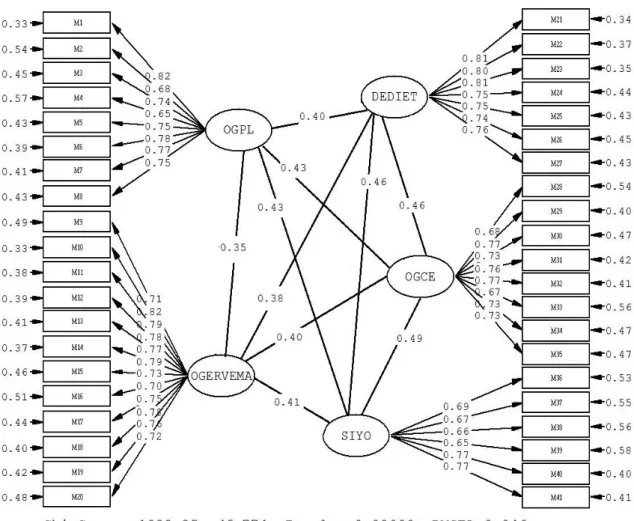
Chi-square (χ2) value and statistical significance levels were calculated for the conformity indicators relating to the confirmatory factor analysis presented in Figure 1. The Chi-square value [χ2=1032.35, df=77, p<.05] calculated with regard to the model-data fit is significant. Chi-square degree of freedom rate, which was calculated by including the effect of sample size, is fairly low (1032.35/774=1.3). In fit indexes, on the other hand, root mean square error of approximation (RMSEA) was found to be .05. RMSEA value between 0 and .05 shows that a good fit was achieved.
Table 2.
Factor Loading Values for the items in the Teaching-Learning Process Competencies Scale.
Learning Environment and materials
Factor Loading
10-Making use of computers and other technological devices in material preparation .81 14-Making use of environmental opportunities in material preparation .80 18-Organizing the physical conditions in the learning environment (temperature, light, noise level
etc.) in a way to support learning .77
19-Considering the principles of usage of tools and equipment while designing the learning
environment .77
12-Making the materials user-friendly and economical .77 11-Considering the views of students while preparing materials in the teaching-learning process .77 17-Designing learning environments according to activity type (individual, collaborative etc.) .75 13-Making sure that the prepared materials are suitable for the course content .75 15-Reaching resources on teaching-learning in technological environments (databases, online
resources etc.) .74
20-Using technological resources effectively in teaching-learning process .72 9-Considering individual differences when preparing and choosing the materials .71 16-Considering different backgrounds of students when designing learning environments .70 Planning teaching
1-Preparing a student-oriented lesson plan .81
5-Collaborating with the other teachers while planning the lesson .77 8-Specifying the resources and materials to be used in the lesson in the lesson plan .76 6-Specifying the activities suitable for the aim of the lesson in the lesson plan .74 3-Specifying the aims and learning outcomes in the lesson plan .74 7-Specifying the methods and techniques suitable for the aims of the lesson in the lesson plan .74 2-Considering individual differences in the lesson plan .70 4-Relating the lesson to the other lessons and disciplines while planning the lesson .67 Diversifying teaching
34-Highlighting the aspects students are successful at .78 28-Seeking guidance from experts while diversifying teaching .74
31-Making individual learning plans .72
32-Diversifying assessment and evaluation approaches considering individual differences .72 30-Being informed about legal foundations regarding students with special problems .71 29-Considering individual differences while determining teaching methods .71 33-Giving constructive and explanatory feedback to students .70 35-Providing self-motivation opportunities to students .68 Extracurricular activities
23-Designing extracurricular activities considering features of students .81
21-Planning for extracurricular activities .81
22-Making extracurricular activities suitable for the aims of the lesson .77 26-Taking necessary measures to perform extracurricular activities safely .74 24-Making the necessary correspondence and meetings for extracurricular activities .74 27-Designing learning activities considering different needs .72 25-Obtaining the necessary tools for extracurricular activities .72 Classroom management
37-Using time efficiently during teaching-learning process .74 36-Planning lesson in a way to use time efficiently .73 38-Guiding students to use their time efficiently in and out of class .71 40-Guiding students so that they can manage their emotions and thoughts .70 41-Guiding students so that they can improve their self-control skills .69 39-Determining the rules in the classroom with students .67
Figure 1.Teaching-learning process competencies scale CFA loading values.
Data Analysis and Interpretation
As the “Attitude Toward Teaching Profession Scale” and “Teaching-Learning Process Competencies Scale” used in the study are five-point Likert-type scales ranging from 1 to 5, the attitudes and competence levels of teacher candidates were interpreted with respect to the score intervals corresponding to each option [(1.00–1.80), (1.81–2.60), (2.61–3.40), (3.41–4.20) and (4.21–5.00)].
T-test was used to determine whether the difference was significant in terms of the variables derived from the scales (gender, field and graduation status), and .05 level of significance was taken as basis in interpretation. In cases when the difference was significant, the effect size (ES) was calculated by dividing the difference among the group averages into combined standard deviation (Can, 2014).Pearson Correlation coefficient was used to calculate whether a meaningful relationship exists between levels of attitude toward teaching profession and levels of teacher competencies.
Results
Averages and standard deviation values for teacher candidates’ attitudes toward teaching profession are given in Table 3.
Table 3.
Teacher Candidates’ Levels of Attitude toward Teaching Profession.
Love Fear Importance Total
𝑋̅ 4.27 3.59 4.27 4.05
Sd .69 .76 .60 .57
N=387
When the averages relating to attitude toward teaching profession are examined, it can be stated that teacher candidates’ love (X̅ =4.27) and importance (X̅ =4.27) attitudes are higher than fear (X̅ =3.59) attitude, and that their total attitude toward teaching profession is high (X̅ =4.05).
Averages for teacher candidates’ attitudes toward teaching profession and the distribution of these averages across genders are given in Table 3.
Table 4.
Levels of Attitude toward Teaching Profession according to Gender.
Factors Gender N 𝑿̅ Sd. t p ES Love Female 249 4.35 .61 2.27 .00* .30 Male 138 4.13 .79 Fear Female 249 3.59 .75 .08 .94 Male 138 3.58 .78 Importance Female 249 4.33 .55 2.33 .02* .25 Male 138 4.17 .67 Teaching Profession General Female 249 4.10 .54 2.16 .03* .23 Male 138 3.97 .61 *p<.05
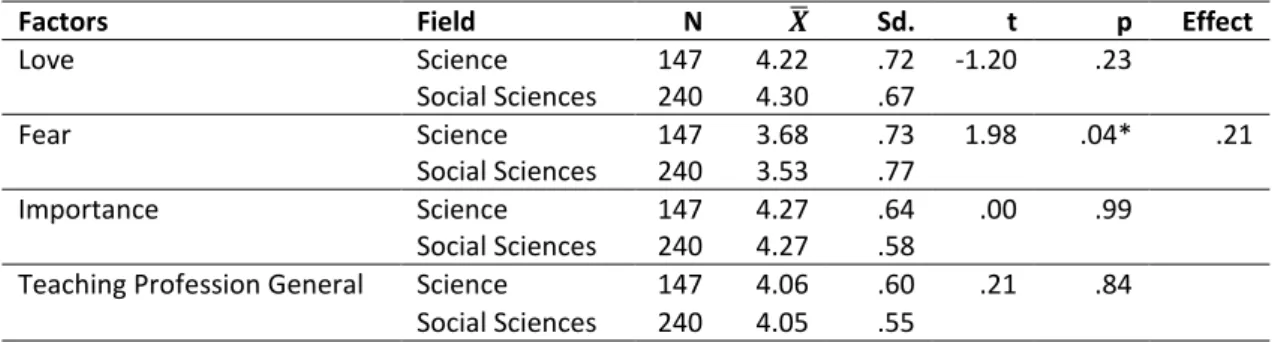
Table 4 demonstrates that, in love (t=2.27, p<.05, ES=.30) and importance (t=2.33, p<.05, ES=.25) factors and attitude toward teaching profession in general (t=2.16, p<.05, ES=.23), female teacher candidates have a higher level of positive attitude compared to the male teacher candidates. In “fear” factor, on the other hand, no meaningful difference was found in terms of gender. Averages pertaining to teacher candidates’ attitudes toward teaching profession and the distribution of these averages across fields of education are given in Table 5.
Table 5.
Levels of Attitude toward Teaching Profession according to Field of Education.
Factors Field N 𝑿̅ Sd. t p Effect
Love Science 147 4.22 .72 -1.20 .23 Social Sciences 240 4.30 .67 Fear Science 147 3.68 .73 1.98 .04* .21 Social Sciences 240 3.53 .77 Importance Science 147 4.27 .64 .00 .99 Social Sciences 240 4.27 .58
Teaching Profession General Science 147 4.06 .60 .21 .84 Social Sciences 240 4.05 .55
*p<.05
As can be seen in Table 5, it is seen that in the factor “fear”, teacher candidates in the field of science have a higher level of positive attitude compared to the teacher candidates in the field of social sciences (t=1.98, p<.05, ES=.21). It was also found that in the factors “love” and “importance”, and “general attitude toward teaching profession”, no meaningful difference was observed in terms of field of education.
Averages for teacher candidates’ attitudes toward teaching profession and the distribution of these averages according to graduation status are given in Table 6.
Table 6.
Levels of Attitude toward Teaching Profession according to Graduation Status.
Factors Graduation Status N 𝑿̅ Sd. t p
Love Graduate Senior Student 103 4.29 .67 .40 .69 284 4.26 .70 Fear Graduate Senior Student 103 3.70 .74 1.83 .07 284 3.54 .76 Importance Graduate Senior Student 103 4.33 .61 1.03 .31 284 4.25 .60 Teaching Profession General Graduate Senior Student 103 4.11 .56 1.25 .21 284 4.03 .57
When the values in Table 6 are examined, no statistically significant difference is observed in the factors and in general attitude toward teaching profession in terms of graduation status.
Averages and standard deviation values pertaining to teacher candidates’ teaching-learning process competencies are given in Table 7.
Table 7.
Teaching-Learning Process Competencies of Teacher Candidates.
Planning Teaching Learning Environment and Materials Extracurricular Activities Diversifying Teaching Classroom Management General (X̅ 3.82 3.80 3.75 3.73 3.91 3.80 Sd .49 .51 .63 .54 .58 .58 N=387
When the averages for attitudes toward teaching-learning process competencies are examined, it is seen that teacher candidates consider themselves most competent in classroom management (X̅ =3.91), which is followed by planning teaching (X̅ =3.82), learning environment and materials (X̅ =3.80), extracurricular activities (X̅ =3.75) and diversifying teaching (X̅ =3.73). It can be stated that teacher candidates consider themselves competent in teaching-learning process in general (X̅ =3.80). Averages for teacher candidates’ teaching-learning process competencies and the distribution of these averages across genders are given in Table 8.
Table 8.
Teaching-Learning Process Competence Levels according to Gender.
Factors Gender N 𝑿̅ Sd. t p
Planning teaching Female 249 3.79 .03 -1.38 .17
Male 138 3.87 .04
Learning environment and materials
Female 249 3.78 .03 -1.27 .21
Male 138 3.85 .04
Extracurricular activities Female 249 3.72 .04 -1.57 .12
Male 138 3.82 .05
Diversifying teaching Female 249 3.73 .03 -.20 .84
Male 138 3.74 .05
Classroom management Female 249 3.90 .04 -.06 .96
Male 138 3.91 .05
Teaching-learning process competencies total
Female 249 3.78 .03 -1.15 .25
As seen in Table 8, teaching-learning process competencies of teacher candidates did not differ statistically significantly in the factors and in total teaching-learning process competencies according to gender. Averages for teacher candidates’ teaching-learning process competencies and the distribution of these averages across fields of education are given in Table 9.
Table 9.
Levels of Teaching-Learning Process Competence according to Field of Education.
Factors Field N 𝑿̅ Sd. t p Effect
Planning teaching Science 147 3.88 .42 1.86 .06 Social Sciences 240 3.79 .52
Learning environment and materials
Science 147 3.85 .49 1.52 .13 Social Sciences 240 3.77 .52
Extracurricular activities Science 147 3.80 .60 1.22 .22 Social Sciences 240 3.72 .64
Diversifying teaching Science 147 3.79 .51 1.66 .10 Social Sciences 240 3.70 .56
Classroom management Science 147 3.99 .55 2.23 .03* .24 Social Sciences 240 3.85 .59 Teaching-learning process competencies total Science Social Sciences 147 3.86 .42 1.99 .04* .21 240 3.76 .46 *p<.05
When the values in Table 9 are examined, it is seen that the competence levels of teacher candidates in science field are higher in classroom management (t=2.23, p<.05, ES=.24) and teaching-learning process competencies in general (t=1.99, p<.05, ES=.21) compared to those in social sciences field. No statistically significant difference was observed in other factors in terms of field of education variable.
Averages for teacher candidates’ teaching-learning process competencies and the distribution of these averages according to graduation status are given in Table 10.
Table 10.
Teaching-Learning Process Competence Levels according to Graduation Status.
Factors Graduation N 𝑿̅ Sd. t p Effect
Planning teaching Graduate 103 3.87 .46 1.21 .23 Senior student 284 3.80 .49 Learning environment and materials Graduate 103 3.89 .51 2.02 .04* .23 Senior student 284 3.77 .50 Extracurricular activities Graduate 103 3.79 .62 .70 .48 Senior student 284 3.74 .63
Diversifying teaching Graduate 103 3.77 .52 .88 .38 Senior student 284 3.72 .55 Classroom management Graduate 103 3.97 .57 1.38 .17 Senior student 284 3.88 .58 Teaching-learning process competencies total Graduate Senior student 103 3.86 .45 1.57 .12 284 3.78 .45 *p<.05
Table 10 shows that in the learning environment and materials factor, graduates consider themselves more competent compared to senior teacher candidates (t=2.02, p<.05, ES=.23). No statistically significant difference was observed in other factors and in total teaching-learning process competencies in terms of graduation status.
The findings on the relationship between teacher candidates’ levels of attitude toward teaching profession and the level of teaching-learning process competence are given in Table 11.
Table 11.
The Relationship between Levels of Attitude toward Teaching Profession and the Level of Teaching-Learning Process Competence.
Factors Plan n in g te ac h in g Le ar n in g e n vi ro n me n t an d mater ial s Ex tr ac u rr ic u lar ac ti vi ti e s D iv e rsi fy in g te ac h in g C lassr o o m man ag e me n t Teac h in g-Le ar n in g Pr o ce ss C o mp e te n ci e s A ff e cti o n Fe ar C ar e Teac h in g p ro fe ssi o n Planning teaching 1.00 Learning environment and materials .64** 1.00 Extracurricular activities .44** .61** 1.00 Diversifying teaching .58** .65** .57** 1.00 Classroom management .58** .62** .54** .73** 1.00 Teaching-Learning Process Competencies .78** .88** .77** .85** .82** 1.00 Love .30** .29** .28** .32** .32** .36** 1.00 Fear .29** .31** .21** .28** .35** .35** .43** 1.00 Importance .26** .30** .26** .32** .31** .35** .74** .36** 1.00 Teaching profession .35** .36** .30** .37** .40** .43** .90** .75** .80** 1.00 *p<.05 (N=387)
Table 11 shows that, as far as teacher candidates’ levels of attitude toward teaching profession and the level of teaching-learning process competence are concerned, both scales and all the sub-dimensions are positively and statistically significantly correlated with one another.
Discussion, Conclusion and Implementation
This study, which aimed to identify teacher candidates’ levels of attitude toward teaching profession and levels of teaching-learning process competencies and the relationship between them, revealed that female teacher candidates have a more positive attitude toward teaching profession compared to male teacher candidates. This finding coincides with the findings of Cramer (2004), Çapri and Çelikkaleli (2008), Çetinkaya (2009), Pehlivan (2004), Sağlam (2008) and Terzi and Tezci (2007). The reason behind this finding may be the fact that teaching profession is considered as a female profession in society and females are more inclined to raise individuals due to their maternal instinct. Another finding was that teacher candidates’ attitudes toward teaching profession did not differ according to their fields of education, as also maintained by Çapri and Çelikkaleli (2008) and Demirtaş et al. (2008). The study also revealed that the attitudes of senior teacher candidates and graduates toward teaching profession did not differ.
It was also found that teacher candidates’ teaching-learning process competencies did not differ according to gender. Konokman and Yelken (2013), and Seferoğlu (2004) also revealed that gender does not affect teaching-learning process competencies. Moreover, the studies of Çakır, Erkuş and Kılıç (2000), and Şeker, Deniz and Görgen (2005) indicated that teacher candidates’ professional competence or self-efficacy believes (Kalaian & Freeman, 1994) is significantly higher in female teacher candidates. Our study also examined whether teacher candidates’ teaching-learning process competencies are influenced by their field of education. The analyses demonstrated that teacher candidates in science field had higher competencies compared to those in social sciences field. On the other hand, some studies in the literature showed that teacher candidates in social sciences had higher competencies (Demirtaş, Cömert, & Öner, 2011; Çakır, Kan, & Sünbül, 2006; Gürbüztürk & Şad, 2009). These different findings may be attributed to the differences in sample size.
The results of the examination of the relationship between teacher candidates’ attitudes toward teaching profession and teaching-learning process competencies revealed a positive relationship between affection, fear and care sub-dimensions of the Attitudes toward Teaching Profession Scale and planning teaching, learning environment and materials, extracurricular activities, diversifying teaching and classroom management sub-dimensions of the Teaching-Learning Process Competencies Scale. In other words, as teacher candidates’ attitudes toward their profession improve, they consider themselves more competent in the teaching-learning process. Our literature review revealed that there are many studies which point to a positive significant relationship between teacher candidates’ competence and their attitudes toward teaching profession (Çakır, 2005; Çakır, Erkuş & Kılıç, 2000; Çapri & Çelikkaleli, 2008; Demirtaş, Cömert, & Öner, 2011; Oğuz & Topkaya, 2008). Similar results were also obtained by Caprara, Barbaranelli, Steca and Malone (2006), who maintained that teachers’ perceptions of competence are influenced by their attitude toward teaching profession.
This study which was conducted to discover teacher candidates’ levels of attitude toward teaching profession and the level of teaching-learning process competencies, and the relationship between these two aspects found that teacher candidates had a positive attitude toward their profession and a high level of teaching-learning process competencies. It also revealed a positively significant relationship between teacher candidates’ levels of attitude toward their profession and levels of teaching-learning process competencies.
Some suggestions derived from the results of the current study are listed below for future researchers:
• It is of great significance to strengthen teacher candidates’ attitude toward teaching profession and maintain its contribution to teaching-learning process competence levels during the preservice training period.
• Also, the necessary working conditions should be ensured so that teacher candidates do not experience any negative change in their attitude toward their profession and their levels of teaching-learning process competencies upon starting teaching.
• As the Teaching-Learning Process Competencies Scale designed for this study is valid and reliable, it can be used to determine the variables that affect competencies of in-service teachers and teacher candidates.
• Further studies could be conducted on teacher candidates’ attitudes toward teaching profession and their teaching-learning process competencies, and different teacher candidate groups could be compared.
• A similar study which involves a larger sample from technical education faculties of various universities may be conducted.
Acknowledge
A part of this study was presented as oral presentation in the 4th International Conference on Curriculum and Instruction, 27-30 October, 2016, Antalya, Turkey.
Türkçe Sürüm
Giriş
Nitelikli öğretmen nasıl yetiştirilir? Sorusu eğitimciler tarafından geçmişte olduğu gibi günümüzde de tartışılmaya devam etmektedir. Bu tartışma öğretmenlik mesleğinin öneminin ve bu meslekteki nitelik arayışının bir sonucudur. Öğretmenlik mesleğine tarih boyunca çeşitli misyonlar yüklenmiş, öğretmenlik mesleği bazen beceri olarak, bazen bilim olarak, bazen de sanat olarak yorumlanmıştır. Ancak yorumlar değişse de öğretmenin eğitim sisteminin en önemli değişkenlerinden biri olduğu algısı hiç farklılaşmamıştır. Statüsü ve saygınlığı, ülke ve kültürlere göre değişmekle birlikte öğretmenlik, doğrudan insanla ilgili olması yönüyle öteden beri kutsal bir meslek olarak görülmüştür. Türk eğitim tarihinde de öğretmenlerin hep saygın bir yeri olmuş, öğretmen denince yaygın bir biçimde toplumda davranış modeli bir insan anlaşılmıştır. Bu nedenle nitelikli öğretmenlere duyulan ihtiyaç bütün toplumlar için devam etmektedir (Eker, 2015).
Bir ülkede yeni nesillerin yaratıcı, verimli, yapıcı, üretken, meslek sahibi, ülkesine karşı sorumluluklarının bilincine varmış vatandaşlar olarak yetiştirilmesinde etkisi olan ilk kişilerden biri öğretmenlerdir (Eker, 2015). Bir eğitim sisteminde hedeflenen birey özellikleri, bu amaçla benimsenmiş öğretme-öğrenme yaklaşımları ve bunları temel alarak tasarlanmış öğretim programları değişse de öğretmen eğitim sisteminin temel unsurudur. Çünkü sıralanan faktörler farklılaşsa da belirlenen hedeflerin gerçekleşmesinde temel değişken öğretmenin niteliğidir. Ülkemizde de son yıllarda eğitim sistemiyle ilgili en önemli sorunlardan birinin, öğretmen yetiştirme sürecinin ve yetiştirilen öğretmenlerin niteliğinin oluşturduğu gözlenmektedir. Yeni nesillerin gelişmesini ve şekillenmesini sağlayan öğretmenin, iyi bir eğitimden geçmesi şarttır. Her meslek gibi öğretmenlik mesleğinin de kendine özgü bilişsel, duyuşsal ve devinimsel davranış nitelikleri vardır (Tanrıverdi, 2015). Öğretim ortamında, hedefleri ve uygun davranışları saptama, bunların gerçekleşeceği ortamı düzenleme ve bu boyutlara ilişkin değerlendirme sorumluluğu taşıyacak öğretmenin niteliği, önemli ölçüde hizmet öncesinde kazanacağı öğretim becerilerine bağlıdır (Çoban 2015). Yetiştirilen öğretmenlerin niteliğinde öğretmen adaylarının öğretmenlik mesleğine ilişkin yeterliklere ne kadar sahip oldukları ve öğretmenlik mesleğine yönelik tutumları önemli bir yer tutmaktadır (Çapri & Çelikkaleli, 2008).
Hem sosyal algımızı hem de davranışlarımızı belirleyicilerinden birisi olarak tutumlar birçok bilimsel çalışmada incelenmeye değer görülmektedir (Üstüner, 2006).Tutum, bireyin düşünce, duygu ve davranışlarını oluşturan eğilim olarak tanımlanabilir (Kağıtçıbaşı, 1999). Bohner ve Wanke (2002) de tutumu “insan bireyselliğinin temel parçası” olarak tanımlamaktadırlar. Bireylerin mesleklerine yönelik tutumları mesleğin gereklerini yerine getirmede büyük önem taşımaktadır (Durmuşoğlu, Yanık & Akkoyunlu, 2009). Söz konusu meslek öğretmenlik olduğunda ise, konunun önemi daha da artmaktadır. Öğretmenlerin sahip oldukları tutumlar ile onların sınıflarındaki davranışları ve uygulamaları arasında yakından ilişki söz konusudur (Rimm-Kaufman & Sawyer, 2004). Dolayısıyla, olumlu tutumun öğretmenlerin başarısına doğru orantılı olarak etki edebilecek bir unsur olduğu bazı araştırma sonuçlarında doğrulanmaktadır (Demir, 2004; Aşkar & Erdem, 1987; Çakır, 2005; Terzi & Tezci, 2007). Diğer yandan bireyin tutumunun ne olduğunun bilinmesi, o bireyin ilgili uyarana karşı davranışının da tahmin edebilmesini sağlayacaktır. Bu durum öğretmenlik mesleği açısından çok daha önemlidir. Bu nedenle öğretmenlik mesleğini yapacak bireylerin bu mesleğin gerekliliklerini daha etkili biçimde yerine getirebilmelerinin koşullarından biri de mesleğe yönelik tutumlarının olumlu olmasıdır (Üstüner, 2006).
Tutumun gelişimini etkileyen birçok faktör bulunmaktadır. Bilişsel öğe tutumu oluşturan faktörler arasında önemli bir yere sahiptir (Tavşancıl, 2002). Yetersiz bilgiye dayalı gelişecek tutum ile daha geniş ve derin bilgiye dayalı oluşan tutumun şiddeti veya derecesinin de farklı olacağı açıktır (Tezci & Terzi, 2007). Başka bir anlatımla öğretmen adaylarının hem mesleğe yönelik olumlu tutumlara sahip olması hem de nitelikli öğretme-öğrenme süreçleri düzenleyebilmeleri için bazı yeterliklere sahip olmaları gerekmektedir.
Yeterlik bir kişinin belli bir görevi yerine getirebilmesi için sahip olması gereken niteliklerdir (Bursalıoğlu, 1981). 1739 sayılı Milli Eğitim Temel Kanunu’nun öğretmenlerin nitelikleri ve seçimine ilişkin 45. maddesinde, “Öğretmen adaylarında genel kültür, özel alan eğitimi ve pedagojik formasyon bakımından aranacak nitelikler Milli Eğitim Bakanlığınca tespit olunur.” ifadesi (MEB, 2006) kapsamında Mart 1999’da MEB ve üniversite temsilcilerinden oluşan öğretmen yeterlikleri komisyonunca, “eğitme-öğretme yeterlikleri”, “genel kültür bilgi ve becerileri” ve “özel alan bilgi ve becerileri” ana başlıklarından oluşan yeterlikler belirlenmiştir. Öğretmen Yetiştirme ve Eğitimi Genel Müdürlüğü bünyesinde çalışan komisyonlarca hazırlanan taslağa gelen eleştiriler doğrultusunda “Öğretmenlik Mesleği Genel Yeterlikleri” geliştirilmiştir. Bu yeterlikler aynı zamanda öğretmen yetiştirme politikalarının belirlenmesinde, öğretmenlerin hizmet öncesi ve hizmet içi eğitimlerinin planlanmasında, öğretmenlerin seçiminde, öğretmenlerin denetlenmesinde ve performanslarının değerlendirilmesinde bir ölçüttür (MEB, 2006). Kasım 2006’da yürürlüğe giren bu yeterlik listesi; “Kişisel ve Meslekî Değerler-Meslekî Gelişim”, “Öğrenciyi Tanıma”, “Öğretme ve Öğrenme Süreci”, “Öğrenmeyi, Gelişimi İzleme ve Değerlendirme”, “Okul-Aile ve Toplum İlişkileri” ve “Program ve İçerik Bilgisi” olmak üzere 6 ana yeterlik, bu yeterliklere ilişkin 31 alt yeterlik ve 233 performans göstergesinden oluşmaktadır (MEB, 2006). Bu yeterlikler Milli Eğitim Bakanlığı Öğretmen Yetiştirme ve Eğitim Genel Müdürlüğünce öğretmen yetiştiren kurumlara gönderilerek, öğretmenlerin belirtilen yeterliklere sahip olacak şekilde yetiştirilmesi istenmiştir (Mahiroğlu, 2004).
Öğretmenin sınıf performansıyla teorik bilgisi arasında yüksek ilişkiler vardır (Holligan, 1997). Diğer yandan öğretmenlerin yeterlilik inançları, verimli bir okulun yaratılmasında da önemli bir değişken olarak değerlendirilmektir (Hoy & Woolfolk, 1993; Pajares & Miller, 1994. Bu çalışma araştırmanın amacı gereği yeterlik gruplarından öğretme-öğrenme süreci yeterlikleri, öğretmenlerin öğrencilerin belirlenen hedeflere ulaşmaları için gerekli olan dersi planlama, materyal hazırlama, öğrenme ortamlarını düzenleme, ders dışı etkinlikleri düzenleme, bireysel farklılıkları dikkate alarak öğretimi çeşitlendirme, zaman yönetimi ve davranış yönetimi boyutlarını içerir.
Eğitim sistemlerinin hedeflediği özellikleri bireylere kazandırabilmeleri için öğretmen adaylarının kendilerine yönelik mesleki yeterlik algıları ve öğretmenlik mesleğine yönelik tutum düzeyleri önemli bir role sahiptir. Mesleğine yönelik olumlu tutuma ve gereken yeterliğe sahip olan öğretmenlerin sistemin ve ürünlerinin niteliğine doğrudan olumlu bir etki yapacağı şüphesizdir. Öğretmenlerin mesleğe yönelik olumlu tutumlarının oluşmasında ve gereken niteliklere sahip olmasında onların hizmet öncesi ve hizmet içinde aldıkları eğitim belirleyici bir etkiye sahiptir. Bireyleri çeşitli alanlara hazırlama amacıyla verilen mesleki eğitimde, mesleği seçen ve o meslek doğrultusunda eğitim alan kişilere gelecekte o mesleğe özgü davranışları gösterebilmesi için gerekli olan bilgiler, duygular ve beceriler kazandırılmaya çalışılır (Üstüner, 2006). Öğretmen yetiştirme programlarının en önemli amacı, öğretmenlik mesleğine yönelik olumlu tutumlar oluşturmak ve mesleğin gerektirdiği yeterliklerini öğretmen adaylarına kazandırmaktır. Ancak öğretmen yetiştirme sürecinde bu ilkelerin ne düzeyle çalıştığı ve öğretmen adaylarının bu niteliklere ne düzeyde sahip olarak mezun olduğu bilinmemektedir. Buna ek olarak öğretmen yeterliğinin nasıl geliştiği, hangi bileşenlerden oluştuğu, yüksek düzey bir öğretmen yeterliği geliştirmeye yönelik hangi programlarının nasıl geliştirileceğinin belirlenmesi için oldukça önemlidir (Pajares, 1997).
Alanyazın incelendiğinde, öğretmen adaylarının mesleğe yönelik tutumlarını belirlemeye yönelik çok sayıda araştırmanın (Akpınar, 2004; Alım & Bekdemir, 2006; Aysu, 2007; Bedel, 2008; Çapa & Çil, 2000; Çetinkaya, 2009; Demir, 2004; Doğan, 2002; Kaya & Büyükkasap, 2005; Oral, 2004; Pehlivan, 2004; Sağlam, 2008; Semerci & Semerci, 2004; Temel, 1990; Terzi & Tezci, 2007; Üstün, 2007; Üstün, Erkan & Akman, 2004) ve sadece yeterlikleri (Davran, 2006; Erişen & Çeliköz, 2003; Karacaoğlu, 2008; Numanoğlu & Bayır, 2009; Petek, 2014; Seferoğlu, 2004; Tabancalı & Çelik, 2013; Ülper & Bağcı, 2012) yer aldığı görülmektedir. Bunun yanında alanyazında öğretmen adaylarının öğretmenlik mesleğine ilişkin tutumları ile mesleki yeterliklerinin birlikte çalışıldığı araştırmalar da (Çakır, Erkuş & Kılıç, 2000;Çakır, 2005; Çakır, Kan & Sünbül, 2006; Çapri & Çelikkaleli, 2008; Çetinkaya, 2007; Demirtaş, Cömert & Özer, 2011) mevcuttur. Ayrıca literatürde öğretmen adaylarının cinsiyetlerinin öğretmenlik mesleğine yönelik tutumlarını etkilediğini ortaya koyan birçok araştırma bulunmaktadır (Cramer, 2004; Çapri & Çelikkaleli,
2008; Çetinkaya, 2009; Pehlivan, 2004; Sağlam, 2008; Terzi & Tezci, 2007). ). Ayrıca, öğretmen adaylarının öğretim yeterliklerinin cinsiyete göre farklılık gösterdiği (Çakır, Erkuş & Kılıç, 2000; Kalaian & Freeman, 1994; Şeker, Deniz & Görgen, 2005) ve konu alanı (Demirtaş, Cömert & Öner, 2011; Çakır, Kan, & Sünbül, 2006; Gürbüztürk & Şad, 2009). Bu sonuçlar araştırma değişkenlerini belirlemede etkili olmuştur.
Öğretmen adaylarının hizmet öncesi eğitimlerinin niteliğinin söz konusu nitelikler açısından belirlenmesi bu becerilerin geliştirilmesine yönelik öneriler geliştirme açısından oldukça önemlidir (Çam Aktaş, 2016). Bu araştırmanın hem değişik örneklem gruplarından elde edilecek bulgularla, hem de daha önceki çalışmalarda elde edilen sonuçların farklılaşıp farklılaşmadığının belirlenmesi açısından adayların öğretmenlik mesleğine ilişkin tutumları ve mesleki yeterliklerinin zamansal açıdan değişip değişmediğini ortaya koyarak literatüre önemli katkılarının olacağı düşünülmektedir. Ayrıca araştırmanın ilgili alana öğretmenlerin öğrenme-öğretme yeterlikleri boyutuna odaklanması yönüyle özgün katkılar yapması beklenmektedir. Bu çerçevede araştırmanın temel amacı öğretmen adaylarının öğretmenlik mesleğine yönelik tutum düzeyleri ile öğretme-öğrenme süreci yeterlik düzeylerini ve aralarındaki ilişkiyi belirlemektir.
Bu çalışmada aşağıdaki sorulara cevap aranacaktır.
Öğretmen adaylarının öğretmenlik mesleğine yönelik tutumları ne düzeydedir? Tutum düzeyleri; a. Cinsiyet
b. Alan ve
c. Mezun olma durumuna göre anlamlı olarak farklılaşmakta mıdır?
Öğretmen adaylarının öğretme-öğrenme süreci yeterlikleri ne düzeydedir? Öğretmenlik yeterlikleri düzeyleri;
a. Cinsiyet b. Alan ve
c. Mezun olma durumuna göre anlamlı olarak farklılaşmakta mıdır?
Öğretmen adaylarının mesleğe yönelik tutum düzeyleri ile öğretme-öğrenme süreci yeterlik düzeyleri arasında anlamlı bir ilişki var mıdır?
Yöntem Araştırma Modeli
Bu çalışma öğretmen adaylarının mesleğe yönelik tutumları ile öğretme-öğrenme süreci yeterliklerinin belirlenmesi yönüyle genel tarama, mesleğe yönelik tutumlar ile öğretme-öğrenme süreci yeterliklerin birlikte değişip değişmediğinin belirlenmesi yönüyle ise ilişkisel tarama modelindedir.
Çalışma Evreni ve Örneklem
Araştırmanın evrenini Balıkesir Üniversitesi Necatibey Eğitim Fakültesinde 2015-2016 eğitim-öğretim yılında düzenlenen pedagojik formasyon eğitimi kursuna katılan toplam 850 öğretmen adayı oluşturmuştur. Araştırma sosyal bilimler ile fen-matematik alanları arasında karşılaştırmayı amaçladığından veriler branşları bu alanlarda gruplanabilen toplam387 öğretmen adayından elde edilmiştir. Araştırmanın çalışma grubunu 249’u (% 64.34) Kadın ve 138’i (% 35.66) erkek öğretmen adayından oluşmaktadır. Çalışma grubunda yer alan adayların 147’si (% 37.98) fen alanında ve 240’ı (% 62.01) sosyal alanda öğrenim görmüşlerdir. Adayların 103’ü (% 26.61) mezun durumda iken 284’ü (% 73.39) öğrenimlerinin son sınıflarında bulunmaktadırlar.
Veri Toplama Araçları
Araştırmanın verileri “Öğretmenlik Mesleği Tutum Ölçeği” ve “Öğretme-Öğrenme Süreci Yeterlikleri Ölçeği ile elde edilmiştir.
Öğretmenlik Mesleği Tutum Ölçeği: Akkuzu (2012) tarafından geliştirilen ölçek öğretmen adaylarının
mesleklerine bakış açılarını, mesleğe ilişkin tutumlarını ölçmek amacıyla kullanılan geçerliği ve güvenirliği test edilmiş 25 maddelik bir ölçektir. Ölçek, 5‟li likert tipinde olup olumlu cümleler “Tamamen Katılıyorum” seçeneğinden “Hiç Katılmıyorum” seçeneğine doğru 5, 4, 3, 2, 1 şeklinde puanlanırken olumsuz cümleler de bunun tam tersi bir yol izlenerek “Tamamen Katılıyorum” seçeneğinden “Hiç Katılmıyorum” seçeneğine doğru 1, 2, 3, 4, 5 şeklinde puanlanmıştır. Öğretmenlik Mesleğine Tutum Ölçeği "sevgi-korku-önem" alt boyutlarından oluşmaktadır. Öğretmen adaylarının öğretmenlik mesleğine ilişkin ifadeleri sırasıyla bu boyutlara göre gruplandırılmıştır: "sevgi" boyutu altında mesleği öğretmeye sevdikleri ifadeler, "korku" boyutu altında mesleği öğretme korkuları ve öğretimin önemi ile ilgili ifadeler Mesleği "önem" boyutuna girmektedir. Ölçeğin alt boyutlarının güvenilirlik katsayıları (sevgi, .95), (korku, .75), (önem .76) ölçeğin güvenilirliğinin göstergeleridir. Örneklem boyutu nedeniyle, veri yapısının uygunluğunu test etmek için faktör analizi için KMO (Kaiser-Meyer-Olkin) kullanılmıştır (.92). Alfa güvenilirlik katsayısı .93 olarak bulundu. Ek olarak, CFA (Doğrulayıcı Faktör Analizi) sonuçları ve doğrulayıcı uyum indeksi değerleri, üç faktörlü yapıyı doğrulamak için ispatlanmıştır. Bu çalışmada, KMO değeri yine .92, alfa güvenilirlik katsayısı .91 olarak bulunmuştur. Bu araştırmada ölçeğin alt boyutlarının güvenilirlik katsayıları aşk (.93), korku (.80) ve önem (.73) olarak hesaplanmıştır.
Öğretme-Öğrenme Süreci Yeterlikleri Ölçeği: öğretmen adaylarının öğretme-öğrenme süreci
yeterlikleri düzeyini belirlemek amacıyla araştırmacılar tarafından geliştirilen “Öğretme-Öğrenme Süreci Yeterlikleri Ölçeği” kullanılmıştır. Ölçekteki maddelerin oluşturulması amacıyla Kasım 2006’da yürürlüğe giren “Öğretmenlik Mesleği Genel Yeterlikleri” kapsamında bulunan “Öğretme-Öğrenme Süreci” ana yeterliği başlığında listelenmiş olan ifadeler (MEB, 2006) ölçek maddeleri olarak biçimlendirilmiştir. Ölçek bu ana yeterlik başlığı altında sıralanmış olan “Öğretimi Planlama” (8 madde), “Öğrenme Ortamı ve Materyal” (12 madde), “Ders Dışı Etkinlikler” (7 madde), “Öğretimi Çeşitlendirme” (8 madde) ve “Sınıf Yönetimi” (6madde) ve olmak üzere 5 alt bölüm ve 41 yeterlilik maddesinden oluşmaktadır. Likert tipinde geliştirilen ölçekte yer alan maddelere ilişkin yeterlik düzeyleri “Çok Yetersizim”, “Yetersizim”, “Kısmen Yeterliyim”, “Yeterliyim” ve “Çok Yeterliyim” olarak derecelendirilmiştir.
60 madde olarak biçimlendirilen “Öğretme-Öğrenme Süreci Yeterlikleri Ölçeği”nin ilk hali önce 74 öğretmen adayına uygulanmış ve elde edilen veriler analize tabi tutulmuştur. Analizler neticesinde ölçekten çıkarılması gereken maddelere karar verilmiş ve ölçek 47 madde olarak tekrar 58 öğretmen adayına uygulanmıştır. Bu adaylardan elde edilen verilerin analiz edilmesi sonucu ölçekten 6 madde daha çıkartılarak 41 maddeye indirilmiştir. 41 maddeden oluşan ölçeğin son haline 159 öğretmen adayından toplanan verilerle geçerlilik ve güvenilirlik testleri ile açımlayıcı faktör analizi yapılmıştır.
Faktör analizi birbiri ile ilişkili çok sayıda değişkeni birbiri ile ilişkisiz ve kavramsal olarak anlamlı yeni değişkenler bulmayı hedefleyen çok değişkenli bir istatistiktir (Büyüköztürk, 2002). Yapılan döndürme işlemleri sonucunda yapılan analiz sonucunda faktör yük değeri .30 ve üstünde olan maddeler değerlendirmeye alınmıştır. Öğretme-Öğrenme Süreci Yeterlikleri Ölçeğinin AFA sonuçları Tablo 1’de yer almaktadır.
Tablo 1’de yer alan AFA sonuçlarına göre, Öğretme-Öğrenme Süreci Yeterlikleri Ölçeği’ne ait KMO değeri .90; Bartlett’s Testi sonucu (χ² (820) =4251.536, p<.05),manidar olduğu görülmektedir. Ölçeğin çalışma grubunda beş faktör olarak algılanmakta ve bu beş faktör toplam varyansın %62.28’ini açıklamaktadır. Birinci faktörde yer alan ve “Öğrenme ortamı ve materyal” olarak adlandırılan faktördeki 12 madde toplam varyansın% 31.26’sını, ikinci faktörde yer alan ve “Öğretimi planlama” olarak adlandırılan faktördeki 8 madde toplam varyansın % 10.59’unu, üçüncü faktörde yer alan ve “Öğretimi çeşitlendirme” olarak adlandırılan faktördeki 8 madde toplam varyansın % 8.56’sını, dördüncü faktörde
yer alan ve “Ders dışı etkinlikler” olarak adlandırılan faktördeki 7 madde toplam varyansın % 6,90’ını ve beşinci faktörde yer alan ve “Sınıf yönetimi” olarak adlandırılan faktördeki 6 madde toplam varyansın % 4.98’ini açıkladığı belirlenmiştir.
Tablo 1.
Öğretme Süreci Yeterlikleri Ölçeği Analizi Değerleri.
Madde Sayısı Faktörler Cronbach Alpha Guttman Split-Half Açıkladığı Toplam Varyans (%)
12 Öğrenme ortamı ve materyal .94 .94 31.26
8 Öğretimi planlama .91 .89 10.59
8 Öğretimi çeşitlendirme .90 .88 8.56
7 Ders dışı etkinlikler .91 .84 6.90
6 Sınıf yönetimi .85 .81 4.98
41 Öğretme-öğrenme süreci yeterlikleri .94 .73 62.28 KMO=.90; χ² (820) =4251.54;p<.05
Öğretme-öğrenme süreci yeterlilikleri ölçeğinin Cronbach Alpha güvenirlik katsayısı ölçeğin tamamı için .94; öğrenme ortamı ve materyal faktörü için .94; öğretimi planlama faktörü için .95; öğretimi çeşitlendirme faktörü için .90; ders dışı etkinlikler faktörü için .91 ve sınıf yönetimi faktörü için .85 olarak hesaplanmıştır. Ölçek formunun iki eş parçaya bölünerek, iki yarının deneklere aynı anda uygulanması sonrası, her iki yarının arasındaki korelasyon ile güvenilirlik testi yapan split-half metodu (Ercan & Kan, 2004) uygulanmış ve ölçeğin tamamı için bu değer .73; öğrenme ortamı ve materyal faktör için .94; öğretimi planlama faktörü için .89; öğretimi çeşitlendirme faktörü için .88; ders dışı etkinlikler faktörü için .85 ve sınıf yönetimi faktörü için .81 olarak bulunmuştur. Öğretme-Öğrenme Süreci Yeterlikleri Ölçeğinde yer alan maddelerin faktör yük değerleri Tablo 2’de yer almaktadır.
Öğretme-öğrenme süreci yeterlikleri ölçeği, yukarıdaki yapı şekliyle Doğrulayıcı faktör analizine (DFA) (Confirmatory Factor Analysis: CFA) tabi tutulmuştur. DFA ölçme modellerinin geliştirilmesinde sık kullanılan ve önceden belirlenmiş bir yapının doğrulanmasını amaçlar (Aytaç & Öngen, 2012). Araştırmada açımlayıcı faktör analizi ile belirlenmiş olan ölçeğin yapısı DFA ile bu çalışma grubundaki uyum düzeyi incelenmiştir.
Şekil 1’de sunulan doğrulayıcı faktör analizine ilişkin uyum göstergeleri ölçek için Ki-kare(χ2) değeri ve istatistiksel manidarlık düzeyleri saptanmıştır. Model veri uyumuna ilişkin hesaplanan Ki-Kare değeri [χ2=1032.35, df=774, p<.05] manidardır. Örneklem büyüklüğünün etkisinin de hesaplamaya dâhil edildiği “Ki-Kare Serbestlik Derecesi” oranı ise oldukça düşük bulunmuştur (1032.35/774=1.33). Uyum indekslerinde ise ortalama hata karekökü(RMSEA) .04 olarak bulunmuştur. RMSEA değeri .00 ile .05 arasında olduğundan iyi bir uyumun var olduğunu gösterdiği söylenebilir.
Tablo 2.
Öğretme-Öğrenme Süreci Yeterlikleri Ölçeği Maddeleri Faktör Yük Değerleri.
Öğrenme ortamı ve materyal
Faktör Yükü
10-Materyal hazırlamada bilgisayar ve diğer teknolojik araçlardan yararlanma .81 14-Materyal hazırlarken çevre olanaklarından yararlanma .80 18-Öğrenme ortamının fiziksel koşullarını (ısı, ışık, ses durumu vb.) öğrenmeyi destekleyecek
biçimde düzenleme .77
19-Öğrenme ortamını düzenlerken araç ve gereçlerin kullanım ilkelerini dikkate alma .77 12-Materyal hazırlarken kullanışlı ve ekonomik olmasına dikkat etme .77 11-Öğretme-öğrenme sürecinde materyaller hazırlarken öğrenci görüşlerini de dikkate alma .77 17-Öğrenme ortamlarını etkinlik türüne göre (bireysel, işbirlikli vb.) düzenleme .75 13-Hazırlanan materyalin öğrenilecek içeriğe uygun olmasına dikkat etme .75 15-Teknolojik ortamlardaki (veri tabanları, çevrimiçi kaynaklar vb.) öğretme – öğrenme ile
ilgili kaynaklara ulaşma .74
20-Öğrenme-öğretme sürecinde teknolojik kaynakları etkili kullanabilme .72 9-Materyalleri hazırlarken ve seçerken bireysel farklılıkları dikkate alma .71 16-Öğrenme ortamlarını düzenlerken öğrencilerin farklı ön yaşantılarını dikkate alma .70 Öğretimi planlama
1-Ders planını öğrenciyi merkeze alarak hazırlama .81 5-Dersi planlarken diğer öğretmenlerle işbirliği yapma .77 8-Ders planında kullanacağı kaynak ve materyalleri belirtme .76 6-Ders planında amaca uygun etkinlikleri belirtme .74 3-Ders planında amaç ve kazanımların neler olacağını belirtme .74 7-Ders planında amaca uygun yöntem ve teknikleri belirtme .74 2-Ders planında bireysel farklılıkları dikkate alma .70 4-Dersi planlarken diğer dersler ve ara disiplinlerle ilişkilendirme .67 Öğretimi çeşitlendirme
34-Öğrencilerin başarılı yönlerini öne çıkarma .78
28-Öğretimi çeşitlendirirken gerektiğinde uzman yardımına başvurma .74
31-Bireysel öğrenme planları yapma .72
32-Bireysel farklılıkları dikkate alarak ölçme ve değerlendirme yaklaşımlarını çeşitlendirme .72 30-Özel sorunları olanlarla ilgili yasal dayanakları bilme .71 29-Öğretim yöntemlerini belirlerken bireysel farklılıkları dikkate alma .71 33-Öğrencilerine yapıcı, açıklayıcı ve geliştirici geri bildirimler verme .70 35-Öğrencilerin kendilerini güdülemeyi öğrenmeleri için olanak sağlama .68 Ders dışı etkinlikler
23-Ders dışı etkinlikleri öğrenci özelliklerini dikkate alarak düzenleme .81
21-Ders dışı etkinlikler için plân hazırlama .81
22-Ders dışı etkinliklerin dersin amaçlarına uygun olmasına dikkat etme .77 26-Ders dışı etkinliklerin güvenle gerçekleşmesi için gerekli önlemleri alma .74 24-Ders dışı etkinlikler için gerekli yazışma ve görüşmeleri yapma .74 27-Farklı ihtiyaçları dikkate alarak öğrenme etkinlikleri düzenleme .72 25-Ders dışı etkinlikler için gereken araçları temin etme .72 Sınıf yönetimi
37-Öğretme - öğrenme sürecinde zamanı etkin kullanma .74 36-Zamanı etkin kullanacak şekilde dersi plânlama .73 38-Öğrencilerin ders içi ve ders dışı zamanlarını etkili kullanmaları için yönlendirmeler yapma .71 40-Öğrencilerin duygu ve düşüncelerini yönetebilmelerinde rehberlik etme .70 41-Öğrencilerin öz denetim becerilerini geliştirmesine rehberlik etme .69 39-Sınıf kurallarını öğrencilerle birlikte belirleme .67