Activities of two Major Lichen Compounds, Diffractaic Acid and Usnic Acid against
Leptinotarsa decemlineata Say, 1824 (Coleoptera: Chrysomelidae)
Bugrahan Emsen
*; Yesim Bulak
**; Erol Yildirim
***; Ali Aslan
****and Sezai Ercisli
***** *Karamanoğlu Mehmetbey University, Kamil Özdağ Faculty of Science, Department of Biology,70200, Karaman-TURKEY
**Iğdır University, Faculty of Agriculture, Department of Plant Protection, 76000, Iğdır- TURKEY ***Atatürk University, Faculty of Agriculture, Department of Plant Protection, 25240, Erzurum-TURKEY
**** Atatürk University, Kazım Karabekir Faculty of Education, Department of Biology Education,
25240, Erzurum-TURKEY
*****Atatürk University, Faculty of Agriculture, Department of Horticulture, 25240, Erzurum-TURKEY
(Received: November 28, 2011 and Accepted: December 13, 2011)
ABSTRACT
Two major lichen compounds (diffractaic and usnic acids), isolated from Usnea longissima Ach. were tested against 4th instar larvae and adults of the Colorado potato beetle, Leptinotarsa decemlineata Say for 24, 48, 72 and 96 h under laboratory conditions. Durations and mortalities were recorded at various concentrations (1.25, 2.5, 5, and 10 mg. ml-1). Results showed that secondary metabolites of U. longissima had a significant insecticidal potential against larvae and adults of L. decemlineata. Mortality rates after 96 h of treatment, with the highest concentration (10 mg. ml-1) of diffractaic and usnic acids, were 100 and 70% for adults and 100 and 80% for larvae, respectively. No mortality was observed in the control treatment. Bioassay tests with diffractaic and usnic acids revealed that the 96 h median lethal concentration (LC50) values were 1.783 and 4.048 mg. ml-1 for adults and 1.509 and 2.759 mg. ml-1, for larvae of L. decemlineata, respectively. The present results suggest that the lichen secondary metabolites may have a potential
action for control of L. decemlineata 4th instar larvae and adults.
Key words:
Diffractaic acid, Usnic acid, Lichen, Leptinotarsa decemlineata
.
INTRODUCTION
The Colorado potato beetle, Leptinotarsa
decemlineata Say, 1824 (Coleoptera: Chrysomelidae) is a serious pest of potatoes. It may cause significant damage to tomatoes and eggplants as well. Both adults and larvae feed on foliage and may completely destroy the crop. Insecticides are currently the worldwide main control method, but unfortunately many chemicals are often unsuccessful when used against this pest because of the beetle's ability to develop, rapidly, insecticide resistance (Gillott, 2005). L. decemlineata has developed resistance to all major insecticide groups, although not every population is resistant to every chemical (Alyokhin et al., 2008). Therefore, in recent years, researchers are looking for new biological insecticides.
Lichens, organisms formed through symbiosis between fungi and algae and/ or cyanobacteria, a very significant insecticidal source within biological insecticides (Emmerich et al., 1993). Antibiotic substances are known in more than 60 species of lichens. Many researches indicated that some lichen acids, such as; usnic and vulpinic have powerful antibiotic effect against some bacteria (Galun, 1988). Furthermore, it was reported that the lichens Letharia vulpina (L.) Hue and Vulpicida
pinastri (Scop.) J.-E. Mattsson had been used to
poison to death wolves and foxes that harmed herds during the winter in some countries of Europe and Scandinavia (Aslan et al., 1998).
Lichens usually contain only one or two major substances, often found in high concentrations. Concentrations of lecanoric acid (2.6 – 4.8% of
Parmelia spp. dry weight) were found (Culberson et al., 1977). In Cetraria islandica, contents of
fumarprotocetraric acid could reach 11%
(Gudjonsdottir and Ingolfsdottir, 1977), while
Pertusaria alaianta contains up to 20% of a mixture
of chloroxanthones (Huneck and Hoefle, 1978). Many experiments proved that lichen metabolites have insecticidal effects; some have antifeedant and/or lethal characteristic on the insects (Emmerich
et al., 1993; Bombuwala, 2001; Nimis and Skert,
2006; Cetin et al., 2008 and Silva et al., 2009). Because of the economic importance of
L. decemlineata in Turkey and many other countries,
the present study was carried out to evaluate the insecticidal action of two secondary metabolites of
Usnea longissima (diffractaic and usnic acids)
against the 4th instar larvae and adults of the pest
in-vivo conditions.
MATERIALS AND METHODS Insects and rearing conditions
Adults of L. decemlineata were collected from potato plantations at Erzurum in Turkey and were reared in the Laboratory of the Department of Plant Protection, Atatürk University, Turkey at 25±1 °C, 64±5 % R.H. and 12:12h L/D. Fourth instar larvae (determined according to their morphological characteristics) and 3-5 day-old adults were used as
6
test insects. In order to define the age of adults, newly emerged adults were collected soon after their emergence from the pupae and placed in separate insect cages.
Plant material and isolation of lichen secondary metabolites
U. longissima (Fungi, Ascomycetes, Parmeliaceae) was collected in July 2009 from Trabzon in Turkey, then kept to dry under indoor conditions. All samples were identified and stored at the herbarium of Kazim Karabekir, Education Faculty, Atatürk University-Erzurum, Turkey. An air-dried sample of 250g U. longissima was extracted by 500 ml diethyl ether using a Soxhlet
apparatus at 40C. The crude extract of lichen
sample was filtered and stored at 4°C, for 24 h to precipitate usnic acid (UA). The UA precipitates were collected and subjected to silica gel (70-230 mesh) column chromatography (CC) by eluting it
with a CHCl3: n-hexane (8:2) solvent system. At the
end of this process, 2.10 g of usnic acid was obtained with a yield 0.84% (w/w). After the usnic acid precipitates were removed, the solution was concentrated using an evaporator under reduced pressure. The extract (18.75 g) was subjected to CC
using silica gel (70-230 mesh), eluted with CHCl3:
n-hexane (7:3, 7.5:2.5, 9:1 and 10:0) and
CHCl3:CH3OH (9:1) solvent systems. Thus, 5.75 g
of diffractaic acid were purified. The spectral data have been previously reported by Bayir et al. (2006) and Odabasoglu et al. (2006).
Preparation of the lichen compound solutions
100 mg of each of the diffractaic and usnic acids were dissolved separately in 10 ml of 80% acetone
solvent to obtain stock solutions with a
concentration of 10 mg. ml-1 of each. Solutions with
the concentrations of 1.25, 2.5, and 5 mg. ml-1 were
prepared by dilution with 80% acetone.
Bioassay
For bioassay, 4th instar larvae and adults of
L. decemlineata were placed in Petri dishes (9 cm)
with a potato leaf. Each replicate consisted of 10 individuals. A dose of 0.8 ml of solution was used for each Petri dish. Initial tests were done to estimate the appropriate dose and exposure time ranges. The concentrations of 1.25,
2.5, 5, and 10 mg. ml-1 were applied in the Petri
dishes. After exposure, mortality of adults and 4th
instar larvae was determined at 24, 48, 72, and 96 h. Petri dishes applied with only 80 % acetone solution were used as control. Three replicates were used for each combination of dose and exposure time. Insecticidal activity of the solutions was expressed
as percent mean mortality of the 4th instar larvae and
adults.
Statistical analysis
The differences among insecticidal activities of the two tested lichen metabolites were determined according to analysis of variance (ANOVA) test by using the SPSS 15.0 software package. Duncan’s test was used for comparison between means. Significance of differences between means were
determined at p<0.01. The median lethal
concentration (LC50) values were calculated
according to the method of Finney (1971). Probit analysis of concentration-mortality data was
conducted to estimate the LC50 values and associated
95 % confidence limits for each treatment (EPA Probit Analysis).
RESULTS AND DISCUSSION
Toxicity effects of the two secondary metabolites (diffractaic and usnic acids) obtained from U.
longissima on 4th instar larvae and adults of L.
decemlineata are summarized in tables (1 and 2).
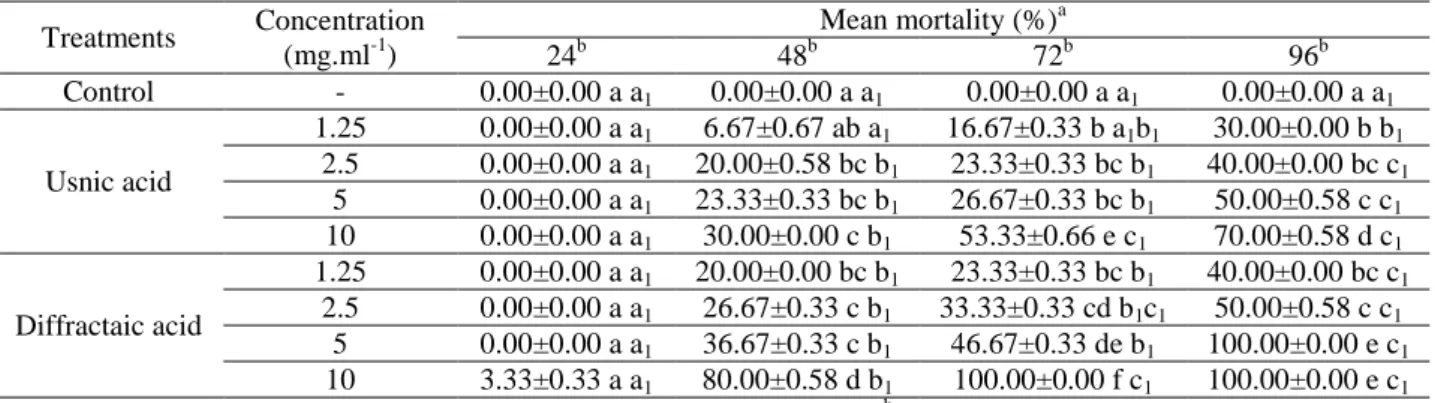
Presented results showed that secondary metabolites of U. longissima had an insecticidal effect on both the larvae and adults of L. decemlineata compared with the control (Figs. 1-4). Higher concentration and longer exposure time resulted to highest toxicity on both larvae and adults. Mortality rates, after 24, 48, 72, and 96 h post treatment with different concentrations of lichen secondary metabolites, are given in figs. 1 and 2.
Analysis of variance demonstrated that the effects of these two acids on the mortality rates
among L. decemlineata adults and 4th instar larvae
were highly significant on the basis of concentration and exposure time tested (Tables 1 and 2). Higher concentrations and longer exposure times resulted in high toxicity of L. decemlineata. Diffractaic acid was more potent and possessed higher mortality rates than that obtained with usnic acid on both of the larvae and adults (Tables 1 and 2).
Mortality rates after 96 h of treatment, with the
highest concentration (10 mg. ml-1) of diffractaic and
usnic acids, were estimated at 100 and 70 % of adults and 100 and 80 % of larvae, respectively. There was no mortality in the control of each metabolite (Figs. 1 and 2).
Total mortality rate increased as the
concentration increased. Diffractaic solution with 10
mg. ml-1 concentration showed highest insecticidal
effect for both larvae and adults (Fig. 3). Meanwhile, diffractaic solution proved to be more toxic to larvae rather than to adults. The highest total mortality was obtained after 96 h exposure period and again the highest larvicidal and adulticidal activities resulted from diffractaic treatment (Fig. 4).
Table (1): Effects of two lichen secondary metabolites on adults of the Colorado potato beetle, Leptinotarsa
decemlineata under laboratory conditions
Treatments Concentration (mg.ml-1) Mean mortality (%)a 24b 48b 72b 96b Control - 0.00±0.00 a a1 0.00±0.00 a a1 0.00±0.00 a a1 0.00±0.00 a a1 Usnic acid 1.25 0.00±0.00 a a1 6.67±0.67 ab a1 16.67±0.33 b a1b1 30.00±0.00 b b1 2.5 0.00±0.00 a a1 20.00±0.58 bc b1 23.33±0.33 bc b1 40.00±0.00 bc c1 5 0.00±0.00 a a1 23.33±0.33 bc b1 26.67±0.33 bc b1 50.00±0.58 c c1 10 0.00±0.00 a a1 30.00±0.00 c b1 53.33±0.66 e c1 70.00±0.58 d c1 Diffractaic acid 1.25 0.00±0.00 a a1 20.00±0.00 bc b1 23.33±0.33 bc b1 40.00±0.00 bc c1 2.5 0.00±0.00 a a1 26.67±0.33 c b1 33.33±0.33 cd b1c1 50.00±0.58 c c1 5 0.00±0.00 a a1 36.67±0.33 c b1 46.67±0.33 de b1 100.00±0.00 e c1 10 3.33±0.33 a a1 80.00±0.58 d b1 100.00±0.00 f c1 100.00±0.00 e c1 a
Mean ±SE of three replicates, each set-up with 10 adults b Exposure time (h) a, b, c, d, e, f: Values followed by different letters in the same column differ significantly at p<0.01 a1, b1, c1: Values followed by different letters in the same row differ significantly at p<0.01
Table (2): Effects of two lichen secondary metabolites on 4th instar larvae of the Colorado potato beetle,
Leptinotarsa decemlineata under laboratory conditions
Mean mortality (%)a Treatments Concentration (mg.ml-1) 24 b 48b 72b 96b Control - 0.00±0.00 a a1 0.00±0.00 a a1 0.00±0.00 a a1 0.00±0.00 a a1 Usnic acid 1.25 0.00±0.00 a a1 10.00±0.58 ab a1b1 20.00±0.00 ab b1 36.67±0.33 b c1 2.5 0.00±0.00 a a1 23.33±0.33 bc b1 26.67±0.33 b b1 43.33±0.33 bc c1 5 0.00±0.00 a a1 30.00±0.00 bcd b1 33.33±0.33 b b1 60.00±1.00 cd c1 10 6.67±0.33 a a1 33.33±0.88 cd a1b1 56.67±0.88 cd b1c1 80.00±0.00 e c1 Diffractaic acid 1.25 0.00±0.00 a a1 23.33±0.33 bc b1 30.00±0.58 b b1c1 46.67±0.33 bcd c1 2.5 0.00±0.00 a a1 30.00±0.00 bcd b1 40.00±0.58 bc b1 63.33±0.33 de c1 5 0.00±0.00 a a1 46.67±0.33 d b1 66.67±0.33 d c1 100.00±0.00 f d1 10 10.00±0.58 a a1 86.67±0.33 e b1 100.00±0.00 e b1 100.00±0.00 f b1 a
Mean ±SE of three replicates, each set-up with 10 4th instar larvae b Exposure time (h)
a, b, c, d, e, f: Values followed by different letters in the same column differ significantly at p<0.01 a1, b1, c1, d1: Values followed by different letters in the same row differ significantly at p<0.01
Fig. (1): Mortality rates among adults of Leptinotarsa decemlineata in relation to exposure time and concentration of two lichen secondary metabolites under laboratory conditions.
8
Fig. (2): Mortality rates among fourth instar larvae of Leptinotarsa decemlineata in relation to exposure time and concentration of two lichen secondary metabolites under laboratory conditions.
Fig. (3): Total mortality rates among adults and fourth instar larvae of Leptinotarsa decemlineata exposed to different concentrations of two lichen secondary metabolites under laboratory conditions.
Fig. (4): Total mortality rates among adults and fourth instar larvae of Leptinotarsa decemlineata according to exposure period of two lichen secondary metabolites under laboratory conditions.
Table (3): LC50 values (mg.ml -1
) of two lichen secondary metabolites on adults of Leptinotarsa decemlineata under laboratory conditions
Treatments Exposure Time (h) LC50 (Limits) Slope (±SE) (Limits)
Usnic acid 72 11.278 (6.407–82.161) 1.170 (0.381) (0.422–1.917) 96 4.048 (2.370–8.032) 1.127 (0.355) (0.431–1.823) Diffractaic acid 72 3.362 (2.612–4.342) 2.421 (0.422) (1.595–3.248) 96 1.783 (1.375–2.176) 3.398 (0.631) (2.160–4.636) Table (4): LC50 values (mg.ml -1
) of two lichen secondary metabolites on 4th instar larvae of Leptinotarsa
decemlineata under laboratory conditions
Treatments Exposure Time (h) LC50 (Limits) Slope (±SE) (Limits)
Usnic acid 72 8.838 (5.172–53.859) 1.091 (0.367) (0.372–1.811)
96 2.759 (1.500–4.236) 1.299 (0.361) (0.591–2.008)
Diffractaic acid 72 2.590 (1.948–3.291) 2.469 (0.428) (1.629–3.309)
96 1.509 (1.080–1.876) 3.289 (0.654) (2.007–4.571)
The LC50 values, at 72 and 96 h, were calculated
for L. decemlineata adults (Table 3) and 4th instar
larvae (Table 4). The 96 h LC50 values were the
lowest. After 96 h exposure period, the LC50 values
calculated for usnic acid and diffractaic acid were
4.048 and 1.783 mg. ml-1 for adults and 2.759 and
1.509 mg. ml-1 for 4th instar larvae, respectively.
Natural products are now being considered as alternatives to the currently available arsenal synthetic compounds (Dayan et al., 1999). The present results confirmed that diffractaic and usnic acids from lichen secondary metabolites had varying degrees of larvicidal and adulticidal activities against L. decemlineata. In agreement with the present results, some previous studies demonstrated that, in general, the toxicity of extracts isolated from lichen samples against pests is related to their secondary components (Emmerich et al., 1993; Bombuwala, 2001; Nimis and Skert, 2006; Cetin et
al., 2008 and Silva et al., 2009). These results
suggested that extracts isolated from different lichen species might have different toxicity levels that might be attributed to their different components and different chemical composition (Sahip et al., 2008).
In this study, diffractaic solutions, with 5 and 10
mg. ml-1 concentrations, showed 100 % mortality of
larvae and adults. These results differed,
significantly at p<0.01, than other concentrations
(1.25 and 2.5 mg. ml-1) at 96 h (Tables 1 and 2).
These disparities (at p<0.01) attract the attention about mortalities occurred after some exposure periods for the same concentration (Tables 1 and 2).
Low values of LC50 at96 h (1.783 mg. ml
-1
for adults
(Table 3) and 1.509 mg. ml-1 for 4th instar larvae
(Table 4)) indicated that diffractaic acid was highly toxic to the tested stages of L. decemlineata.
Lichens are known as biological indicator organisms. They survive better in regions having unpolluted air and produce secondary metabolites
which are likely to be adaptive and not harmful to the environment but they have only an effect on the phytophagous insects. For this reason, lichen acids isolated from lichen extracts are functional substances that are suitable to have effect only on the target organisms.
It can be concluded that diffractaic and usnic acids obtained from Usnea longissima had an insecticidal activity, therefore they may have
potential insecticidal actions against adults and 4th
instar larvae of L. decemlineata.
ACKNOWLEDGEMENT
The authors wish to thank Dr. Marco ULIANA (Italy) for his fruitful comments on the manuscript.
REFERENCES
Alyokhin, A., M. Baker, D. Mota-Sanchez, G. Dively and E. Grafius 2008. Colorado potato beetle resistance to insecticides. Amer. J. Potato Res. 85: 395–413.
Aslan, A., A. Öztürk and E. Kaya 1998. Economic importance of lichens and important lichen species determined in Oltu region. Proceedings of the Symposium of Oltu and its Vicinity from Past to Future, 1-3 July 1998, Oltu. Erzurum: 356-365.
Bayir, Y., F. Odabasoglu, A. Cakir, A. Aslan, H. Suleyman, M. Halici and C. Kazaz 2006. The inhibition of gastric mucosal lesion, oxidative stress and neutrophil-infiltration in rats by the lichen constituent diffractaic acid. Phytomedicine 13: 584–590.
Bombuwala, B. D. K. 2001. Isolation and bio activity studies of lichen substances from Sri Lankan lichens. News Internet Edition, Ph. D. Thesis, Department of Chemistry, University of Peradeniya, Sri Lanka, 132pp.
10
Cetin, H., O. Tufan, A.O. Turk, T. Tay, M. Candan, A. Yanikoglu and H. Sumbul 2008. Insecticidal activity of major lichen compounds, (−)- and (+)- usnic acid, against the larvae of house mosquito,
Culex pipiens L. Parasitol. Res. 2:1277-1279.
Culberson, C. F., W. L. Culberson and A. Johnson 1977. Second supplement to "Chemical and botanical guide to lichen products". Am. Bryol. Lichenol. Soc. Missouri Botanical Garden, Saint Louis, 400 pp.
Dayan, F. E., J. G. Romagni, M. R. Tellez, A. M. Rimando and S. O. Duke 1999. Managing weeds with natural products. Pesticide Outlook, 5:185– 188.
Emmerich, R., I. Giez, O. L. Lange and P. Proksch 1993. Toxicity and antifeedant activity of lichen compounds against the polyphagous herbivorous insect Spodoptera littoralis. Phytochemical 33:1389-1394.
Finney, D. J. 1971. Probit analysis 3rd edition. Cambridge Univ. Press. London.
Galun, M. 1988. Lichenization. CRC Handbook of Lichenology. Boca Raton: M. CRC Press, 2, 153–169.
Gillott, C. 2005. Entomology. University of Saskatchewan Saskatoon, Saskatchewan Press, Canada, pp 750–768.
Gudjonsdottir, G. A. and K. Ingolfsdottir 1977.
Quantitative determination of protolichesterinic
and fumarprotocetraric acids in Cetraria
islandica by high-performance liquid
chromatography. J. Chromatography A,
757:303–306.
Huneck, S. and G. Hoefle1978. Struktur and 13
C-NMR-spektroskopie von chlorhaltigen
Flechtenxanthonen. Tetrahedron, 34:2491–2502. Nimis, P. L. and N. Skert 2006. Lichen chemistry
and selective grazing by the coleopteran
Lasioderma serricorne. Environ. Exp. Bot.
55:175-182.
Odabasoglu, F., A. Cakir, H. Suleyman, A. Aslan, Y. Bayir, M. Halici and C. Kazaz 2006. Gastroprotective and antioxidant effects of usnic acid on indomethacin-induced gastric ulcer in rats. J. Ethnopharmacol. 103:59–65.
Sahip, K., S. Kularate, S. Kumar and V. Karunarate 2008. Effect of (+)-usnic acid on the shot-hole borer (Xyleborus fornicatus Eichh.) of tea. J. Nat. Sci. Found. Sri Lanka, 36:335-336.
Silva, M. D. C., R. A. Sa, T. H. Napoleao, F. S. Gomes, N. D. L. Santos, A. C. Albuquerque, H. S. Xavier, P. M. G. Paiva and M. T. S. Correia 2009. Purified Cladonia verticillaris Lichen Lectin: Insecticidal activity on Nasutitermes
corniger (Isoptera: Termitidae). Int. Biodeter.