CERN-EP-2018-167 2019/01/25
CMS-SMP-16-003
Measurement of differential cross sections for inclusive
isolated-photon and photon+jet production in
proton-proton collisions at
√
s
=
13 TeV
The CMS Collaboration
∗Abstract
Measurements of inclusive isolated-photon and photon+jet production in proton-proton collisions at√s = 13 TeV are presented. The analysis uses data collected by the CMS experiment in 2015, corresponding to an integrated luminosity of 2.26 fb−1. The cross section for inclusive isolated photon production is measured as a function of the photon transverse energy in a fiducial region. The cross section for photon+jet production is measured as a function of the photon transverse energy in the same fiducial region with identical photon requirements and with the highest transverse momentum jet. All measurements are in agreement with predictions from next-to-leading-order perturbative QCD.
Published in the European Physical Journal C as doi:10.1140/epjc/s10052-018-6482-9.
c
2019 CERN for the benefit of the CMS Collaboration. CC-BY-4.0 license
∗See Appendix A for the list of collaboration members
1
Introduction
The measurement of inclusive isolated-photon and photon+jet production cross sections can di-rectly probe quantum chromodynamics (QCD). The dominant production processes in proton-proton (pp) collisions at the energies of the CERN LHC are quark-gluon Compton scattering qg→qγ, together with contributions from quark-antiquark annihilation qq→gγ, and parton fragmentation qq(gg) →X+γ. Both the CMS and ATLAS Collaborations have reported
mea-surements of the differential cross sections for isolated prompt photon production [1–7] and for the production of a photon in association with jets [8–10] using data with center-of-mass ener-gies of 2.76, 7, and 8 TeV. The ATLAS Collaboration has also reported the same measurements at a center-of-mass energy of 13 TeV [11, 12].
The published measurements show agreement with the results of next-to-leading-order (NLO) perturbative QCD calculations [13, 14].
These LHC measurements are sensitive to the gluon density function g(x, Q2) over a wide
range of parton momentum fraction x and energy scale Q2 [15–17]. These measurements
were not included in the global parton distribution function (PDF) fits [18–20] until very re-cently [21]. An improved understanding of all PDFs is key to reducing the associated theo-retical uncertainties in the calculation of many relevant cross sections, including Higgs boson production and new physics searches.
In this paper, measurements are reported for the inclusive isolated-photon cross section in a fiducial region using data collected by the CMS Collaboration in proton-proton collisions at √
s =13 TeV, corresponding to an integrated luminosity of 2.26 fb−1[22]. The specific fiducial region is defined at generator level as: (1) photon transverse momentum ET >190 GeV, (2)
ra-pidity|y| <2.5, and (3) an isolated photon where the sum of the pTof all particles inside a cone
of radius ∆R = √(∆φ)2+ (∆η)2 = 0.4 around the photon is less than 5 GeV. The photon+jet
cross section is also measured in this fiducial region with the same photon requirements and with pjetT >30 GeV and|yjet| <2.4. The significant increase in center-of-mass energy compared with the previous CMS papers [1, 2] opens a large additional region of phase space.
The dominant background for the photon+jet process is QCD multijet production with an iso-lated electromagnetic (EM) deposit from decays of neutral hadrons, mostly from π0mesons. A
multivariate analysis method is used to identify prompt photons using a boosted decision tree (BDT) algorithm, implemented using the TMVA v4.1.2 toolkit [23]. Photon yields are extracted using the shape of the BDT distributions, and the measured cross sections are compared to the results of NLO QCD calculations.
2
The CMS detector
CMS is a general-purpose detector built to explore physics at the TeV scale. The central fea-ture of the CMS apparatus is a superconducting solenoid of 6 m internal diameter, providing a magnetic field of 3.8 T. Within the solenoid volume are a silicon pixel and a strip tracker, a lead tungstate crystal electromagnetic calorimeter (ECAL), and a brass and scintillator hadron cal-orimeter (HCAL), each composed of a barrel and two endcap sections. Forward calcal-orimeters extend the pseudorapidity η coverage provided by the barrel and endcap detectors. Muons are measured in gas-ionization detectors embedded in the steel flux return yoke outside the solenoid. A more detailed description of the CMS detector, together with the definition of the coordinate system and the relevant kinematic variables, is given in Ref. [24].
The ECAL consists of 75 848 lead tungstate crystals, which provide coverage up to|η| =1.479
in the barrel region (EB) and 1.479< |η| <3.0 in two endcap regions (EE). A preshower
detec-tor consisting of two planes of silicon sensors interleaved with a total of 3 radiation lengths of lead is located in front of the EE.
The silicon tracker measures charged particles within the range|η| <2.5. For nonisolated
par-ticles of transverse momenta 1< pT <10 GeV and|η| <1.4, the track resolutions are typically
1.5% in pTand 25–90 (45–150) µm in the transverse (longitudinal) impact parameter [25].
The global event reconstruction (also called particle-flow event reconstruction) [26] reconstructs and identifies each particle candidate with an optimized combination of all subdetector infor-mation.
In CMS, both converted and unconverted photons are reconstructed using ECAL clusters and are included in the analysis. The clustering algorithm results in an almost complete collection of the energy of the photons, unconverted ones and those converting in the material upstream of the calorimeter. First, cluster “seeds” are identified as local energy maxima above a given threshold. Second, clusters are grown from the seeds by aggregating crystals with at least one side in common with a clustered crystal and with an energy in excess of a given threshold. This threshold represents about two standard deviations of the electronic noise, which depends on |η|. The energy in an individual crystal can be shared between clusters under the assumption
that each seed corresponds to a single EM particle. Finally, clusters are merged into “superclus-ters”, to allow good energy containment, accounting for geometrical variations of the detector along η, and increasing robustness against additional pp collisions in the same or adjacent bunch crossings (pileup). The clustering excludes 1.44 < |η| < 1.56, which corresponds to the
transition region between the EB and EE. The fiducial region terminates at|η| =2.5 where the
tracker coverage ends.
The energy of photons is computed from the sum of the energies of the clustered crystals, cal-ibrated and corrected for degradation in the crystal response over time [27]. The preshower energy is added to that of the superclusters in the region covered by this detector. To opti-mize the resolution, the photon energy is corrected using a multivariate regression technique that estimates the containment of the electromagnetic shower in the superclusters, the shower losses for photons that convert in the material upstream of the calorimeter, and the effects of pileup [28]. The regression training is performed on simulated events using shower shape and position variables of the photon as inputs. The regression provides a per-photon estimate of the function parameters that quantify the containment, the shower losses, and pileup and there-fore a prediction of the distribution of the ratio of true energy to the uncorrected supercluster energy. The most probable value of this distribution is taken as the photon energy correction. The regression output is used to correct the reconstucted photon energy in data to agree with simulated events. An additional smearing is applied to the photon energy in simulation to reproduce the resolution observed in data. The scale correction and smearing procedure uses a multistep procedure exploiting electrons from Z→ e+e−decays. In the EB, an energy reso-lution of about 1% is achieved for unconverted photons in the tens of GeV energy range. The remaining EB photons have a resolution of about 1.3% up to|η| = 1.0, rising to about 2.5% at
|η| = 1.4. In the EE, the resolution of unconverted or late-converting photons is about 2.5%,
while the remaining EE photons have a resolution between 3 and 4%.
Electrons are identified as a primary charged track consistent with potentially multiple ECAL energy clusters from both the electron and from potential bremsstrahlung photons produced in the tracker material. Muons are identified as a track in the central tracker consistent with either a track or several hits in the muon system, associated with a minimum ionization signature
in the calorimeters. Charged hadrons are charged-particle tracks not identified as electrons or muons. Finally, neutral hadrons are identified as HCAL energy clusters not linked to any charged-hadron track, or as ECAL and HCAL energy excesses with respect to the expected charged-hadron energy deposit.
Jets are clustered from all particle candidates reconstructed by the global event reconstruction with the infrared- and collinear- safe anti-kT algorithm [29, 30] using a distance parameter R
of 0.4. The momenta of jets reconstructed using particle-flow candidates in the simulation are within 5 to 10% of particle-level jet momenta over the whole jet pT spectrum and detector
acceptance, and corrected on average accordingly. In situ measurements of the momentum balance in dijet, photon+jet, Z+jet, and multijet events are used to correct for any residual differences in jet energy scale in data and simulation [31]. The jet energy resolution amounts typically to 15 (8)% at 10 (100) GeV.
3
Simulation samples
Simulated event samples for photon+jet and multijet final states are generated at leading order (LO) with PYTHIA 8 (v8.212) [32]. The photon+jet sample contains direct photon production originating from quark-gluon Compton scattering and quark-antiquark annihilation.
The multijet sample, which is dominated by final states with quark and gluon jets, is used in the estimate of systematic uncertainties, and to estimate the small bias in the extracted photon yield from the BDT fit, as described in section 5. For these studies, events containing a photon, produced via the fragmentation process and passing the fiducial requirements, are removed, leaving only events with nonfiducial photons. The removed events are considered part of the signal, although they are not included in the signal sample in the training of the BDT due to associated large statistical uncertainties. The distributions of the variables used in the BDT training were examined and are consistent with those of the direct photons, within the statisti-cal uncertainty.
The MADGRAPH (v5.2.2.2) [33, 34] LO generator, interfaced with PYTHIA 8, is used to gen-erate an additional sample of photon+jet events containing up to 4 jets that are used to esti-mate systematic uncertainties. Samples of Z/γ∗+jets events are generated at NLO with MAD -GRAPH5 aMC@NLO (v5.2.2.2) [33, 35] and are used for calibration and validation studies de-scribed later. The CUETP8M1 tune [36] is used inPYTHIA8. The NNPDF2.3 LO PDF [37] and the NNPDF3.0 NLO PDF [18] are used to generate simulation samples, where the former is used withPYTHIA8.
The simulated processes include the effect of the pileup. The pileup contribution is simulated with additional minimum bias events superimposed on the primary event using the measured distribution of the number of reconstructed interaction vertices, an average of 14 vertices per bunch crossing. A detailed detector simulation based on the GEANT4 (v9.4p03) [38] package is applied to all the generated signal and background samples.
4
Data samples and event selection criteria
Events containing high energy photon candidates are selected using the two-level CMS trig-ger system [39]. At the first level, events are accepted if they have an ECAL trigtrig-ger tower, which has a segmentation corresponding to 5×5 ECAL crystals, with total transverse energy ET, defined as the magnitude of the photon transverse momentum, greater than 40 GeV. The
reconstruction [28]. An event is accepted online if it contains at least one ECAL cluster with ET
greater than 175 GeV, and if the “H/E”, defined as the ratio of energy deposited in the HCAL to that in the ECAL, is less than 0.15 (0.10) in the EB (EE) region.
All events are required to have at least one well-reconstructed primary vertex [25]. The recon-structed vertex with the largest value of summed physics-object p2T is the primary pp interac-tion vertex. The physics objects are the jets, clustered using the jet finding algorithm [29, 30] with the tracks assigned to the vertex as inputs, and the associated missing transverse momen-tum pmissT [40], taken as the negative vector sum of the pTof those jets. In addition, photon+jet
events are required to be balanced in pT, and hence the magnitude of missing transverse
mo-mentum, defined as the magnitude of the negative vector sum of the momenta of all recon-structed particle-flow objects projected onto the plane perpendicular to the beam axis in an event, is required to be less than 70% of the highest photon ET.
Photon candidates are selected as described in the following procedure. An electron veto is im-posed by requiring the absence of hits in the innermost layer of the silicon pixel detector that could be ascribed to an electron track consistent with the energy and position of the photon ECAL cluster. Criteria on the energy measured in HCAL (H), isolation, and shower shape vari-ables are applied to reject photons arising from electromagnetic decays of particles in hadronic showers. Hence, H/E is required to be less than 0.08 (0.05) for photon candidates in the EB (EE), respectively. The sum of the ETof other photons in a cone (photon isolation) of size∆R= 0.3
around the photon candidate is required to be less than 15 GeV, and the sum of pTof charged
hadrons in the same cone (hadron isolation) is required to be less than 2.0 (1.5) GeV for photon candidates in the EB (EE).
To further suppress photons from decays of neutral mesons (π0, η, etc.) that survive the iso-lation and HCAL energy leakage criteria, a selection on the EM shower shape is imposed by requiring that its second moment σηη [28], which is a measure of the lateral extension of the shower along the η direction, be<0.015 (0.045) for photon candidates in the EB (EE). The pho-ton candidate with the highest ET that satisfies the above selection criteria in each event is
referred to as the leading photon. The data consist of 212 134 events after applying inclusive isolated-photon selections and 207 120 events after applying the photon+jet requirements. The estimated electron contribution is typically at 10−3 level as a result of the electron veto algo-rithm. This contribution is small compared to statistical uncertainties of the photon yield and other systematic uncertainties.
The photon reconstruction and selection efficiencies are estimated using simulated events that pass the fiducial region requirements at the generator level. The efficiency is about 90–92% (83– 85%) for EB (EE) photons, depending on the ET of the photon candidate. The loss of efficiency
comes primarily from the hadron isolation requirement. Multiplicative scale factors (SF) are applied to correct potential differences in efficiencies between data and simulation. The SFs are obtained from the ratio of the efficiency in data to that in simulated control samples. The pho-ton SF is derived from Drell–Yan Z→e+e−events, where one of the electrons is reconstructed as a photon. The events are selected by requiring the invariant mass of the electron pair to be between 60–120 GeV. The electron veto SF is determined using final-state radiation photons in Z→ µ+µ−γevents. All SFs are within 1% of unity, and their uncertainties are included in the
total systematic uncertainty. All efficiencies and SF are measured as functions of photon ETand
rapidity y using the same binning as the cross section measurement.
The absolute photon trigger efficiency, as a function of photon ET, is measured using events
collected with a jet trigger that contains a photon candidate, which satisfies the signal selection criteria and is spatially separated from the jet that triggered the event by∆R(γ, jet) >0.7. The
trigger efficiency is above 99% for EB (EE) photons above 200 (220) GeV. The ET-dependent
trigger efficiency is used to compute the cross section, and the associated uncertainties are incorporated into the uncertainty calculation for the cross section.
For the cross section measurement as a function of jet y, the jets are required to: (1) satisfy a set of selection criteria that remove detector noise [41], (2) have a separation from the lead-ing photon of ∆R > 0.4, and (3) have pT greater than 30 GeV. The pT requirement for jets is
fully efficient for simulation events with both photon and jet in their fiducial regions. The jet candidate with the highest pTsatisfying the above requirements is selected.
The measurement of the differential cross section for inclusive isolated photons uses four ranges of photon rapidity,|yγ| <0.8, 0.8 < |yγ| < 1.44, 1.57 < |yγ| < 2.1, and 2.1 < |yγ| < 2.5. The photon+jet differential cross section measurement uses two ranges of photon rapidity, |yγ| < 1.44 and 1.57 < |yγ| < 2.5, and two ranges of jet rapidity, |yjet| < 1.5 and 1.5 < |yjet| < 2.4. For all cases, the results are presented in nine bins in photon ETbetween 190 to 1000 GeV,
ex-cept for two cases: the 2.1 < |yγ| < 2.5 region for the isolated-photon measurement and the 1.57 < |yγ| < 2.5 and 1.5 < |yjet| < 2.4 regions for the photon+jet measurement, where eight bins in photon ETbetween 190 to 750 GeV are used.
5
Cross section measurement
To further suppress remaining backgrounds originating from jets faking photons, a BDT is constructed utilizing the following discriminating variables:
1. Photon η, φ, and energy;
2. Several shower shape variables:
(a) The energy sum of the 3×3 crystals centered on the most energetic crystal in the photon divided by the energy of the photon;
(b) The ratio of E2×2, the maximum energy sum collected in a 2×2 crystal matrix that
includes the largest energy crystal in the photon, and E5×5, the energy collected in a
5×5 crystal matrix centered around the same crystal (E2×2/E5×5);
(c) The second moment of the EM cluster shape along the η direction (σηη);
(d) The diagonal component of the covariance matrix that is constructed from the energy-weighted crystal positions within the 5×5 crystal array (qηφ);
(e) The energy-weighted spreads along η (ση) and φ (σφ), calculated using all crystals in the photon cluster, which provide further measures of the lateral spread of the shower.
3. For photon candidates in the EE, the preshower shower width, σRR =
√
σxx2 +σyy2 , where σxxand σyymeasure the lateral spread in the two orthogonal sensor planes of the detector,
and the fraction of energy deposits in the preshower.
4. The median energy density per unit area in the event ρ [30] to minimize the effect of the pileup.
The distributions of the BDT values are used in a two-template binned likelihood fit to estimate the photon yield. A separate BDT is constructed for each bin of photon y and ET. The signal
PYTHIA 8. This template is validated using Z → µ+µ−γdata samples and also a data sample
of Z→e+e−candidates where each candidate contains an electron reconstructed as a photon. The signal templates have a systematic uncertainty due to differences in the distributions of the BDT input variables in data and simulation. To evaluate this uncertainty, the distribution of each variable obtained from a sample of simulated Z→e+e−events is modified until agree-ment is obtained with the data. Signal templates are made using the same procedure. The difference in the templates is treated as a nuisance parameter in the fit procedure.
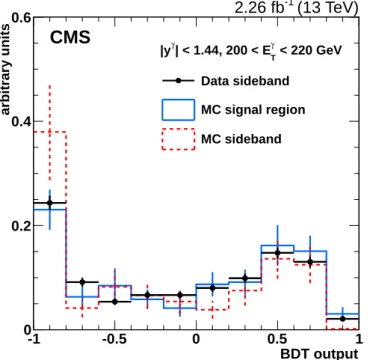
The background BDT template is derived from the data, using a sideband region defined using the same signal selection, but relaxing the hadron isolation criterion. The hadron isolation for the sideband region is required to be between 7 and 13 (6 and 12) GeV for EB (EE) photons, where the chosen ranges ensure negligible signal contamination. Possible biases in the photon yields due to differences between the background BDT templates in the control and signal regions are estimated using simulated events and are found to be less than 5%. Photon yields extracted from the fits are corrected for these biases. The statistical uncertainties in each bin of the background template constructed from the data sideband events are also included as nuisance parameters in the fitting procedure. Figure 1 shows the BDT templates obtained for a particular photon ET and y bin for the data sideband and for the signal and sideband regions
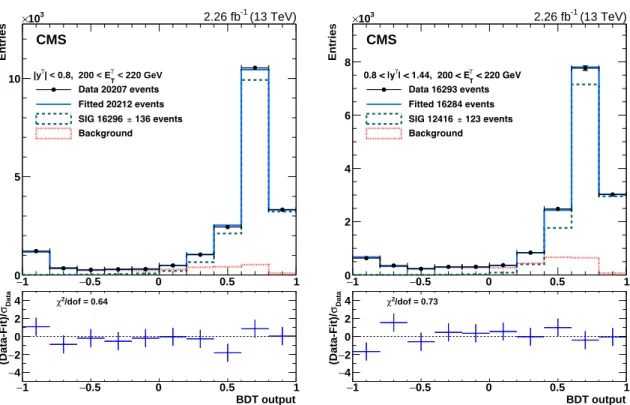
from simulated QCD multijet events. The distributions of BDT outputs for EB and EE photons in data are shown in Fig. 2 for photon ETbetween 200 and 220 GeV and jet|y| <1.5. The fitted
results for the signal, background, and combined distributions are also shown in Fig. 2. The ratio of experimental data to the simulation results demonstrates agreement as indicated by the
χ2per degree of freedom.
BDT output -1 -0.5 0 0.5 1 arbitrary units 0 0.2 0.4 0.6 < 220 GeV T γ | < 1.44, 200 < E γ |y Data sideband MC signal region MC sideband (13 TeV) -1 2.26 fb
CMS
Figure 1: Distributions of the BDT for background photons in the 200–220 GeV bin for the EB region. The points show events from a sideband region of the photon isolation selection criteria, the solid histogram shows the events in the signal region in simulated QCD multijet events, and the dashed histogram shows the sideband region for simulated QCD multijet events. All three samples have their statistical uncertainties shown as error bars.
imple-BDT output 1 − −0.5 0 0.5 1 Entries 0 5 10 3 10 × < 220 GeV γ | < 0.8, 200 < E γ |y (13 TeV) -1 2.26 fb CMS BDT output 1 − −0.5 0 0.5 1 Data σ (Data-Fit)/ 4 − 2 − 0 2 4 χ2/dof = 0.64 T Data 20207 events Fitted 20212 events SIG 16296 ± 136 events Background BDT output 1 − −0.5 0 0.5 1 Entries 0 2 4 6 8 3 10 × γ γ (13 TeV) -1 2.26 fb CMS BDT output 1 − −0.5 0 0.5 1 Data σ (Data-Fit)/ 4 − 2 − 0 2 4 χ2/dof = 0.73 0.8 < |y | < 1.44, 200 < E < 220 GeV T Data 16293 events Fitted 16284 events SIG 12416 ± 123 events Background
Figure 2: Distributions of the BDT output for an EB (left) and an EE (right) bin with photon ET between 200–220 GeV and|yjet| <1.5. The points represent data, and the solid histograms,
approaching the data points, represent the fit results with the signal (dashed) and background (dotted) components displayed. The bottom panels show the ratio of the data to the fitted results and the χ2/dof.
mented in the RooUnfold software package [43], to take into account migrations between dif-ferent bins due to the photon energy scale and resolution, and into and out of the fiducial ET
region. The unfolding response matrix is obtained from thePYTHIA8 photon+jet sample. The unfolding corrections are small, of the order of 1%. The size of the corrections is also verified using an independent photon+jet sample generated with MADGRAPH.
The inclusive isolated-photon differential production cross section is calculated as d2σ dyγdEγ T = U (N γ) ∆yγ∆Eγ T 1 eSF L, (1)
and the photon+jet as
d3σ dyγdEγ Tdyjet = U (N γ) ∆yγ∆Eγ T∆yjet 1 eSF L, (2)
whereU (Nγ)denotes the unfolded photon yields in bins of width ∆Eγ
T and∆y, and y is the
rapidity of either the photon or the jet. In these equations, e denotes the product of trigger, reconstruction, and selection efficiencies; SF the product of the selection and electron veto scale factors; and L is the integrated luminosity.
6
Systematic uncertainties
The uncertainty in the efficiency of the event selection is typically small except in the high-ET
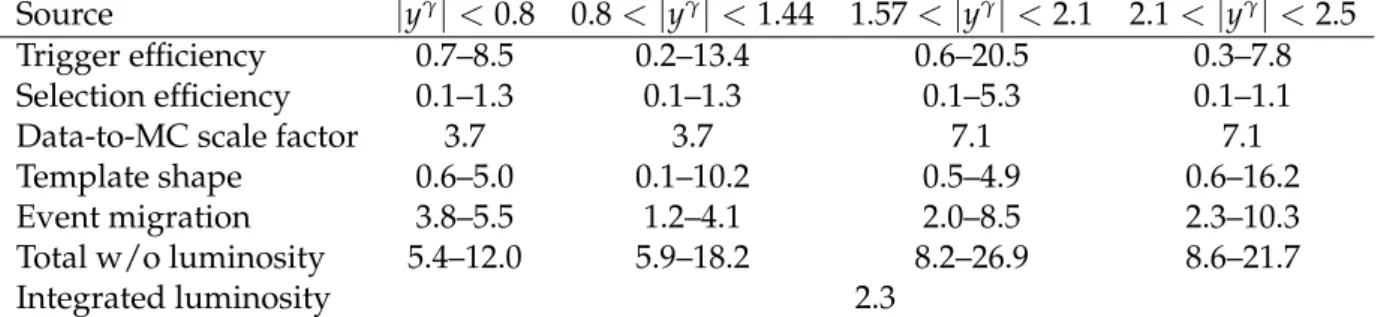
of the systematic uncertainties in the cross section measurement, due to the uncertain in trig-ger and event selection efficiencies, Data-to-MC scale factors, signal and background template shapes, bin migrations from the unfolding procedure, and uncertainties in the photon energy scale and resolution, is given in Table 1. All of the above are treated as uncorrelated.
The systematic uncertainties in the trigger efficiency are dominated by the statistical uncer-tainty in jet trigger data where the trigger efficiencies are measured. The uncertainties of the selection efficiency are dominated by the statistical uncertainties of the simulation sample. The uncertainties of the Data-to-MC scale factor are based on the available Z→e+e−events, and a pT extrapolation is employed.
The systematic uncertainties in the signal and background templates are incorporated into the fit as nuisance parameters. For the signal template uncertainty, the nuisance parameter is as-signed a Gaussian prior, while log-normal priors are asas-signed to the background template nui-sances. A description of the general methodology can be found in Ref. [44]. The bias correction, applied to the photon yields, due to the selection of the sideband range is also considered as a systematic uncertainty.
The impact on photon yields due to the event migration between photon pT bins from the
unfolding uncertainties, which include photon energy scale and resolution uncertainties, is roughly 5%. The uncertainties of the event selection efficiency due to the jet selection, jet energy scale and resolution, and jet rapidity migration are negligible.
The total uncertainty, not considering luminosity uncertainty, in the yield per bin, excluding the highest photon ETbin in each y range, is about 5–8% for EB and 9–17% for EE photons. The
highest photon ET bins in all y region have limited events in data and simulated samples for
the evaluation of systematics.
The uncertainty in the measurement of the CMS integrated luminosity is 2.3% [22] and it is added in quadrature with other systematic uncertainties.
Table 1: Impact on cross sections, in percent, for each systematic uncertainty source in the four photon rapidity regions,|yγ| <0.8, 0.8< |yγ| <1.44, 1.57 < |yγ| <2.1, and 2.1< |yγ| <2.5. The ranges, when quoted, indicate the variation over photon ETbetween 190–1000 GeV.
Source |yγ| <0.8 0.8< |yγ| <1.44 1.57< |yγ| <2.1 2.1< |yγ| <2.5
Trigger efficiency 0.7–8.5 0.2–13.4 0.6–20.5 0.3–7.8
Selection efficiency 0.1–1.3 0.1–1.3 0.1–5.3 0.1–1.1
Data-to-MC scale factor 3.7 3.7 7.1 7.1
Template shape 0.6–5.0 0.1–10.2 0.5–4.9 0.6–16.2
Event migration 3.8–5.5 1.2–4.1 2.0–8.5 2.3–10.3
Total w/o luminosity 5.4–12.0 5.9–18.2 8.2–26.9 8.6–21.7
Integrated luminosity 2.3
7
Results and comparison with theory
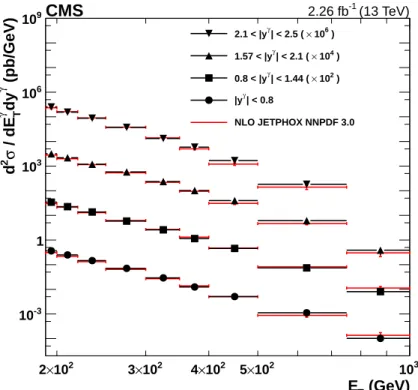
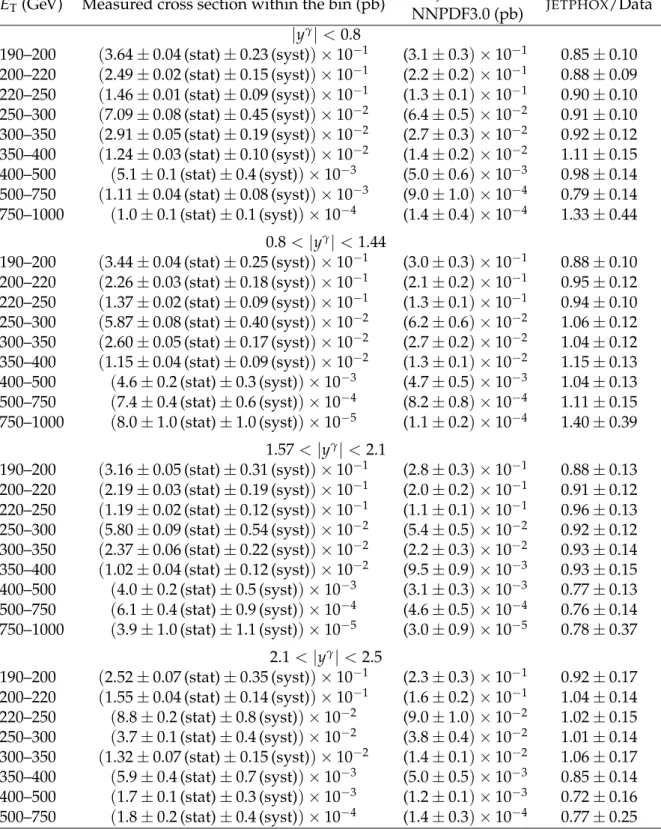
The measured inclusive isolated-photon cross sections as a function of photon ET are shown
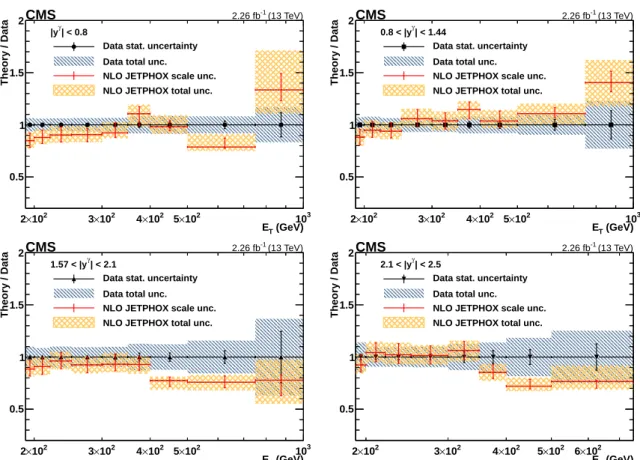
in Fig. 3 and the ratio compared with theory in Fig. 4 for photon ET greater than 190 GeV and
|yγ| <2.5 in 4 rapidity bins. The results are listed in Table 2. The measurements for photon+jet
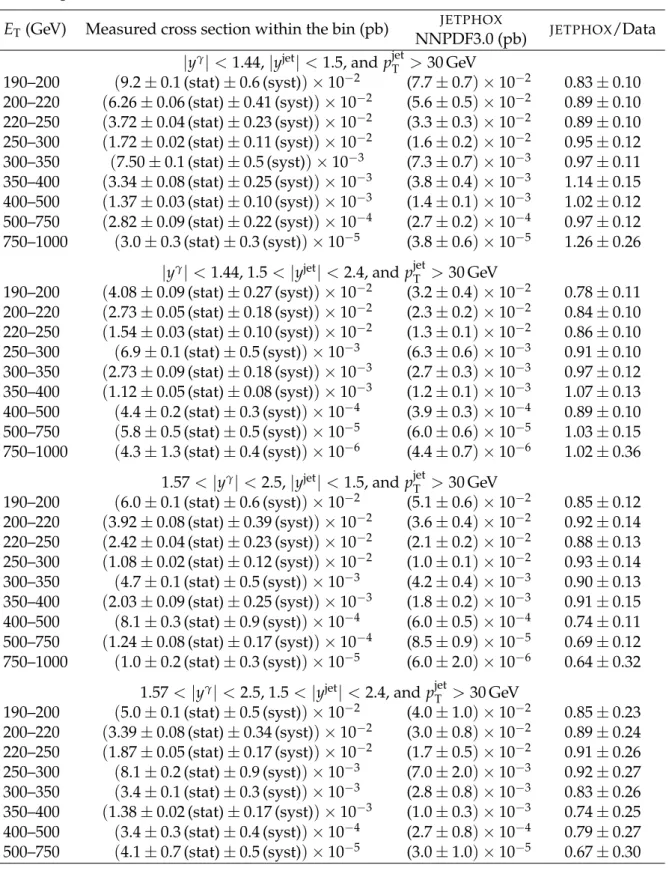
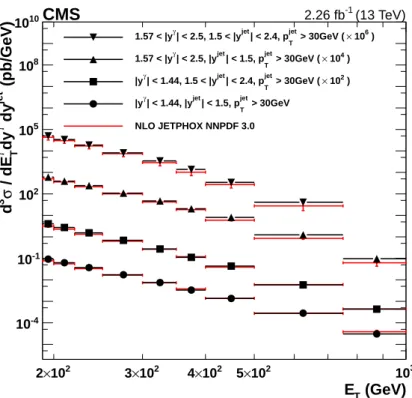
cross sections as a function of photon ETare shown in Fig. 5 and the ratio compared with theory
in Fig.6 with additional requirements of pjetT >30 GeV and|yjet| <2.4. The results are binned in two photon rapidity and two jet rapidity bins and are listed in Table 3. The predictions require
an isolated photon at generator level as described previously, with a transverse isolation energy less than 5 GeV.
The measured cross sections in the overlapping photon ET regions are increased by approxi-mately a factor of 3 to 5 compared to previous CMS measurements at 7 TeV [1, 2, 8]. This 13 TeV analysis also extends the photon ET range from 400 (300) GeV in the 7 TeV inclusive photon
(photon+jet) results to 1 TeV.
The measured cross sections are compared with NLO perturbative QCD calculations from the
JETPHOX 1.3.1 generator [13, 45, 46], using the NNPDF3.0 NLO [18] PDFs and the
Bourhis-Fontannaz-Guillet (BFG) set II parton fragmentation functions [47]. The renormalization, fac-torization, and fragmentation scales are all set to be equal to the photon ET. To estimate the
effect of the choice of theoretical scales on the predictions, the three scales are varied indepen-dently from ET/2 to 2ET, while keeping their ratio between one-half and two. The impact of
JETPHOX cross section predictions due to the uncertainties in the PDF and in the strong
cou-pling αS=0.118 at the mass of Z boson is calculated using the 68% confidence level NNPDF3.0
NLO replica. The uncertainty of parton-to-particle level transformation of the NLO pQCD prediction due to the underlying event and parton shower is studied by comparing with ded-icated PYTHIAsamples where the choice and tuning of the generator has been modified. The differences between the dedicatedPYTHIAand the nominal sample are between 0.5 to 2.0%, de-pending on the photon ETand y, and they are assigned as the systematic uncertainty. The total
theoretical uncertainties of the cross section predictions are evaluated as the quadratic sum of the scale, PDF,αS, and underlying event and parton shower uncertainties.
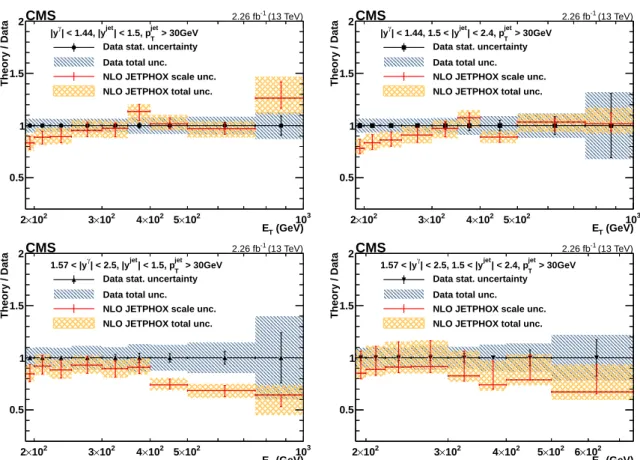
The ratio of the theoretical predictions to data, together with the experimental and theoretical uncertainties, are shown in Figs. 4 and 6 for the isolated-photon and photon+jet cross section measurements respectively. The uncertainties in the theoretical predictions and ratios to data are symmetrized in the tables; the largest value between the positive and negative uncertain-ties is listed. Measured cross sections are in agreement with theoretical expectations within statistical and systematic uncertainties.
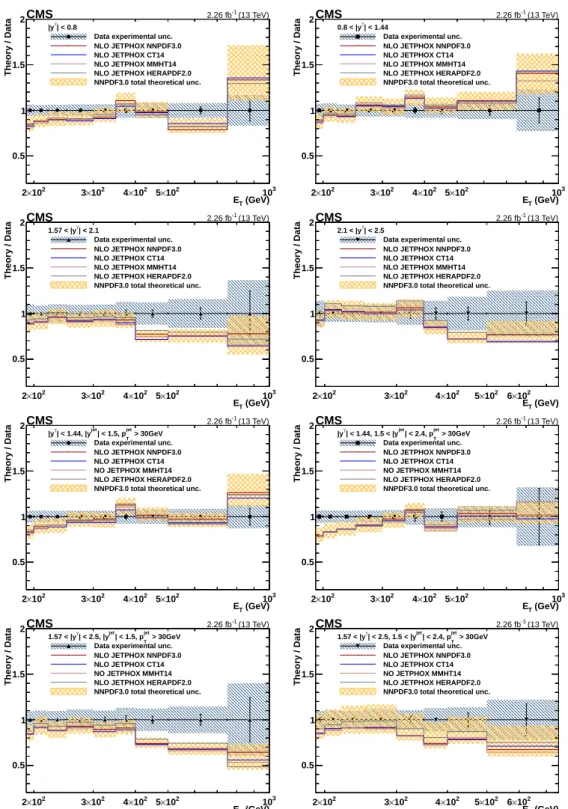
The ratio of the theoretical predictions to data based on JETPHOX at NLO with different PDF sets, including MMHT14 [19], CT14 [20], and HERAPDF2.0 [48] together with NNPDF3.0, are shown in Fig. 7. The differences between JETPHOX predictions using different PDF sets are small, within the theoretical uncertainties estimated with NNPDF3.0.
8
Summary
The differential cross sections for inclusive isolated-photon and photon+jet production in proton-proton collisions at a center-of-mass energy of 13 TeV are measured with a data sample collected by the CMS experiment corresponding to an integrated luminosity of 2.26 fb−1. The measure-ments of inclusive isolated-photon production cross sections are presented as functions of pho-ton transverse energy and rapidity with Eγ
T >190 GeV and|yγ| <2.5. The photon+jet
produc-tion cross secproduc-tions are presented as funcproduc-tions of photon transverse energy, and photon and jet rapidities, with requirement of an isolated photon and jet where pjetT >30 GeV and|yjet| <2.4.
The measurements are compared with theoretical predictions produced using theJETPHOX next-to-leading order calculations using different parton distribution functions. The theoretical pre-dictions agree with the experimental measurements within the statistical and systematic un-certainties. For low to middle range in photon ET, where the experimental uncertainties are
to further constrain the proton PDFs. The agreement between data and theory, and the new next-to-next-to-leading-order (NNLO) calculations [49] motivate the use of additional mea-surements to better estimate the gluon and other PDFs.
(GeV) T E 2 10 × 2 3×10² 4×10² 5×10² 3 10 (pb/GeV) γ dy T γ / dE σ 2 d -3 10 1 3 10 6 10 9 10 ) 6 10 × | < 2.5 ( γ 2.1 < |y ) 4 10 × | < 2.1 ( γ 1.57 < |y ) 2 10 × | < 1.44 ( γ 0.8 < |y | < 0.8 γ |y NLO JETPHOX NNPDF 3.0 (13 TeV) -1 2.26 fb CMS
Figure 3: Differential cross sections for isolated-photon production in photon rapidity bins, |yγ| < 0.8, 0.8 < |yγ| < 1.44, 1.57 < |yγ| < 2.1, and 2.1 < |yγ| < 2.5. The points show the measured values and their total uncertainties; the lines show the NLO JETPHOX predictions with the NNPDF3.0 PDF set.
Table 2: Measured and predicted differential cross section for isolated-photon production, along with the statistical and systematical uncertainties in the various ET and y bins.
Predic-tions useJETPHOXat NLO with the NNPDF3.0 PDF set. The ratio of theJETPHOXpredictions to data are listed in the last column, with the total uncertainty estimated assuming uncorrelated experimental and theoretical uncertainties.
ET(GeV) Measured cross section within the bin (pb) NNPDF3.0 (pb)JETPHOX JETPHOX/Data
|yγ| < 0.8 190–200 (3.64 ± 0.04 (stat) ± 0.23 (syst)) × 10−1 (3.1 ± 0.3) × 10−1 0.85 ± 0.10 200–220 (2.49 ± 0.02 (stat) ± 0.15 (syst)) × 10−1 (2.2 ± 0.2) × 10−1 0.88 ± 0.09 220–250 (1.46 ± 0.01 (stat) ± 0.09 (syst)) × 10−1 (1.3 ± 0.1) × 10−1 0.90 ± 0.10 250–300 (7.09 ± 0.08 (stat) ± 0.45 (syst)) × 10−2 (6.4 ± 0.5) × 10−2 0.91 ± 0.10 300–350 (2.91 ± 0.05 (stat) ± 0.19 (syst)) × 10−2 (2.7 ± 0.3) × 10−2 0.92 ± 0.12 350–400 (1.24 ± 0.03 (stat) ± 0.10 (syst)) × 10−2 (1.4 ± 0.2) × 10−2 1.11 ± 0.15 400–500 (5.1 ± 0.1 (stat) ± 0.4 (syst)) × 10−3 (5.0 ± 0.6) × 10−3 0.98 ± 0.14 500–750 (1.11 ± 0.04 (stat) ± 0.08 (syst)) × 10−3 (9.0 ± 1.0) × 10−4 0.79 ± 0.14 750–1000 (1.0 ± 0.1 (stat) ± 0.1 (syst)) × 10−4 (1.4 ± 0.4) × 10−4 1.33 ± 0.44 0.8 < |yγ| < 1.44 190–200 (3.44 ± 0.04 (stat) ± 0.25 (syst)) × 10−1 (3.0 ± 0.3) × 10−1 0.88 ± 0.10 200–220 (2.26 ± 0.03 (stat) ± 0.18 (syst)) × 10−1 (2.1 ± 0.2) × 10−1 0.95 ± 0.12 220–250 (1.37 ± 0.02 (stat) ± 0.09 (syst)) × 10−1 (1.3 ± 0.1) × 10−1 0.94 ± 0.10 250–300 (5.87 ± 0.08 (stat) ± 0.40 (syst)) × 10−2 (6.2 ± 0.6) × 10−2 1.06 ± 0.12 300–350 (2.60 ± 0.05 (stat) ± 0.17 (syst)) × 10−2 (2.7 ± 0.2) × 10−2 1.04 ± 0.12 350–400 (1.15 ± 0.04 (stat) ± 0.09 (syst)) × 10−2 (1.3 ± 0.1) × 10−2 1.15 ± 0.13 400–500 (4.6 ± 0.2 (stat) ± 0.3 (syst)) × 10−3 (4.7 ± 0.5) × 10−3 1.04 ± 0.13 500–750 (7.4 ± 0.4 (stat) ± 0.6 (syst)) × 10−4 (8.2 ± 0.8) × 10−4 1.11 ± 0.15 750–1000 (8.0 ± 1.0 (stat) ± 1.0 (syst)) × 10−5 (1.1 ± 0.2) × 10−4 1.40 ± 0.39 1.57 < |yγ| < 2.1 190–200 (3.16 ± 0.05 (stat) ± 0.31 (syst)) × 10−1 (2.8 ± 0.3) × 10−1 0.88 ± 0.13 200–220 (2.19 ± 0.03 (stat) ± 0.19 (syst)) × 10−1 (2.0 ± 0.2) × 10−1 0.91 ± 0.12 220–250 (1.19 ± 0.02 (stat) ± 0.12 (syst)) × 10−1 (1.1 ± 0.1) × 10−1 0.96 ± 0.13 250–300 (5.80 ± 0.09 (stat) ± 0.54 (syst)) × 10−2 (5.4 ± 0.5) × 10−2 0.92 ± 0.12 300–350 (2.37 ± 0.06 (stat) ± 0.22 (syst)) × 10−2 (2.2 ± 0.3) × 10−2 0.93 ± 0.14 350–400 (1.02 ± 0.04 (stat) ± 0.12 (syst)) × 10−2 (9.5 ± 0.9) × 10−3 0.93 ± 0.15 400–500 (4.0 ± 0.2 (stat) ± 0.5 (syst)) × 10−3 (3.1 ± 0.3) × 10−3 0.77 ± 0.13 500–750 (6.1 ± 0.4 (stat) ± 0.9 (syst)) × 10−4 (4.6 ± 0.5) × 10−4 0.76 ± 0.14 750–1000 (3.9 ± 1.0 (stat) ± 1.1 (syst)) × 10−5 (3.0 ± 0.9) × 10−5 0.78 ± 0.37 2.1 < |yγ| < 2.5 190–200 (2.52 ± 0.07 (stat) ± 0.35 (syst)) × 10−1 (2.3 ± 0.3) × 10−1 0.92 ± 0.17 200–220 (1.55 ± 0.04 (stat) ± 0.14 (syst)) × 10−1 (1.6 ± 0.2) × 10−1 1.04 ± 0.14 220–250 (8.8 ± 0.2 (stat) ± 0.8 (syst)) × 10−2 (9.0 ± 1.0) × 10−2 1.02 ± 0.15 250–300 (3.7 ± 0.1 (stat) ± 0.4 (syst)) × 10−2 (3.8 ± 0.4) × 10−2 1.01 ± 0.14 300–350 (1.32 ± 0.07 (stat) ± 0.15 (syst)) × 10−2 (1.4 ± 0.1) × 10−2 1.06 ± 0.17 350–400 (5.9 ± 0.4 (stat) ± 0.7 (syst)) × 10−3 (5.0 ± 0.5) × 10−3 0.85 ± 0.14 400–500 (1.7 ± 0.1 (stat) ± 0.3 (syst)) × 10−3 (1.2 ± 0.1) × 10−3 0.72 ± 0.16 500–750 (1.8 ± 0.2 (stat) ± 0.4 (syst)) × 10−4 (1.4 ± 0.3) × 10−4 0.77 ± 0.25
Table 3: Measured and predicted differential cross section for photon+jet production, along with statistical and systematical uncertainties in the various ET and y bins. Predictions are
based onJETPHOXat NLO with the NNPDF3.0 PDF set. The ratio of theJETPHOXpredictions to the data are listed in the last column, with the total uncertainty estimated assuming uncor-related experimental and theoretical uncertainties.
ET(GeV) Measured cross section within the bin (pb) NNPDF3.0 (pb)JETPHOX JETPHOX/Data
|yγ| < 1.44, |yjet| < 1.5, and pjet
T > 30 GeV 190–200 (9.2 ± 0.1 (stat) ± 0.6 (syst)) × 10−2 (7.7 ± 0.7) × 10−2 0.83 ± 0.10 200–220 (6.26 ± 0.06 (stat) ± 0.41 (syst)) × 10−2 (5.6 ± 0.5) × 10−2 0.89 ± 0.10 220–250 (3.72 ± 0.04 (stat) ± 0.23 (syst)) × 10−2 (3.3 ± 0.3) × 10−2 0.89 ± 0.10 250–300 (1.72 ± 0.02 (stat) ± 0.11 (syst)) × 10−2 (1.6 ± 0.2) × 10−2 0.95 ± 0.12 300–350 (7.50 ± 0.1 (stat) ± 0.5 (syst)) × 10−3 (7.3 ± 0.7) × 10−3 0.97 ± 0.11 350–400 (3.34 ± 0.08 (stat) ± 0.25 (syst)) × 10−3 (3.8 ± 0.4) × 10−3 1.14 ± 0.15 400–500 (1.37 ± 0.03 (stat) ± 0.10 (syst)) × 10−3 (1.4 ± 0.1) × 10−3 1.02 ± 0.12 500–750 (2.82 ± 0.09 (stat) ± 0.22 (syst)) × 10−4 (2.7 ± 0.2) × 10−4 0.97 ± 0.12 750–1000 (3.0 ± 0.3 (stat) ± 0.3 (syst)) × 10−5 (3.8 ± 0.6) × 10−5 1.26 ± 0.26
|yγ| < 1.44, 1.5 < |yjet| < 2.4, and pjet
T > 30 GeV 190–200 (4.08 ± 0.09 (stat) ± 0.27 (syst)) × 10−2 (3.2 ± 0.4) × 10−2 0.78 ± 0.11 200–220 (2.73 ± 0.05 (stat) ± 0.18 (syst)) × 10−2 (2.3 ± 0.2) × 10−2 0.84 ± 0.10 220–250 (1.54 ± 0.03 (stat) ± 0.10 (syst)) × 10−2 (1.3 ± 0.1) × 10−2 0.86 ± 0.10 250–300 (6.9 ± 0.1 (stat) ± 0.5 (syst)) × 10−3 (6.3 ± 0.6) × 10−3 0.91 ± 0.10 300–350 (2.73 ± 0.09 (stat) ± 0.18 (syst)) × 10−3 (2.7 ± 0.3) × 10−3 0.97 ± 0.12 350–400 (1.12 ± 0.05 (stat) ± 0.08 (syst)) × 10−3 (1.2 ± 0.1) × 10−3 1.07 ± 0.13 400–500 (4.4 ± 0.2 (stat) ± 0.3 (syst)) × 10−4 (3.9 ± 0.3) × 10−4 0.89 ± 0.10 500–750 (5.8 ± 0.5 (stat) ± 0.5 (syst)) × 10−5 (6.0 ± 0.6) × 10−5 1.03 ± 0.15 750–1000 (4.3 ± 1.3 (stat) ± 0.4 (syst)) × 10−6 (4.4 ± 0.7) × 10−6 1.02 ± 0.36 1.57 < |yγ| < 2.5, |yjet| < 1.5, and pjet
T > 30 GeV 190–200 (6.0 ± 0.1 (stat) ± 0.6 (syst)) × 10−2 (5.1 ± 0.6) × 10−2 0.85 ± 0.12 200–220 (3.92 ± 0.08 (stat) ± 0.39 (syst)) × 10−2 (3.6 ± 0.4) × 10−2 0.92 ± 0.14 220–250 (2.42 ± 0.04 (stat) ± 0.23 (syst)) × 10−2 (2.1 ± 0.2) × 10−2 0.88 ± 0.13 250–300 (1.08 ± 0.02 (stat) ± 0.12 (syst)) × 10−2 (1.0 ± 0.1) × 10−2 0.93 ± 0.14 300–350 (4.7 ± 0.1 (stat) ± 0.5 (syst)) × 10−3 (4.2 ± 0.4) × 10−3 0.90 ± 0.13 350–400 (2.03 ± 0.09 (stat) ± 0.25 (syst)) × 10−3 (1.8 ± 0.2) × 10−3 0.91 ± 0.15 400–500 (8.1 ± 0.3 (stat) ± 0.9 (syst)) × 10−4 (6.0 ± 0.5) × 10−4 0.74 ± 0.11 500–750 (1.24 ± 0.08 (stat) ± 0.17 (syst)) × 10−4 (8.5 ± 0.9) × 10−5 0.69 ± 0.12 750–1000 (1.0 ± 0.2 (stat) ± 0.3 (syst)) × 10−5 (6.0 ± 2.0) × 10−6 0.64 ± 0.32
1.57 < |yγ| < 2.5, 1.5 < |yjet| < 2.4, and pjet
T > 30 GeV 190–200 (5.0 ± 0.1 (stat) ± 0.5 (syst)) × 10−2 (4.0 ± 1.0) × 10−2 0.85 ± 0.23 200–220 (3.39 ± 0.08 (stat) ± 0.34 (syst)) × 10−2 (3.0 ± 0.8) × 10−2 0.89 ± 0.24 220–250 (1.87 ± 0.05 (stat) ± 0.17 (syst)) × 10−2 (1.7 ± 0.5) × 10−2 0.91 ± 0.26 250–300 (8.1 ± 0.2 (stat) ± 0.9 (syst)) × 10−3 (7.0 ± 2.0) × 10−3 0.92 ± 0.27 300–350 (3.4 ± 0.1 (stat) ± 0.3 (syst)) × 10−3 (2.8 ± 0.8) × 10−3 0.83 ± 0.26 350–400 (1.38 ± 0.02 (stat) ± 0.17 (syst)) × 10−3 (1.0 ± 0.3) × 10−3 0.74 ± 0.25 400–500 (3.4 ± 0.3 (stat) ± 0.4 (syst)) × 10−4 (2.7 ± 0.8) × 10−4 0.79 ± 0.27 500–750 (4.1 ± 0.7 (stat) ± 0.5 (syst)) × 10−5 (3.0 ± 1.0) × 10−5 0.67 ± 0.30
(GeV) T E 2 10 × 2 3×10² 4×10² 5×10² 103 Theory / Data 0.5 1 1.5 2 | < 0.8 γ |y
Data stat. uncertainty Data total unc. NLO JETPHOX scale unc. NLO JETPHOX total unc.
(13 TeV) -1 2.26 fb CMS (GeV) T E 2 10 × 2 3×10² 4×10² 5×10² 103 Theory / Data 0.5 1 1.5 2 | < 1.44 γ 0.8 < |y
Data stat. uncertainty Data total unc. NLO JETPHOX scale unc. NLO JETPHOX total unc.
(13 TeV) -1 2.26 fb CMS (GeV) T E 2 10 × 2 3×10² 4×10² 5×10² 3 10 Theory / Data 0.5 1 1.5 2 | < 2.1 γ 1.57 < |y
Data stat. uncertainty Data total unc. NLO JETPHOX scale unc. NLO JETPHOX total unc.
(13 TeV) -1 2.26 fb CMS (GeV) T E 2 10 × 2 3×10² 4×10² 5×10² 6×10² Theory / Data 0.5 1 1.5 2 | < 2.5 γ 2.1 < |y
Data stat. uncertainty Data total unc. NLO JETPHOX scale unc. NLO JETPHOX total unc.
(13 TeV)
-1
2.26 fb CMS
Figure 4: The ratios of theoretical NLO predictions to data for the differential cross sections for isolated-photon production in four photon rapidity bins, |yγ| < 0.8, 0.8 < |yγ| < 1.44, 1.57 < |yγ| < 2.1, and 2.1 < |yγ| < 2.5, are shown. The error bars on data points represent the statistical uncertainty, while the hatched area shows the total experimental uncertainty. The errors on the ratio represent scale uncertainties, and the shaded regions represent the total theoretical uncertainties.
(GeV) T E 2 10 × 2 3×10² 4×10² 5×10² 3 10 (pb/GeV) jet dy γ dy T γ / dE σ 3 d -4 10 -1 10 2 10 5 10 8 10 10 10 ) 6 10 × > 30GeV ( jet T | < 2.4, p jet | < 2.5, 1.5 < |y γ 1.57 < |y ) 4 10 × > 30GeV ( jet T | < 1.5, p jet | < 2.5, |y γ 1.57 < |y ) 2 10 × > 30GeV ( jet T | < 2.4, p jet | < 1.44, 1.5 < |y γ |y > 30GeV jet T | < 1.5, p jet | < 1.44, |y γ |y NLO JETPHOX NNPDF 3.0 (13 TeV) -1 2.26 fb CMS
Figure 5: Differential cross sections for photon+jet production in two photon rapidity bins, |yγ| < 1.44 and 1.57 < |yγ| <2.5, and two jet rapidity bins,|yjet| < 1.5 and 1.5< |yjet| < 2.4.
The points show the measured values with their total uncertainties, and the lines show the
(GeV) T E 2 10 × 2 3×10² 4×10² 5×10² 103 Theory / Data 0.5 1 1.5 2 > 30GeV jet T | < 1.5, p jet | < 1.44, |y γ |y
Data stat. uncertainty Data total unc. NLO JETPHOX scale unc. NLO JETPHOX total unc.
(13 TeV) -1 2.26 fb CMS (GeV) T E 2 10 × 2 3×10² 4×10² 5×10² 103 Theory / Data 0.5 1 1.5 2 > 30GeV jet T | < 2.4, p jet | < 1.44, 1.5 < |y γ |y
Data stat. uncertainty Data total unc. NLO JETPHOX scale unc. NLO JETPHOX total unc.
(13 TeV) -1 2.26 fb CMS (GeV) T E 2 10 × 2 3×10² 4×10² 5×10² 3 10 Theory / Data 0.5 1 1.5 2 > 30GeV jet T | < 1.5, p jet | < 2.5, |y γ 1.57 < |y
Data stat. uncertainty Data total unc. NLO JETPHOX scale unc. NLO JETPHOX total unc.
(13 TeV) -1 2.26 fb CMS (GeV) T E 2 10 × 2 3×10² 4×10² 5×10² 6×10² Theory / Data 0.5 1 1.5 2 > 30GeV jet T | < 2.4, p jet | < 2.5, 1.5 < |y γ 1.57 < |y
Data stat. uncertainty Data total unc. NLO JETPHOX scale unc. NLO JETPHOX total unc.
(13 TeV)
-1
2.26 fb CMS
Figure 6: The ratios of theoretical NLO prediction to data for the differential cross sections for photon+jet production in two photon rapidity (|yγ| <1.44 and 1.57 < |yγ| < 2.5) and two jet rapidity (|yjet| <1.5 and 1.5< |yjet| <2.4) bins , are shown. The error bars on the data points represent their statistical uncertainty, while the hatched area shows the total experimental un-certainty. The error bars on the ratios show the scale uncertainties, and the shaded area shows the total theoretical uncertainties.
(GeV) T E 2 10 × 2 3×10² 4×10² 5×10² 103 Theory / Data 0.5 1 1.5 2 (13 TeV) -1 2.26 fb CMS | < 0.8 γ |y
Data experimental unc. NLO JETPHOX NNPDF3.0 NLO JETPHOX CT14 NLO JETPHOX MMHT14 NLO JETPHOX HERAPDF2.0 NNPDF3.0 total theoretical unc.
(GeV) T E 2 10 × 2 3×10² 4×10² 5×10² 103 Theory / Data 0.5 1 1.5 2 (13 TeV) -1 2.26 fb CMS | < 1.44 γ 0.8 < |y
Data experimental unc. NLO JETPHOX NNPDF3.0 NLO JETPHOX CT14 NLO JETPHOX MMHT14 NLO JETPHOX HERAPDF2.0 NNPDF3.0 total theoretical unc.
(GeV) T E 2 10 × 2 3×10² 4×10² 5×10² 3 10 Theory / Data 0.5 1 1.5 2 (13 TeV) -1 2.26 fb CMS | < 2.1 γ 1.57 < |y
Data experimental unc. NLO JETPHOX NNPDF3.0 NLO JETPHOX CT14 NLO JETPHOX MMHT14 NLO JETPHOX HERAPDF2.0 NNPDF3.0 total theoretical unc.
(GeV) T E 2 10 × 2 3×10² 4×10² 5×10² 6×10² Theory / Data 0.5 1 1.5 2 (13 TeV) -1 2.26 fb CMS | < 2.5 γ 2.1 < |y
Data experimental unc. NLO JETPHOX NNPDF3.0 NLO JETPHOX CT14 NLO JETPHOX MMHT14 NLO JETPHOX HERAPDF2.0 NNPDF3.0 total theoretical unc.
(GeV) T E 2 10 × 2 3×10² 4×10² 5×10² 103 Theory / Data 0.5 1 1.5 2 (13 TeV) -1 2.26 fb CMS > 30GeV jet T | < 1.5, p jet | < 1.44, |y γ |y
Data experimental unc. NLO JETPHOX NNPDF3.0 NLO JETPHOX CT14 NO JETPHOX MMHT14 NLO JETPHOX HERAPDF2.0 NNPDF3.0 total theoretical unc.
(GeV) T E 2 10 × 2 3×10² 4×10² 5×10² 103 Theory / Data 0.5 1 1.5 2 (13 TeV) -1 2.26 fb CMS > 30GeV jet T | < 2.4, p jet | < 1.44, 1.5 < |y γ |y
Data experimental unc. NLO JETPHOX NNPDF3.0 NLO JETPHOX CT14 NO JETPHOX MMHT14 NLO JETPHOX HERAPDF2.0 NNPDF3.0 total theoretical unc.
(GeV) T E 2 10 × 2 3×10² 4×10² 5×10² 3 10 Theory / Data 0.5 1 1.5 2 (13 TeV) -1 2.26 fb CMS > 30GeV jet T | < 1.5, p jet | < 2.5, |y γ 1.57 < |y
Data experimental unc. NLO JETPHOX NNPDF3.0 NLO JETPHOX CT14 NO JETPHOX MMHT14 NLO JETPHOX HERAPDF2.0 NNPDF3.0 total theoretical unc.
(GeV) T E 2 10 × 2 3×10² 4×10² 5×10² 6×10² Theory / Data 0.5 1 1.5 2 (13 TeV) -1 2.26 fb CMS > 30GeV jet T | < 2.4, p jet | < 2.5, 1.5 < |y γ 1.57 < |y
Data experimental unc. NLO JETPHOX NNPDF3.0 NLO JETPHOX CT14 NO JETPHOX MMHT14 NLO JETPHOX HERAPDF2.0 NNPDF3.0 total theoretical unc.
Figure 7: Ratios of JETPHOX NLO predictions to data for various PDF sets as a function of photon ET for inclusive isolated-photons (top four panels) and photon+jet (four bottom
pan-els). Data are shown as points, the error bars represent statistical uncertainties, while the hatched area represents the total experimental uncertainties. The theoretical uncertainty in the NNPDF3.0 prediction is shown as a shaded area.
Acknowledgments
We congratulate our colleagues in the CERN accelerator departments for the excellent perfor-mance of the LHC and thank the technical and administrative staffs at CERN and at other CMS institutes for their contributions to the success of the CMS effort. In addition, we gratefully acknowledge the computing centres and personnel of the Worldwide LHC Computing Grid for delivering so effectively the computing infrastructure essential to our analyses. Finally, we acknowledge the enduring support for the construction and operation of the LHC and the CMS detector provided by the following funding agencies: BMWFW and FWF (Austria); FNRS and FWO (Belgium); CNPq, CAPES, FAPERJ, and FAPESP (Brazil); MES (Bulgaria); CERN; CAS, MoST, and NSFC (China); COLCIENCIAS (Colombia); MSES and CSF (Croatia); RPF (Cyprus); SENESCYT (Ecuador); MoER, ERC IUT, and ERDF (Estonia); Academy of Finland, MEC, and HIP (Finland); CEA and CNRS/IN2P3 (France); BMBF, DFG, and HGF (Germany); GSRT (Greece); OTKA and NIH (Hungary); DAE and DST (India); IPM (Iran); SFI (Ireland); INFN (Italy); MSIP and NRF (Republic of Korea); LAS (Lithuania); MOE and UM (Malaysia); BUAP, CINVESTAV, CONACYT, LNS, SEP, and UASLP-FAI (Mexico); MBIE (New Zealand); PAEC (Pakistan); MSHE and NSC (Poland); FCT (Portugal); JINR (Dubna); MON, RosAtom, RAS, and RFBR (Russia); MESTD (Serbia); SEIDI and CPAN (Spain); Swiss Funding Agencies (Switzerland); MST (Taipei); ThEPCenter, IPST, STAR, and NSTDA (Thailand); TUBITAK and TAEK (Turkey); NASU and SFFR (Ukraine); STFC (United Kingdom); DOE and NSF (USA). Individuals have received support from the Marie-Curie programme and the European Re-search Council and Horizon 2020 Grant, contract No. 675440 (European Union); the Leventis Foundation; the A. P. Sloan Foundation; the Alexander von Humboldt Foundation; the Belgian Federal Science Policy Office; the Fonds pour la Formation `a la Recherche dans l’Industrie et dans l’Agriculture (FRIA-Belgium); the Agentschap voor Innovatie door Wetenschap en Tech-nologie (IWT-Belgium); the F.R.S.-FNRS and FWO (Belgium) under the “Excellence of Science - EOS” - be.h project n. 30820817; the Ministry of Education, Youth and Sports (MEYS) of the Czech Republic; the Lend ¨ulet (“Momentum”) Programme and the J´anos Bolyai Research Schol-arship of the Hungarian Academy of Sciences, the New National Excellence Program ´UNKP, the NKFIA research grants 123842, 123959, 124845, 124850 and 125105 (Hungary); the Council of Science and Industrial Research, India; the HOMING PLUS programme of the Foundation for Polish Science, cofinanced from European Union, Regional Development Fund, the Mo-bility Plus programme of the Ministry of Science and Higher Education, the National Science Center (Poland), contracts Harmonia 2014/14/M/ST2/00428, Opus 2014/13/B/ST2/02543, 2014/15/B/ST2/03998, and 2015/19/B/ST2/02861, Sonata-bis 2012/07/E/ST2/01406; the National Priorities Research Program by Qatar National Research Fund; the Programa Estatal de Fomento de la Investigaci ´on Cient´ıfica y T´ecnica de Excelencia Mar´ıa de Maeztu, grant MDM-2015-0509 and the Programa Severo Ochoa del Principado de Asturias; the Thalis and Aristeia programmes cofinanced by EU-ESF and the Greek NSRF; the Rachadapisek Sompot Fund for Postdoctoral Fellowship, Chulalongkorn University and the Chulalongkorn Aca-demic into Its 2nd Century Project Advancement Project (Thailand); the Welch Foundation, contract C-1845; and the Weston Havens Foundation (USA).
References
[1] CMS Collaboration, “Measurement of the isolated prompt photon production cross section in pp collisions at√s =7 TeV”, Phys. Rev. Lett. 106 (2011) 082001,
[2] CMS Collaboration, “Measurement of the differential cross section for isolated prompt photon production in pp collisions at 7 TeV”, Phys. Rev. D 84 (2011) 052011,
doi:10.1103/PhysRevD.84.052011, arXiv:1108.2044.
[3] CMS Collaboration, “Measurement of isolated photon production in pp and PbPb collisions at√sNN=2.76 TeV”, Phys. Lett. B 710 (2012) 256,
doi:10.1016/j.physletb.2012.02.077, arXiv:1201.3093.
[4] ATLAS Collaboration, “Measurement of the inclusive isolated prompt photon cross section in pp collisions at√s=7 TeV with the ATLAS detector”, Phys. Rev. D 83 (2011) 052005, doi:10.1103/PhysRevD.83.052005, arXiv:1012.4389.
[5] ATLAS Collaboration, “Measurement of the inclusive isolated prompt photon
cross-section in pp collisions at√s =7 TeV using 35 pb−1of ATLAS data”, Phys. Lett. B
706(2011) 150, doi:10.1016/j.physletb.2011.11.010, arXiv:1108.0253.
[6] ATLAS Collaboration, “Measurement of the inclusive isolated prompt photons cross section in pp collisions at√s =7 TeV with the ATLAS detector using 4.6 fb−1”, Phys. Rev. D 89 (2014) 052004, doi:10.1103/PhysRevD.89.052004, arXiv:1311.1440. [7] ATLAS Collaboration, “Measurement of the inclusive isolated prompt photon cross
section in pp collisions at√s =8 TeV with the ATLAS detector”, JHEP 08 (2016) 005,
doi:10.1007/JHEP08(2016)005, arXiv:1605.03495.
[8] CMS Collaboration, “Measurement of the triple-differential cross section for photon+jets production in proton-proton collisions at√s=7 TeV”, JHEP 06 (2014) 009,
doi:10.1007/JHEP06(2014)009, arXiv:1311.6141.
[9] ATLAS Collaboration, “Measurement of the production cross section of an isolated photon associated with jets in proton-proton collisions at√s=7 TeV with the ATLAS detector”, Phys. Rev. D 85 (2012) 092014, doi:10.1103/PhysRevD.85.092014,
arXiv:1203.3161.
[10] ATLAS Collaboration, “High-E√ Tisolated-photon plus jets production in pp collisions at
s =8 TeV with the ATLAS detector”, Nucl. Phys. B 918 (2017) 257,
doi:10.1016/j.nuclphysb.2017.03.006, arXiv:1611.06586.
[11] ATLAS Collaboration, “Measurement of the cross section for inclusive isolated-photon production in pp collisions at√s =13 TeV using the ATLAS detector”, Phys. Lett. B 770 (2017) 473, doi:10.1016/j.physletb.2017.04.072, arXiv:1701.06882.
[12] ATLAS Collaboration, “Measurement of the cross section for isolated-photon plus jet production in pp collisions at√s =13 TeV using the ATLAS detector”, Phys. Lett. B 780 (2018) 578, doi:10.1016/j.physletb.2018.03.035, arXiv:1801.00112.
[13] P. Aurenche et al., “A new critical study of photon production in hadronic collisions”, Phys. Rev. D 73 (2006) 094007, doi:10.1103/PhysRevD.73.094007,
arXiv:hep-ph/0602133.
[14] R. Ichou and D. d’Enterria, “Sensitivity of isolated photon production at TeV hadron colliders to the gluon distribution in the proton”, Phys. Rev. D 82 (2010) 014015,
[15] W. Vogelsang and A. Vogt, “Constraints on the proton’s gluon distribution from prompt photon production”, Nucl. Phys. B 453 (1995) 334,
doi:10.1016/0550-3213(95)00424-Q, arXiv:hep-ph/9505404.
[16] D. d’Enterria and J. Rojo, “Quantitative constraints on the gluon distribution function in the proton from collider isolated-photon data”, Nucl. Phys. B 860 (2012) 311,
doi:10.1016/j.nuclphysb.2012.03.003, arXiv:1202.1762.
[17] L. Carminati et al., “Sensitivity of the LHC isolated-gamma+jet data to the parton distribution functions of the proton”, EPL 101 (2013) 61002,
doi:10.1209/0295-5075/101/61002, arXiv:1212.5511.
[18] NNPDF Collaboration, “Parton distributions for the LHC Run II”, JHEP 04 (2015) 040,
doi:10.1007/JHEP04(2015)040, arXiv:1410.8849.
[19] L. A. Harland-Lang, A. D. Martin, P. Motylinski, and R. S. Thorne, “Parton distributions in the LHC era: MMHT 2014 PDFs”, Eur. Phys. J. C 75 (2015) 204,
doi:10.1140/epjc/s10052-015-3397-6, arXiv:1412.3989.
[20] S. Dulat et al., “New parton distribution functions from a global analysis of quantum chromodynamics”, Phys. Rev. D 93 (2016) 033006,
doi:10.1103/PhysRevD.93.033006, arXiv:1506.07443.
[21] J. M. Campbell, J. Rojo, E. Slade, and C. Williams, “Direct photon production and PDF fits reloaded”, Eur. Phys. J. C78 (2018) 470, doi:10.1140/epjc/s10052-018-5944-4,
arXiv:1802.03021.
[22] CMS Collaboration, “CMS luminosity measurement for the 2015 data-taking period”, CMS Physics Analysis Summary CMS-PAS-LUM-15-001, 2016.
[23] H. Voss, A. H ¨ocker, J. Stelzer, and F. Tegenfeldt, “TMVA, the toolkit for multivariate data analysis with ROOT”, in XIth International Workshop on Advanced Computing and Analysis Techniques in Physics Research (ACAT), p. 40. 2007. arXiv:physics/0703039.
doi:10.22323/1.050.0040.
[24] CMS Collaboration, “The CMS Experiment at the CERN LHC”, JINST 3 (2008) S08004, doi:10.1088/1748-0221/3/08/S08004.
[25] CMS Collaboration, “Description and performance of track and primary-vertex reconstruction with the CMS tracker”, JINST 9 (2014) P10009,
doi:10.1088/1748-0221/9/10/P10009, arXiv:1405.6569.
[26] CMS Collaboration, “Particle-flow reconstruction and global event description with the CMS detector”, JINST 12 (2017) P10003, doi:10.1088/1748-0221/12/10/P10003,
arXiv:1706.04965.
[27] CMS Collaboration, “Energy calibration and resolution of the CMS electromagnetic calorimeter in pp collisions at√s=7 TeV”, JINST 8 (2013) P09009,
doi:10.1088/1748-0221/8/09/P09009, arXiv:1306.2016.
[28] CMS Collaboration, “Performance of photon reconstruction and identification with the CMS detector in proton-proton collisions at√s=8 TeV”, JINST 10 (2015) P08010,
[29] M. Cacciari, G. P. Salam, and G. Soyez, “The anti-kTjet clustering algorithm”, JHEP 04
(2008) 063, doi:10.1088/1126-6708/2008/04/063, arXiv:0802.1189.
[30] M. Cacciari, G. P. Salam, and G. Soyez, “FastJet user manual”, Eur. Phys. J. C 72 (2012) 1896, doi:10.1140/epjc/s10052-012-1896-2, arXiv:1111.6097.
[31] CMS Collaboration, “Jet energy scale and resolution in the CMS experiment in pp collisions at 8 TeV”, JINST 12 (2017) P02014,
doi:10.1088/1748-0221/12/02/P02014, arXiv:1607.03663.
[32] T. Sj ¨ostrand et al., “An Introduction to PYTHIA 8.2”, Comput. Phys. Commun. 191 (2015) 159, doi:10.1016/j.cpc.2015.01.024, arXiv:1410.3012.
[33] J. Alwall et al., “The automated computation of tree-level and next-to-leading order differential cross sections, and their matching to parton shower simulations”, JHEP 07 (2014) 079, doi:10.1007/JHEP07(2014)079, arXiv:1405.0301.
[34] J. Alwall et al., “Comparative study of various algorithms for the merging of parton showers and matrix elements in hadronic collisions”, Eur. Phys. J. C 53 (2008) 473,
doi:10.1140/epjc/s10052-007-0490-5, arXiv:0706.2569.
[35] R. Frederix and S. Frixione, “Merging meets matching in MC@NLO”, JHEP 12 (2012) 061, doi:10.1007/JHEP12(2012)061, arXiv:1209.6215.
[36] CMS Collaboration, “Event generator tunes obtained from underlying event and multiparton scattering measurements”, Eur. Phys. J. C 76 (2016) 155,
doi:10.1140/epjc/s10052-016-3988-x, arXiv:1512.00815.
[37] NNPDF Collaboration, “Parton distributions with LHC data”, Nucl. Phys. B 867 (2013) 244, doi:10.1016/j.nuclphysb.2012.10.003, arXiv:1207.1303.
[38] GEANT4 Collaboration, “GEANT4—a simulation toolkit”, Nucl. Instrum. Meth. A 506 (2003) 250, doi:10.1016/S0168-9002(03)01368-8.
[39] CMS Collaboration, “The CMS trigger system”, JINST 12 (2017) P01020,
doi:10.1088/1748-0221/12/01/P01020, arXiv:1609.02366.
[40] CMS Collaboration, “Performance of missing energy reconstruction in 13 TeV pp collision data using the CMS detector”, CMS Physics Analysis Summary CMS-PAS-JME-16-004, 2016.
[41] CMS Collaboration, “Jet algorithms performance in 13 TeV data”, CMS Physics Analysis Summary CMS-PAS-JME-16-003, 2017.
[42] G. D’Agostini, “A multidimensional unfolding method based on Bayes’ theorem”, Nucl. Instrum. Meth. A 362 (1995) 487, doi:10.1016/0168-9002(95)00274-X.
[43] T. Adye, “Unfolding algorithms and tests using RooUnfold”, Proceedings, PHYSTAT 2011 Workshop on Statistical Issues Related to Discovery Claims in Search Experiments and Unfolding (2011) 313, doi:10.5170/CERN-2011-006.313, arXiv:1105.1160.
[44] ATLAS and CMS Collaborations, LHC Higgs Combination Group, “Procedure for the LHC Higgs boson search combination in summer 2011”, CMS/ATLAS joint note ATL-PHYS-PUB-2011-11, CMS NOTE 2011/005, 2011.
[45] S. Catani, M. Fontannaz, J. P. Guillet, and E. Pilon, “Cross section of isolated prompt photons in hadron-hadron collisions”, JHEP 05 (2002) 028,
doi:10.1088/1126-6708/2002/05/028, arXiv:hep-ph/0204023.
[46] Z. Belghobsi et al., “Photon-jet correlations and constraints on fragmentation functions”, Phys. Rev. D 79 (2009) 114024, doi:10.1103/PhysRevD.79.114024,
arXiv:0903.4834.
[47] L. Bourhis, M. Fontannaz, and J. P. Guillet, “Quark and gluon fragmentation functions into photons”, Eur. Phys. J. C 2 (1998) 529, doi:10.1007/s100520050158,
arXiv:hep-ph/9704447.
[48] H1 and ZEUS Collaborations, “Combination of measurements of inclusive deep inelastic e±p scattering cross sections and QCD analysis of HERA data”, Eur. Phys. J. C 75 (2015) 580, doi:10.1140/epjc/s10052-015-3710-4, arXiv:1506.06042.
[49] J. M. Campbell, R. K. Ellis, and C. Williams, “Direct photon production at next-to-next-to-leading order”, Phys. Rev. Lett. 118 (2017) 222001,
A
The CMS Collaboration
Yerevan Physics Institute, Yerevan, Armenia A.M. Sirunyan, A. Tumasyan
Institut f ¨ur Hochenergiephysik, Wien, Austria
W. Adam, F. Ambrogi, E. Asilar, T. Bergauer, J. Brandstetter, E. Brondolin, M. Dragicevic, J. Er ¨o, A. Escalante Del Valle, M. Flechl, R. Fr ¨uhwirth1, V.M. Ghete, J. Hrubec, M. Jeitler1, N. Krammer, I. Kr¨atschmer, D. Liko, T. Madlener, I. Mikulec, N. Rad, H. Rohringer, J. Schieck1, R. Sch ¨ofbeck,
M. Spanring, D. Spitzbart, A. Taurok, W. Waltenberger, J. Wittmann, C.-E. Wulz1, M. Zarucki Institute for Nuclear Problems, Minsk, Belarus
V. Chekhovsky, V. Mossolov, J. Suarez Gonzalez Universiteit Antwerpen, Antwerpen, Belgium
E.A. De Wolf, D. Di Croce, X. Janssen, J. Lauwers, M. Pieters, M. Van De Klundert, H. Van Haevermaet, P. Van Mechelen, N. Van Remortel
Vrije Universiteit Brussel, Brussel, Belgium
S. Abu Zeid, F. Blekman, J. D’Hondt, I. De Bruyn, J. De Clercq, K. Deroover, G. Flouris, D. Lontkovskyi, S. Lowette, I. Marchesini, S. Moortgat, L. Moreels, Q. Python, K. Skovpen, S. Tavernier, W. Van Doninck, P. Van Mulders, I. Van Parijs
Universit´e Libre de Bruxelles, Bruxelles, Belgium
D. Beghin, B. Bilin, H. Brun, B. Clerbaux, G. De Lentdecker, H. Delannoy, B. Dorney, G. Fasanella, L. Favart, R. Goldouzian, A. Grebenyuk, A.K. Kalsi, T. Lenzi, J. Luetic, N. Postiau, E. Starling, L. Thomas, C. Vander Velde, P. Vanlaer, D. Vannerom, Q. Wang
Ghent University, Ghent, Belgium
T. Cornelis, D. Dobur, A. Fagot, M. Gul, I. Khvastunov2, D. Poyraz, C. Roskas, D. Trocino, M. Tytgat, W. Verbeke, B. Vermassen, M. Vit, N. Zaganidis
Universit´e Catholique de Louvain, Louvain-la-Neuve, Belgium
H. Bakhshiansohi, O. Bondu, S. Brochet, G. Bruno, C. Caputo, P. David, C. Delaere, M. Delcourt, B. Francois, A. Giammanco, G. Krintiras, V. Lemaitre, A. Magitteri, A. Mertens, M. Musich, K. Piotrzkowski, A. Saggio, M. Vidal Marono, S. Wertz, J. Zobec
Centro Brasileiro de Pesquisas Fisicas, Rio de Janeiro, Brazil
F.L. Alves, G.A. Alves, L. Brito, G. Correia Silva, C. Hensel, A. Moraes, M.E. Pol, P. Rebello Teles Universidade do Estado do Rio de Janeiro, Rio de Janeiro, Brazil
E. Belchior Batista Das Chagas, W. Carvalho, J. Chinellato3, E. Coelho, E.M. Da Costa,
G.G. Da Silveira4, D. De Jesus Damiao, C. De Oliveira Martins, S. Fonseca De Souza,
H. Malbouisson, D. Matos Figueiredo, M. Melo De Almeida, C. Mora Herrera, L. Mundim, H. Nogima, W.L. Prado Da Silva, L.J. Sanchez Rosas, A. Santoro, A. Sznajder, M. Thiel, E.J. Tonelli Manganote3, F. Torres Da Silva De Araujo, A. Vilela Pereira
Universidade Estadual Paulistaa, Universidade Federal do ABCb, S˜ao Paulo, Brazil
S. Ahujaa, C.A. Bernardesa, L. Calligarisa, T.R. Fernandez Perez Tomeia, E.M. Gregoresb, P.G. Mercadanteb, S.F. Novaesa, SandraS. Padulaa, D. Romero Abadb
Institute for Nuclear Research and Nuclear Energy, Bulgarian Academy of Sciences, Sofia, Bulgaria
A. Aleksandrov, R. Hadjiiska, P. Iaydjiev, A. Marinov, M. Misheva, M. Rodozov, M. Shopova, G. Sultanov