Poly(vinyl chloride–vinyl acetate) Copolymer
NURCAN BALCI,1ERDAL BAYRAMLI,1
LEVENT TOPPARE2
1
Department of Chemistry, Middle East Technical University, 06531 Ankara, Turkey 2
Department of Chemistry, Bilkent University, 06533 Ankara, Turkey
Received 27 May 1996; accepted 7 August 1996
ABSTRACT: Composites of a polypyrrole ( PPy ) and poly ( vinyl chloride – vinyl acetate ) copolymer ( PVC – PVA ) were prepared both chemically and electrochemically. An insu-lating polymer was retained in the blend and the thermal stability of the polymer was enhanced by polymerizing pyrrole into the host matrix in both cases. The composites prepared electrochemically gave the best results in terms of conductivity and air stabil-ity.q 1997 John Wiley & Sons, Inc. J Appl Polym Sci 64: 667–671, 1997
INTRODUCTION
In this article, we describe the preparation andcharacterization of a PPy / poly ( vinyl chloride – vi-nyl acetate ) ( PPy / PVC – PVA ) composite by both The conductivity and stability of organic
conduct-chemical and electroconduct-chemical methods, with the ing polymers have been largely improved, but for
simple expectation that the composites should practical purposes, there exist several difficulties
have better mechanical properties compared to because of their poor mechanical properties.
Sev-pure PPy. The retainment of conductivity, on the eral attempts have been made to overcome this
other hand, should reveal conducting polymer problem, one of which was the synthesis of
com-composites. This argument very much depends on posites, where the conductivity of the conducting
the type of insulating polymer used in the electro-polymer is combined with the mechanical
proper-chemical blending process.6
With suitable poly-ties of the matrix polymer. Composites can be
pre-mers, percolation thresholds as low as 7% of the pared chemically or electrochemically. The first
insulating polymer content can be achieved with attempt of chemical preparation of polypyrrole
little loss in conductivity. ( PPy ) as a polymeric composite was reported by
Bjorklund and Lundstroom.1Polypyrrole as a con-ductive polymer was electrochemically
synthe-EXPERIMENTAL
sized for the first time by Weiss et al. in 19652 and later studied by Diaz et al.3
Potentiostatic
For the synthesis of the PPy composite with PVC – anodic polymerization of pyrrole in acetonitrile
PVA which has 10% PVA content, an in situ poly-containing a tetraalkylammonium salt was used
merization technique was used. This was carried to obtain conductive PPy films. In the
mean-out by introducing pyrrole into the polymer ma-time, many studies have been done to obtain
sta-trix ( VC – VA ) followed by a treatment with an ble, processable, and conductive polymeric
mate-oxidant solution. Iron ( III ) chloride was used as rials.4 – 8
the oxidant and THF was chosen as the solvent. After the casting and the polymerization reaction were completed, films were dried in a vacuum and Correspondence to: L. Toppare.
PPy / PVC – PVA composites were prepared by the electrochemical polymerization of pyrrole onto a PVC – PVA-coated electrode. A 2% VC – VA solu-tion in THF was used for the coating of the plati-num electrode. The monomer concentration was 0.025 M , the electrolyte was tetrabutylammonium tetrafluoroborate ( TBAFB ) , and the solvent was acetonitrile. The Pt working electrode was main-tained at 1.1 V vs. a Ag / Ag/reference electrode. The electrolysis time was about 15 – 20 min and the drying temperature of the films was 507C. The amounts of insulating and conducting polymer coatings were determined gravimetrically. The details of potentiostatic electrolysis were pre-viously given elsewhere.6,7
FTIR studies were conducted to investigate the presence of both polymers in the blend. FTIR spec-tra of polymers and composites were recorded on a Nicolet 510 FTIR spectrophotometer with KBR pellets at a 2 cm01resolution.
Conductivity measurements were made at room temperature using the standard four-probe technique in which a constant current source is used to pass a steady current through the outer-most probes and the voltage drop across the inner two is measured.8
Mechanical testing of films were done by an Instron TM 1102 tensile testing machine with a 0.31 mm/min crosshead speed at ambient tem-perature. All composites were tested several times ( three to four ) . Sample sizes were 3.5 cm to 2.9 mm.
Differential scanning calorimetry studies were carried out under a N2 atmosphere using a TA Instruments Thermal Analyst 2000 System. The heating rate was 107C/min. The data presented represent the first run for all cases.
RESULTS AND DISCUSSION
Figure 1 DSC of ( a ) PVC – PVA, ( b ) PPy / PVC – PVA composite prepared chemically, and ( c ) PPy / PVC – PVA composite prepared electrochemically.In situ polymerization of pyrrole with the VC –
VA copolymer leads to formation of black films. The FTIR spectra of the composite and the
poly-mer were investigated. The FTIR spectra of the for electrochemical composites was at 1080 cm01, which is assigned to the dopant anion ( BF0
4) . PPy / PVC – PVA composite reveals that the
insu-lating polymer was retained in the blend. Some The glass transition temperature of the copoly-mer ( PVC – PVA ) is 717C (Tg) and it melts at
of the characteristic peaks ( cm01) of the composite
are a C{Cl band at 695, a C{N band at 1100, 2967C (Tm) . Above 3007C, degradation takes
place, which can be seen from Figure 1. Thermal a C{C band at 1238, a C|O stretching band at
1740, and a C{H stretching band of PVC – PVA behaviors of electrochemical and chemical com-posites are similar. The thermal stability of the at 2970. A different peak which was observed only
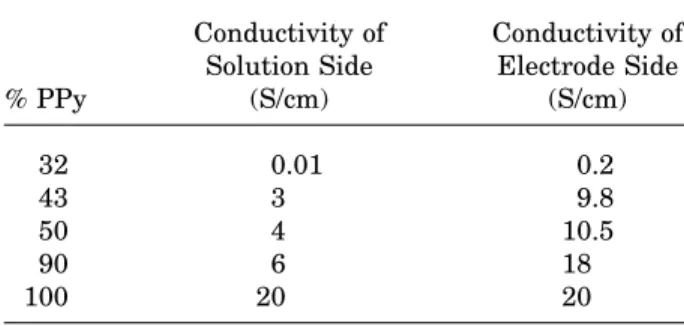
Table I Conductivities of the Films Obtained by Anodic Oxidation of PPy
Conductivity of Conductivity of Solution Side Electrode Side
% PPy (S/cm) (S/cm) 32 0.01 0.2 43 3 9.8 50 4 10.5 90 6 18 100 20 20
This is a sign of incompatibility since both pris-tine polymers yield higher tensile strengths com-pared to the composite concerned. The maximum percent elongation of the composite gave almost a constant value around 3% ( Fig. 3 ) . It was not possible to determine the same parameters for the electrochemically prepared composite since we were restricted by the electrode size.
The conductivities of the chemically prepared composite films are between 1004and 1003S / cm Figure 2 Maximum tensile strength vs. % PPy
con-and the air stability is very low. The conductivi-tent of chemically produced PPy / PVC – PVA
compos-ties of electrochemically prepared films are given ites.
in Table I.
The conductivities of the solution side and that of the electrode side of the films were different. There exists a threefold increase in the conductiv-polymer was enhanced by the formation of a
com-posite structure. ities of the electrode side of the composite films
containing PPy above 40% with respect to the con-Mechanical tests showed that PPy and PVC –
PVA are not compatible. There was a certain de- ductivities of solution sides ( Fig. 4 ) . An important difference lies in the conductivities of the compos-crease in the tensile strength for an increasing
percentage of PPy up to one point and then an ites. The conductivity of the PPy / PVC – PVA com-posite prepared electrochemically is environmen-increase was observed ( Fig. 2 ) .
Figure 3 Tensile strength vs. % elongation curves of chemically produced PPy / PVC – PVA composites for several PPy contents.
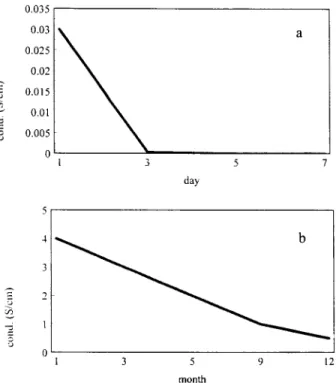
Figure 6 Conductivity vs. time graphs for ( a ) chemi-Figure 4 Weight % vs. log conductivity of solution cally prepared PPy / PVC – PVA ( 50% by PPy ) and ( b ) side of PPy / PVC – PVA ( prepared electrochemically ) . electrochemically prepared PPy / PVC – PVA ( 50% by
PPy ) .
tally stable. Threshold conductivities near 40% were observed for the electrolytic composite. Above the threshold concentration ( 40% PPy ) , conductivity is not affected much by the amount of the conducting polymer ; however, there exists a steeper rise in the conductivity up to the threshold concentration.
On the other hand, there is no threshold value in the chemically prepared composite ( Fig. 5 ) . While chemically prepared composites lose their conductivity in 1 week, electrolytic composites are still conducting after 1 year ( Fig. 6 ) .
CONCLUSION
The thermal stability of the PVC – PVA copolymer was enhanced by making the composite with PPy. The electrochemically prepared PPy / PVC – PVA composite is a film-forming conducting material with a threshold conductivity at 40% PPy and its air stability is very good. However, the chemically prepared composite loses its conductivity in 1 Figure 5 Weight % vs. log conductivity of PPy / PVC –
3. A. F. Diaz, K. K. Kanazawa, and G. P. Gardini, J. more advantageous in terms of conductivity and
Chem. Soc. Chem. Commun., 635 ( 1979 ) . air stability.
4. M. A. De Paoli, Quim. Nova, 9, 133 ( 1986 ) . 5. N. Balcı, E. Bayramlı, and L. Toppare, Composites,
26, 229 ( 1995 ) .
REFERENCES
6. H. L. Wang, J. E. Fernandez, and L. Toppare,Mac-romolecules, 23, 1053 ( 1990 ) .
1. R. B. Bjorklund and I. Lundstroom, J. Electron. 7. S. Dog‰an, U. Akbulut, and L. Toppare, Syn. Met.,
Mater., 13, 211 ( 1984 ) . 53, 29 ( 1990 ) .
2. R. Mac Neill, D. E. Weiss, and D. Willist, Aust. J. 8. F. Selampınar, U. Akbulut, T. Yalc¸ın, S¸. Su¨zer, and L. Toppare, Syn. Met., 62, 201 ( 1994 ) .