BEAM SEARCH ALGORITHMS FOR THE MIXED-MODEL
ASSEMBLY LINE SEQUENCING PROBLEM
A THESIS
SUBMITTED TO THE DEPARTMENT OF INDUSTRIAL ENGINEERING AND THE INSTITUTE OF ENGINEERING AND SCIENCE
OF BILKENT UNIVERSITY
IN PARTIAL FULFILLMENT OF THE REQUIREMENTS FOR THE DEGREE OF
MASTER OF SCIENCE
By Yasin Göçgün
I certify that I have read this thesis and that in my opinion it is fully adequate, in scope and in quality, as a thesis for the degree of Master of Science.
Prof. İhsan Sabuncuoğlu (Principal Advisor)
I certify that I have read this thesis and that in my opinion it is fully adequate, in scope and in quality, as a thesis for the degree of Master of Science.
Prof. Erdal Erel
I certify that I have read this thesis and that in my opinion it is fully adequate, in scope and in quality, as a thesis for the degree of Master of Science.
Asst. Prof. Ayşegül Toptal
Approved for the Institute of Engineering and Science:
Prof. Mehmet Baray
Abstract
BEAM SEARCH ALGORITHMS FOR THE MIXED-MODEL ASSEMBLY LINE SEQUENCING PROBLEM
Yasin Göçgün
M.S. in Industrial Engineering Supervisor: Prof. İhsan Sabuncuoğlu
July 2005
In this thesis, we study the mixed-model assembly line sequencing problem that considers the following objectives: 1) leveling the part usage, and 2) leveling workload on the final assembly line. We propose Beam Search algorithms for this problem. Unlike the traditional Beam Search, the proposed algorithms have information exchange and backtracking capabilities. The performances of the proposed algorithms are compared with those of the heuristics in the literature. The results indicate that the proposed methods generally outperform the existing heuristics. A comprehensive bibliography is also provided in this study.
Özet
KARIŞIK MODELLİ MONTAJ HATTI SIRALAMA PROBLEMİ İÇİN IŞIN TARAMASI ALGORİTMALARI
Yasin Göçgün
Endüstri Mühendisliği Yüksek Lisans Tez Yöneticisi: Prof. İhsan Sabuncuoğlu
Temmuz 2005
Bu tezde, şu belirtilen amaçları göz önüne alan karışık modelli montaj hattı sıralama problemini incelemekteyiz: son montaj hattı üzerinde 1) parça kullanımı ve 2) iş yükü dengelenmesi. Bu problem için Işın Taraması algoritmaları önermekteyiz. Geleneksel Işın Tarama yönteminden farklı olarak, önerilen algoritmalar bilgi değiştirme ve geri izleme yeteneğine sahiptir. Önerilen algoritmaların performansları literatürdeki sezgisel yöntemlerinki ile karşılaştırılmıştır. Sonuçlar, önerilen yöntemlerin halihazırdaki yöntemlerden genelde üstün olduğunu göstermektedir. Bu çalışmada ayrıca ayrıntılı bir kaynakça verilmektedir.
Acknowledgement
I would like to express my sincere gratitude to Prof. İhsan Sabuncuoğlu and Prof. Erdal Erel for their instructive comments and encouragements in this thesis work. I believe that their valuable suggestions in the supervision of the thesis will guide me throughout all my academic life.
I am also indebted to Asst. Prof. Ayşegül Toptal for accepting to review this thesis, and her useful comments and suggestions.
I would like to express my special thanks to Sefa Erenay for his encouragements, friendship, and for sharing his technical knowledge with me.
I would also like to thank to Evren Körpeoğlu, Murat Kalaycılar, Utku Koç, Oğuz Şöhret, Çağrı Latifoğlu, İ. Esra Büyüktahtakın, Önder Bulut, Kaya Sevindik, Zümbül Bulut, M. Mustafa Tanrıkulu, Fazıl Paç, and all my friends for their morale support during my graduate study.
Finally, I would like to express my deepest gratitude to my family for their understanding and patience during my graduate life.
CONTENTS
CHAPTER 1 ...…………. … 1
INTRODUCTION ...….….. … 1
1.1.Background ...…………. 2
1.2. Statement of the problem ……… 4
1.3. Contribution ……… 5
1.4. Thesis outline ……….…………. 6
CHAPTER 2 ……….. 7
LITERATURE REVIEW ……….………… 7
2.1. MMAL sequencing problem ………... 7
2.1.1. The MMAL problem with single objective ... 8
2.1.2. The MMAL problem with multiple objectives ... 13
2.2. Beam search techniques ... 21
2.3. Summary of the literature and research motivation ... 24
CHAPTER 3 ... 26
PROBLEM FORMULATION AND EXISTING HEURISTICS ... 26
3.1. Problem formulation ... 26
3.1.1. The parts usage problem ... 26
3.1.2. The load leveling problem ... 28
3.2.2. 2-step Heuristic ... 32
3.2.3. Variance Method ... 32
3.2.4. 2-step-variance Method ... 34
3.2.5. Beam Search Method ... 34
3.2.6. Performance of the heuristics ... 35
CHAPTER 4 ... 36
PROPOSED ALGORITHM ... 36
4.1. Structure of beam search ... 36
4.2. Proposed Beam search Method ... 37
4.2.1. Backtracking procedure ... 40
4.2.1.1. Equivalency Theorem ... 41
4.2.2. Exchange of Information (EOI) procedure ... 44
4.2.3. Global evaluation ... 47
4.2.4. Different versions of the proposed method ... 50
CHAPTER 5 ... 57
COMPUTATIONAL RESULTS ... 57
5.1. The evaluation of the proposed algorithm ... 57
5.1.1. Computational results for the parts usage measure ... 58
5.1.1.1. Experimental conditions ... 58
5.1.1.2. Results of the comparison study ... .. 60
5.1.1.2.2. Comparison ... 61
5.1.2. The computational results for the loading problem ... 62
5.1.2.1. Experimental conditions ... 62
5.1.2.2. Results ... 69
5.2. The effect of backtracking and EOI on solution quality ... 69
5.2.1. The effect of backtracking ... 69
5.2.2. The effect of EOI ... 71
5.3. The effect of EOI at different positions ... 72
CHAPTER 6 ... 78
CONCLUSION ... 78
BIBLIOGRAPHY ... 80
LIST OF FIGURES
FIGURE 1: MIXED-MODEL MULTI-LEVEL PRODUCTION SYSTEM ... 3 FIGURE 2: THE FLOW OF PRODUCTION IN MIXED-MODEL ASSEMBLY LINES ... 3 FIGURE 3: REPRESENTATION OF A BS TREE ... 37 FIGURE 4: THE SCHEMATIC VIEW OF BACKTRACKING PROCEDURE ... 43 FIGURE 5: THE SCHEMATIC VIEW OF EOI ... 46
FIGURE 6: THE ILLUSTRATION OF SEVERAL STEPS OF THE HEURISTIC
USED IN GLOBAL EVALUATION ... 49 FIGURE 7: DIFFERENT VERSIONS OF THE PROPOSED ALGORITHM .... 51 FIGURE 8: THE BS TREE OBTAINED BY IMPLEMENTING BS-1 ... 54 FIGURE 9: THE BACKTRACKING PROCEDURE INVOKED IN THE
IMPLEMENTATION OF BS-4 ... 55 FIGURE 10: THE EOI PROCEDURE IN THE IMPLEMENTATION OF BS-4 ... 56 FIGURE 11: THE EFFECT OF EOI ON THE PERFORMANCE MEASURE
WHEN NUMBER OF LEVELS IS 20 ……… 74 FIGURE 12: THE EFFECT OF INFORMATION EXCHANGE ON THE
PERFORMANCE MEASURE WHEN NUMBER OF LEVELS IS INCREASED TO 260 ... 76
LIST OF TABLES
Table 1: The summary of research on MMAL sequencing problem ... 19 Table 2: The part structure used for the example problem ... 52 Table 3: Experimental factors and their levels used in the comparison ………. 59 Table 4: Demand pattern for the newly generated problems ………. 59 Table 5: Demand pattern for the example problem ……… 60 Table 6: The comparison of the algorithms in terms of computational effort …. 61
Table 7: The computational results obtained by the data sets in given in the literature ……… 63 Table 8: The computational results obtained by the newly generated data sets … 66 Table 9: Experimental factors and their levels for the loading problem ……… 68 Table 10: Demand pattern for the newly generated problems ……….. 68 Table 11: The computational results for the loading problem ……….. 70 Table 12: The effect of backtracking on the solution quality ……… 71 Table 13: The effect of exchange of information on the solution quality ……. 72 Table A.1: Number of each part required for each product ……….. 87 Table A2: Demand vector for products ………. 90
C h a p t e r 1
INTRODUCTION
An assembly line consists of a sequence of stations performing a specified set of tasks repeatedly on consecutive items moving along the line (Erel et al. 2005). The development of the first assembly line is credited to Henry Ford in 1913. Since the early times of Henry Ford, several advancements took place that changed assembly lines from single-model lines to more flexible systems such as lines with parallel stations, and customer-oriented mixed-model lines.
In today’s business environment, many industries have to cope with the trend of diversification of customer demand which requires an increasing variety of products. Many repetitive manufacturers that used to produce single items via mass production now have to produce more variety of products on a single assembly line. Hence, many companies have been using mixed-model assembly lines (MMALs). This is because, mixed-model lines can assemble a variety of related products in very small quantities without a changeover delay. In this way, the companies can respond quickly to changes in market demand and avoid large inventories of specific product models.
Below, background for the mixed-model lines, statement of the problem, contribution of this study, and thesis outline are given.
1.1. Background
Mixed-model assembly lines (MMALs) are a type of production line where a variety of product models similar in product characteristics are assembled. They are generally used in multi-level production systems (Figure 1). In multi-level production systems, raw materials are fabricated into components which are combined into sub-assemblies; sub-assemblies are assembled into products on a final assembly line.
Mixed-model lines become popular in recent decades, especially as an integral part of just-in-time (JIT) production systems. JIT is a pull system, meaning that the sub-assemblies, components and raw materials are pulled forward as they are needed; production is initiated by one level’s requirement for the output of another level. Hence, the final assembly line is the focus for controlling mixed-model lines.
The effective utilization of mixed-model lines requires that the following two problems be tackled: 1) the line balancing problem, and 2) the line sequencing problem. The line balancing problem is the process of allocating the set of tasks to stations to finish an assembly work. A task is the smallest work element of the total work in an assembly process. A station is a location on the line at which work is performed on the product. The line sequencing is a problem of determining a sequence of the product models on the final assembly line with the objective of optimizing line utilization.
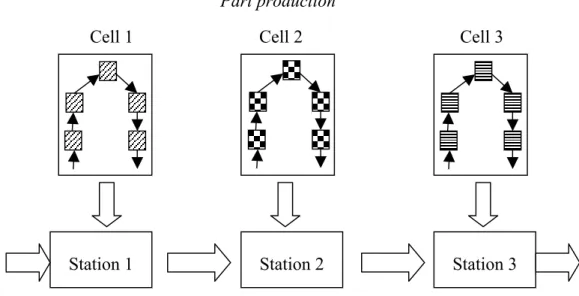
In many JIT systems, part production is made in manufacturing cells that manufacture families of parts (Leu et al. 1997). Figure 2 shows how parts being
Production Level
1. Products
…
2. Sub-assemblies
…
…
3. Components
…
4. Raw materials
…
Figure 1. Mixed-model multi-level production system
Part production
Cell 1 Cell 2 Cell 3
Final assembly line
Figure 2. The flow of production in mixed-model assembly lines
1 2
1 2 3 4
1 2 3
1 2 3
1.2. Statement of the problem
In this thesis, we study the MMAL sequencing problem assuming that the line balancing is accomplished, and setup times between the different product models are negligible. In determining the sequence of models produced on the line, we consider the following common goals separately:
1) Leveling parts usage: maintain a constant rate of usage of all parts that feed the final assembly line
2) Leveling workload: Smooth the workload on the final assembly line to reduce the chance of production delays and stoppages
The first goal, also known as leveling the parts usage, requires that products (level 1) be assembled at rates proportional to their volume requirements, and parts (levels 2, 3, and so on) be pulled through the system at constant rates (Miltenburg and Sinnamon 1992). In other words, there should be very little variability in the parts usage from one time period to the next.
The second goal, balancing the workload, recognizes that not all products have the same operation time at each station on the line. Products requiring relatively longer operation times at any station are difficult to assemble unless they are balanced off with products having shorter operation times. The load leveling goal aims to level the work load on the final assembly line to reduce the chance of production delays and line stoppages. Products are sequenced so that production requirements for the outputs required to support the production of the products are balanced.
variability only at the sub-assembly level (level 2), as suggested by Monden (1983). Small versions of this problem are optimally solved by exact procedures. However, heuristics should be developed to handle large-size problems. The existing heuristics are computationally efficient but their performances are not sufficient enough in terms of solution quality. Hence, in this study we aim to propose an efficient heuristic procedure for the parts usage problem that outperforms the existing heuristics in terms of solution quality.
In order to solve the MMAL sequencing problem, we propose several beam search methods which include some enhancement tools, and compare their performances against the well-known heuristics from the literature.
1.3. Contribution
First, this research is the first to use enhanced Beam Search methods for the MMAL sequencing problem. Second, our proposed algorithms are generally superior to the state-of-the-art heuristics in terms of solution quality. We also draw conclusions about the algorithmic performances of the existing heuristics, which have not been performed completely in the literature.
Our contribution to beam search literature is two-fold: First we incorporate a novel enhancement tool, the exchange of information (EOI) procedure, into traditional beam search applications and show that it generally improves the solution quality. Second we draw inferences about where EOI should be invoked during the search procedure.
1.4. Thesis outline
The rest of the thesis is organized as follows. We briefly discuss the existing studies in Chapter 2. We give the formulation of the problem, and the explanation of the heuristics developed for the problem in Chapter 3. In Chapter 4, we discuss the proposed Beam Search algorithms in detail. We explain the computational results in Chapter 5. Finally, in Chapter 6 we give concluding remarks and further research directions.
C h a p t e r 2
LITERATURE REVIEW
This chapter is organized in two sections: 1) brief discussion of the research conducted on the MMAL sequencing problem, and 2) summary of the studies on the beam search.
2.1. MMAL sequencing problem
After first investigated by Kilbridge and Webster (1963), a large number of research have been conducted on the MMAL sequencing problem, the pioneers of which are Thomopoulos (1967), Dar-el and Cother (1975), and Dar-el and Cucuy (1977), and Yamashita and Okamura (1979). A common property of all these studies is that, they consider the final assembly line, by ignoring the effects on other levels in the multi-level production system, with different objectives such as minimizing line length, and line stoppages. The first analysis of mixed-model, multi-level production systems have been made by Monden (1983), and Miltenburg and Sinnamon (1989). The detailed explanation of research carried out on the MMAL sequencing problem is given below.
2.1.1. The MMAL problem with single objective
Miltenburg (1989) studies the mixed-model sequencing problem by considering the variation in production rates of the finished products. Under the assumption that all models require the same number and mix of parts, he emphasizes that minimizing the variation in production rates of the finished products achieves minimizing the variation in parts usage rates. The author formulates the problem as a nonlinear integer programming model with the aim of minimizing the total deviation of actual production rates from the desired production rates. The author develops an exact algorithm to solve the program which has a worst case complexity that grows exponentially with the number of products. Hence, he proposes two heuristics, called Miltenburg’s Algorithm 3 Using Heuristic 1 (MA3H1), and Miltenburg’s Algorithm 3 Using Heuristic 2 (MA3H2) for the problem.
In another study, Miltenburg and Sinnamon (1989) consider multi-level model production systems to solve mixed-model sequencing problem with the objective of keeping a constant rate of every part used by the system. They develop a mathematical model for the problem, and extend the heuristics proposed by Miltenburg (1989) to include all levels in the multi-level system. In a follow up study, Miltenburg and Sinnamon (1992) consider the same problem and propose heuristic procedures for finding good solutions, and solving large problems.
Sumichrast and Russell (1990) consider the MMAL sequencing problem with the objective of leveling the parts usage. They review five sequencing methods which are Goal Chasing 1 (GC1), Goal Chasing 2 (GC2), and Miltenburg’s three heuristics (M-A1, MA3H1, and M-A3H2). The performance of the heuristics is
is based on the ability to minimize the mean absolute deviation from uniform production of each model. The results of their experimental study indicate that M-A3H2 outperforms other methods under all conditions tested. They also observe that the relative performance of the method is not related to the number of models, demand type, or the length of production sequence. As for the case of different models requiring different components, only goal chasing methods are tested since Miltenburg’s algorithms are not appropriate for this problem. It is shown that the performance of the two goal chasing methods is good when the products have simple product structures. However, when more than one component or many different components are used for models, the performance of GC2 worsens significantly.
Miltenburg and Goldstein (1991) address the mixed-model multi-level sequencing problem that considers both the usage and loading goal. They propose a single-stage and a double-stage heuristic to solve the joint problem. The single-stage (double-stage) heuristic myopically minimizes the one-stage (two-stage) variation each time a model is added to the sequence.
Kubiak and Sethi (1991) study the MMAL sequencing problem with the objective of minimizing the product usage variation. They formulate an assignment problem to obtain optimal level schedules for MMALs. They show that their assignment formulation can be extended to more general objective functions than the one used by Miltenburg (1989).
Inman and Bulfin (1991) propose Earliest Due Date (EDD) algorithm to determine the optimal sequence with the objective of leveling product usage rate. They demonstrate that model sequencing can be reduced to a single machine
sequencing problem if processing times are identical for all items. They compare the EDD approach with others reported in the literature. The computational study shows that the proposed algorithm is as good as other algorithms in terms of solution quality when evaluated with respect to traditional objectives, but its sequences are found extremely faster.
Yano and Rachamadugu (1991) study the problem of MMAL sequencing to minimize work overload. They first consider the sequencing problem for a single station, and propose an optimal procedure for this problem. For multiple stations, they develop a heuristic procedure which is shown to reduce work overload significantly.
For the MMAL sequencing problem, Ding and Cheng (1993) propose a simple heuristic procedure that aims to smooth product usage rate. They compare the proposed algorithm with M-A3H2 in problem sets conducted by Russell and Sumichrast. The experimental results indicate that the proposed method is as good as M-A3H2 in solution quality regarding the mean squared and absolute deviations and much more efficient in terms of computational effort. It is also shown that as the number of products increases, the computation time required by M-A3H2 increases much faster than the proposed method.
Kubiak (1993) reviews the results of research conducted on the problem of MMAL sequencing with the goal of smoothing the parts usage rate. In his paper, he considers research efforts made on both product usage rate and component usage rate variation with various objective functions such as maximum and total deviaiton between actual usage and the expected usage. The author relates the results of this
programming model of the problem. The author further discusses another primary concern in JIT systems, which is smoothing the workload on each workstation on the line to reduce the chance of production delays and stoppages.
Ng and Mak (1994) study the sequencing problem of mixed-model assembly lines that produce products with similar part requirements in a just-in-time production environment. The objective used in their study is to minimize the total variation of the actual production quantities of products from desired amount. They propose an efficient Branch and Bound algorithm for determining the optimal sequence. The computational results reveal that the algorithm is very efficient for the MMAL sequencing problem.
Bautista et al. (1996) develop an exact algorithm that considers leveling parts usage rate to solve MMAL sequencing problem. Their algorithm is based on bounded dynamic programming (BDP). BDP combines features of dynamic programming with features of branch and bound algorithms. The authors show that the problem is equivalent to searching for a minimum path in an associated graph. They also emphasize the myopic behavior of goal chasing method, and propose several heuristics that are modification of GC method.
Cheng and Ding (1996) study the MMAL sequencing problem with the objective of maintaining nearly constant rates of model usage on the line. They generalize the problem to consider the weights for different models in evaluating their influence on the model usage rate. They demonstrate that the existing sequencing heuristics (i.e., Miltenburg’s Algorithm 3 using heuristic 2, two-stage algorithm, and EDD method) for equal-weight MMALs can be extended to this problem. They also compare these modified heuristics and an optimal procedure in terms of solution quality and CPU
time requirements. The results indicate that the modified EDD, the modified two-stage, and the modified MA3-H2 methods are quite efficient for this problem.
Duplaga et al. (1996) describe and illustrate the mixed-model sequencing approach used by Hyundai Motor Company that minimizes the parts usage variation. Hyundai’s methodology is developed to provide a reasonable solution that approximates the result found by GCM1 while reducing CPU time considerations.
In their paper, Kim et al. (1996) propose a genetic algorithm for the MMAL sequencing problem to minimize the overall length of a line. The computational results indicate that the proposed algorithm is very efficient in terms of CPU time considerations as well as solution quality.
Duplaga and Bragg (1998) compare the performance of six sequencing heuristics developed for smoothing parts usage in MMALs. The heuristics evaluated in their study are Goal-Chasing Method 1, Goal-Chasing Method 2, Hyundai’s heuristic, Miltenburg and Sinnamon’s heuristic 1, Miltenburg and Sinnamon’s heuristic 2, and Extended Goal-Chasing method. Performance comparison is made considering products that may require different components that are common among products. The results of their computational experiments show that Extended Goal-chasing Method and Miltenburg and Sinnamon’s heuristic 2 have statistically better performance than the others.
In another study, Zhu and Ding (2000) transform the minimization of the two-stage variation in the mixed-model sequencing problem of reducing the part-level variation to product-level terms. The two-stage transformation is based on a simplification of the two-stage approach and a relationship matrix that evaluates the
indicate that the proposed method generally outperforms the one-stage method in terms of solution quality, and is much faster than direct enumeration in computation. The authors also present a general sufficient condition for the equivalence of the sequencing problems of the product and part levels.
In another study, Celano et al. (2005) investigate the sequencing of MMAL assuming the parts usage smoothing as the goal of the sequence selection. They study this problem considering not only the traditional goal chasing approaches, which assume zero-length assembly lines, but also models which take into account the effective length of the assembly line. This implies that the number of workstations and their extensions become important parameters for the optimal sequence of the models. They propose a simulated annealing (SA) algorithm for this problem and compare it with Goal Chasing algorithms. The experimental results indicate that in the most cases the SA outperforms other heuristics. It is also shown that the differences in the algorithm performances are affected by workstations and parts number. As line length and mix to be assembled grows, satisfying the component usage constraint becomes very difficult.
2.1.2. The MMAL problem with multiple objectives
Dar-El (1978) develops a broad classification of mixed-model assembly lines (MMAL) from which four categories of model sequencing are derived. In each category, satisfying one or both of two objective criteria, the one minimizing the overall line length, and the other minimizing the throughput time is aimed. Methodologies for solving the sequencing problem in each category are also
presented. The author also proposes a design strategy that can be followed by designers of mixed-model assembly lines.
Bard et al. (1994) study MMAL sequencing problem with the objective of minimizing the line length of the line (i.e., minimizing the risk of stopping the conveyor and the station lengths are fixed) and maintaining constant product usage rate. They present a bicriteria formulation of the problem that is suitable to examine the tradeoffs between line length and product usage. The resulting model is solved with a combination of Branch and Bound and heuristics such as Tabu Search and adjacent pairwise interchange heuristic. The evaluation of the methods is performed with a wide range of problems sizes defined by the number of stations on the line, the number of different model types, and the total number of units to be assembled. The results reveal that as problem size increases, computation times grow exponentially for Branch and Bound algorithm, which necessitates the use of heuristics for large problems. It is also shown that in the majority of cases at least one of the heuristics finds either the optimal or near-optimal solution.
Hyun et al. (1998) propose a new genetic algorithm (GA) to solve multiple objective sequencing problems in MMALs. They consider three objectives: minimizing total utility work, minimizing total setup cost, and keeping model production constant. The algorithm searches for a set of diverse non-dominated solutions and give importance to the diversity of solutions and the Pareto optimality. The results of the performance comparison of the proposed GA with three existing GAs in terms of solution quality and diversity reveal that the proposed GA is better, especially for problems that are large, and involve great variation in setup cost.
Merengo et al. (1999) develop new balancing and sequencing methods for the MMAL problem with the following objectives: minimizing the rate of incomplete jobs (in paced lines and in moving lines) or the probability of blocking/starvation events, and reducing WIP. Minimizing the product usage variation is also considered by their sequencing methodology. Regarding the sequencing problems, they highlight the similarities between the need to minimize incomplete units and the need to level product usage. They demonstrate that one single sequencing method can meet both objectives.
Sumichrast et al. (2000) develop a new sequencing method, Evolutionary Production Sequencer (EPS) to maximize production on MMAL’s. They evaluate the performance of EPS using three measures: minimum cycle time necessary to attain 100% completion without rework, percent of items completed without rework for a given cycle time, and maintaining nearly constant rates of parts usage. Sequence smoothness is measured by the mean absolute deviation (MAD) between actual part usage and the expected part usage at each level in the production sequence. They compare the performance of EPS with well-known sequencing methods developed by Miltenburg (1989), Okamura and Yamashina (1979), and Yano and Rachamadugu (1991). Their experimental study indicates that, when MAD is the criterion of success, EPS is inferior to the Miltenburg heuristic, but better than the other two methods.
In another study, McMullen and Frazier (2000) propose a Simulated Annealing (SA) based heuristic that simultaneously considers both setups and the stability of product usage rates to solve MMAL sequencing problem. The performance of the SA algorithm is compared with that of Tabu Search approach from the literature.
The results indicate that the SA approach generally outperforms Tabu Search. It is also shown that the SA approach achieves near-optimal solutions for smaller problems.
In another study, Zeramdini (2000) et al. consider bicriteria sequencing problem for mixed-model assembly lines with the following goals: 1) keeping a constant rate of parts usage, and 2) leveling the workload at work stations to avoid line stoppages. They develop a two-step approach, where in the first step they consider only goal 1 by applying Extended Goal Chasing Method (EGCM). In the second step they place emphasis on goal 2, by investigating the efficiency of a spacing-constraint based approach, in comparison with a more general time-based one. They show that the EGCM is an appropriate choice for step 1 with a new performance measure that represents a lower bound on variation in parts usage. As for the workload smoothing, it is shown that the spacing-constraint based method outperforms the time-based approach.
Drexl and Kimms (2001) propose a new integer-programming model that considers both of the following objectives: smoothing the usage rate of all parts fed into the final assembly line, and keeping the line’s workstation loads as constant as possible. Unlike the algorithms reported in the literature, their model allows one to control the risk of conveyor stoppage or enables one to control the cost for utility work while producing smooth JIT schedules. They solve the problem by specifying a set-partitioning/ column-generation approach. They demonstrate that solving the LP-relaxation of this model by column generation provides tight lower bounds for the optimal value of objective function.
Korkmazel and Meral (2001) study MMAL sequencing problem considering two major goals: 1) smoothing the workload on each workstation on the assembly line, 2) keeping a constant rate of usage of products on the assembly line. They develop the modified Ding and Cheng algorithm to minimize the sum of deviations of actual production from the desired amount. The proposed algorithm is compared with M-A3H2 and Ding and Cheng (D&C) Algorithm. The results of evaluation reveal that the modified D&C algorithm outperforms the other methodologies in all problem instances handled. Furthermore, the approaches that perform better than the others are extended for the bicriteria problem considering goals 1 and 2, simultaneously. In their study, it is also demonstrated that the bicriteria problem with the sum-of-deviations type objective function can also be formulated as an assignment problem; and hence, the optimal solution to the small-sized problems can be obtained by solving the assignment problem.
Ponnambalam (2003) et al. propose a genetic algorithm (GA) for the MMAL sequencing problem considering both a single objective and multiple objectives. They compare genetic algorithm with the algorithm of Miltenburg and Sinnamon (MS1992) to get the constant usage of every part considering variation at four levels: 1) product, 2) subassembly, 3) component, and 4) raw material. The results of evaluation show that GA outperforms MS1992 in the majority of the problems investigated. As for the multiple-objective genetic algorithm for sequencing MMALs, the minimization of total utility work, leveling parts usage, and minimization of total setup cost are considered. The genetic algorithm used to solve this problem employs the selection mechanism of Pareto stratum-niche cubicle. Pareto stratum-niche cubicle is compared with the selection based on scalar fitness
function value. The results show that GA using Pareto stratum-niche cubicle performs better than the GA with other selection mechanisms.
McMullen and Tarasewich (2005) consider the problem of mixed-model sequencing with setups. The problem has two objectives: minimizing the product usage variation and number of setups. Since the objectives are frequently in opposition with one another, they present an efficient frontier approach for this problem. To effectively generate efficient frontiers necessary to solve the problem, they develop a beam-search heuristic. The experimental results reveal that the proposed approach performs well in terms of solution quality as well as computational effort.
In a recent study, Mansouri (2005) develops a multi-objective genetic algorithm for MMAL sequencing problem to optimize the variation of product usage rates and number of steps simultaneously. Since the two objectives are inversely correlated with each other, simultaneously optimizing both of them is difficult. Hence, the proposed method searches for locally Pareto-optimal or locally non-dominated frontier where simultaneous minimization of the product usage rate variation and the number of setups is desired. Performance of the algorithm is compared against a total enumeration (TE) scheme in small problems and also against several heuristics in small, medium and large problems. The results of evaluation show that the proposed method is better in CPU time considerations and it outperforms the comparator algorithms in solution quality as well as computational effort.
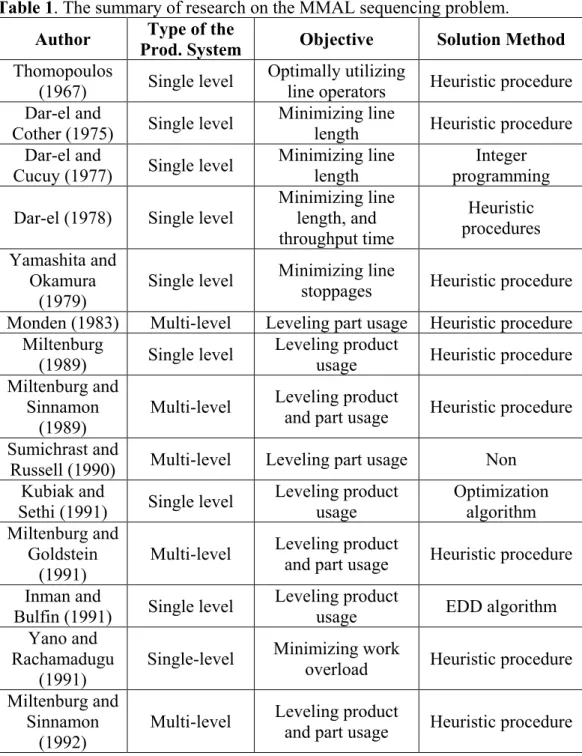
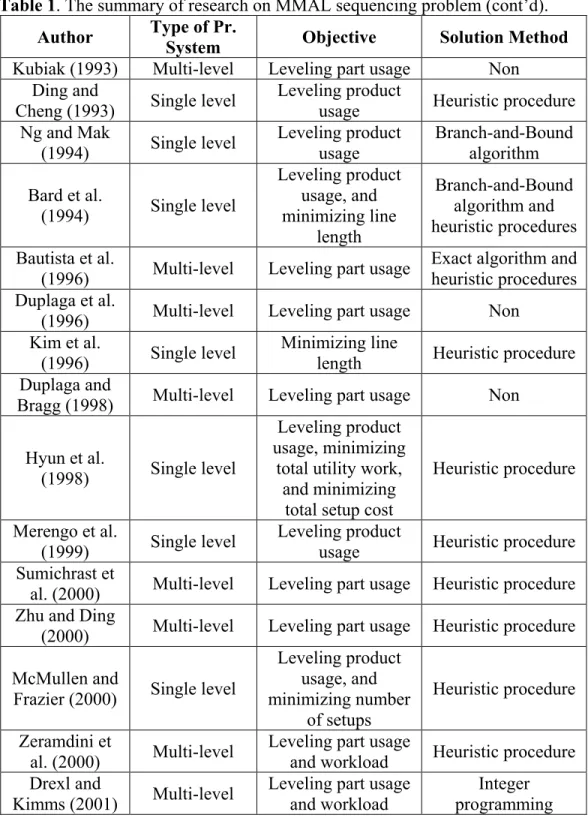
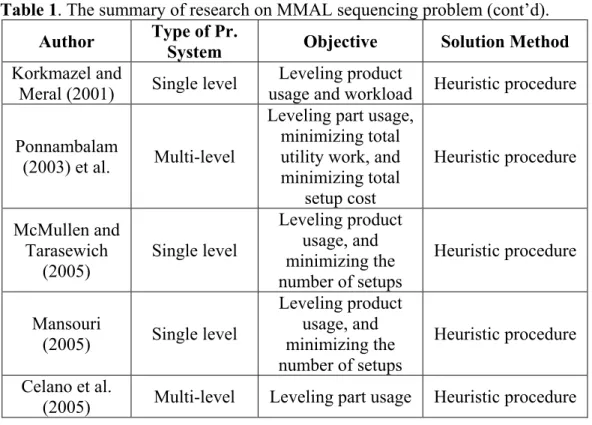
It is worth concluding this section with the summary of research on the MMAL sequencing problem. Table 1 presents the related research with their objectives.
Table 1. The summary of research on the MMAL sequencing problem.
Author Type of the
Prod. System Objective Solution Method
Thomopoulos
(1967) Single level
Optimally utilizing
line operators Heuristic procedure Dar-el and
Cother (1975) Single level
Minimizing line
length Heuristic procedure
Dar-el and
Cucuy (1977) Single level
Minimizing line length
Integer programming Dar-el (1978) Single level
Minimizing line length, and throughput time Heuristic procedures Yamashita and Okamura (1979)
Single level Minimizing line
stoppages Heuristic procedure
Monden (1983) Multi-level Leveling part usage Heuristic procedure
Miltenburg
(1989) Single level
Leveling product
usage Heuristic procedure
Miltenburg and Sinnamon
(1989)
Multi-level Leveling product
and part usage Heuristic procedure Sumichrast and
Russell (1990) Multi-level Leveling part usage Non
Kubiak and
Sethi (1991) Single level
Leveling product usage Optimization algorithm Miltenburg and Goldstein (1991)
Multi-level Leveling product
and part usage Heuristic procedure Inman and
Bulfin (1991) Single level
Leveling product
usage EDD algorithm
Yano and Rachamadugu
(1991)
Single-level Minimizing work
overload Heuristic procedure
Miltenburg and Sinnamon
(1992)
Multi-level Leveling product
Table 1. The summary of research on MMAL sequencing problem (cont’d).
Author Type of Pr.
System Objective Solution Method
Kubiak (1993) Multi-level Leveling part usage Non
Ding and
Cheng (1993) Single level
Leveling product
usage Heuristic procedure
Ng and Mak (1994) Single level Leveling product usage Branch-and-Bound algorithm Bard et al. (1994) Single level Leveling product usage, and minimizing line length Branch-and-Bound algorithm and heuristic procedures Bautista et al.
(1996) Multi-level Leveling part usage
Exact algorithm and heuristic procedures Duplaga et al.
(1996) Multi-level Leveling part usage Non
Kim et al.
(1996) Single level
Minimizing line
length Heuristic procedure
Duplaga and
Bragg (1998) Multi-level Leveling part usage Non
Hyun et al.
(1998) Single level
Leveling product usage, minimizing
total utility work, and minimizing
total setup cost
Heuristic procedure
Merengo et al.
(1999) Single level
Leveling product
usage Heuristic procedure
Sumichrast et
al. (2000) Multi-level Leveling part usage Heuristic procedure
Zhu and Ding
(2000) Multi-level Leveling part usage Heuristic procedure
McMullen and
Frazier (2000) Single level
Leveling product usage, and minimizing number of setups Heuristic procedure Zeramdini et al. (2000) Multi-level
Leveling part usage
and workload Heuristic procedure
Drexl and
Kimms (2001) Multi-level
Leveling part usage and workload
Integer programming
Table 1. The summary of research on MMAL sequencing problem (cont’d).
Author Type of Pr.
System Objective Solution Method
Korkmazel and
Meral (2001) Single level
Leveling product
usage and workload Heuristic procedure Ponnambalam
(2003) et al. Multi-level
Leveling part usage, minimizing total utility work, and minimizing total setup cost Heuristic procedure McMullen and Tarasewich (2005) Single level Leveling product usage, and minimizing the number of setups Heuristic procedure Mansouri (2005) Single level Leveling product usage, and minimizing the number of setups Heuristic procedure Celano et al.
(2005) Multi-level Leveling part usage Heuristic procedure
2.2. Beam search techniques
Beam search is an adaptation of the branch and bound method which involves searching a limited number of solution paths (i.e., beam width number of paths) in parallel. Since it progresses level by level without backtracking, optimal solution is not guaranteed. At any level, only the best beam width promising nodes, are kept for further sprouting. A variation of BS, called Filtered Beam Search, includes a filtering procedure, by which some nodes are eliminated by a quick method, and only remaining nodes (filter width) are globally evaluated (the detailed explanation of the structure of beam search is given in Chapter 4).
Beam search technique was first used by (Lowerre 1976) in the artificial intelligence applications. Later, it was incorporated into other applications such as
FMS and job shop scheduling problems (see Ow and Morton 1988, Sabuncuoglu and Karabuk 1998, Sabuncuoglu and Bayiz 2000). More recently, some enhancement tools have been used with beam search techniques which are mentioned below.
Honda et al. (2003) propose backtracking beam search algorithm for multi-objective flowshop problem to minimize both multi-objectives. As there may not be a schedule that can optimize both criteria, the authors seek non-dominated schedules (i.e., feasible schedules that are not dominated by any other feasible schedules). In the proposed method, the traditional beam search is performed. Then, backtracking is invoked to some nodes and the re-search is performed many times so that widespread non-dominated solutions can be obtained. During the searching, the pruned nodes are preserved. The lower bound of each pruned node is compared with the tentative solution, and the bounded operation is applied, as done in branch-and-bound method. The computational study indicates that the proposed algorithm can find more balanced solutions than does the beam search method.
In another study, Croce and Tadei (2004) develop a Recovering Beam Search (RBS) method for the two combinatorial optimization problems: the two-machine total completion time flow shop scheduling problem and the uncapacitated p-median location problem. The recovering phase of the algorithm aims at recovering from previous wrong decisions. This step is invoked to each of the beam width number of best child nodes generated. For a given node, the recovering phase, by means of interchange operators applied to the current partial schedule, checks whether the current solution is dominated by another partial solution sharing the same search tree
evaluation show that RBS procedure outperforms basic beam search approach in solution quality, and is competitive with the state-of-the-art heuristics.
Valente and Alves (2005) develop filtered and recovering beam search algorithms for the single machine earliness/tardiness scheduling problem with no idle time. The RBS algorithm differs from filtered beam search in three ways: First, its beam width is equal to 1; second, the global evaluation is employed by a weighted sum of both lower and upper bounds for the solution that can be obtained from the partial schedule represented by the node. Third, once the best node and the corresponding best partial solution are retained, a recovering step is applied. The computational results show that the RBS algorithms outperform the filtered beam search algorithm in terms of solution quality as well as computational effort.
Ghirardi and Potts (2005) propose a RBS method for minimizing makespan on unrelated parallel machine. In order to test its effectiveness, they compare it with a procedure reported in the literature. The computational study reveals that the RBS algorithm generally outperforms the other in both solution quality as well as computational time. In addition, it is shown that the RBS method is able to generate approximate solutions for instances with large size using reasonable computation time.
Esteve et al. (2005) propose RBS algorithm and several heuristic algorithms for the single machine JIT scheduling problem. The recovering step is invoked to each of the beam width number of best child nodes generated. For a given node, a local search is applied to the current partial schedule. If the obtained partial schedule is superior and has a lower makespan than the current one, the current schedule is replaced by the better schedule. The authors state that although this condition is not
an exact dominance condition, it improves the behavior of RBS algorithm. The computational experiments indicate that the RBS algorithm outperforms other heuristics in solution quality.
2.3. Summary of the literature and research motivation
Over years, a large number of research have been conducted on the MMAL sequencing problem with the aim of minimizing the parts usage variation and the workload variation. Since the parts usage problem is considered to be more important for JIT production systems, the majority of research deals with the parts usage problem.
Although small versions of this problem are optimally solved by exact procedures, heuristic methods are needed to solve large-size problems in a reasonable time frame. Hence, several heuristic procedures are developed for the problem in the literature. Although they are efficient in terms of CPU time considerations, they are not competent in solution quality. In addition to this, there is not a sufficient study on the performance comparison of the state-of-the-art heuristics in the literature. Hence, in this study we propose Beam Search algorithms to minimize the parts usage variation that generally outperform the existing heuristics. We also implement these algorithms to solve the load leveling problem. We draw conclusions about the algorithmic performances of the state-of-the-art heuristics in the literature, as well.
Beam search applications have also been used in various research areas such as scheduling, artificial intelligence, and assembly lines. In recent studies, the
tools. The algorithms we propose are one type of enhanced beam search techniques, which have never been used for the MMAL sequencing problem. Unlike the traditional beam search applications, the proposed algorithms have the following capabilities: 1) backtracking, and 2) exchange of information (EOI). Among the enhancement procedures, exchange of information is a novel enhancement tool for the beam search literature. We further address the research question of where to invoke EOI in the search procedure.
C h a p t e r 3
PROBLEM FORMULATION AND
EXISTING HEURISTICS
First, the formulation of the MMAL sequencing problem is given by considering the part usage and load leveling goals separately. Then, the solution procedures reported in the literature are explained in Section 3.2.
3.1. Problem formulation
3.1. 1. The parts usage problem
The formulation of the MMAL sequencing problem to minimize the parts usage variation was developed by Jin and Wu (2002), which is presented below.
We assume that there are N different models to be produced on the final assembly line, and C different parts that can be used by a model. The following notation is used in formulating the problem.
di : the demand for model i, i = 1,…, N
cj,i : the number of part j required for one model i, i = 1,…, N, j = 1,…, C
D : the total demand for models, =
∑
N
d D
Tj: the total number of part j required for the full sequence, j = 1,…, C,
∑
= = N i i i j j c d T 1 ,rj: the desired parts consuming rate,
T j j D T r =
xi,k: the total number of model i sequenced in the first k position for a specific
sequence
The desired number of part j consumed in the first k positions for a specific sequence is: kr j
The cumulative consumption of part j for one specific sequence at position k is:
∑
= N i i j k i c x 1 , ,Hence, the parts usage variation at ant level (i.e., level k) is calculated as follows:
2 1 1 , ,
∑ ∑
= = − = C j j N i i j k i c kr x V (1)Various types of objective functions for this problem are used in the literature such as minimizing the absolute deviation or maximum deviation of the actual parts usage from the desired amount. However, we use one of the most popular objective functions: the sum of quadratic differences between the actual parts usage and desired parts usage.
Using the notations and the objective function given above, the MMAL sequencing problem is formulated as follows:
2 1 1 1 , , SDQ Min.
∑ ∑ ∑
= = = − = T D k C j j N i i j k i c kr x (2) s.t.∑
= = N i k i k x 1 , k = 1,…, DT (3) 1 1 , ,k − ik− ≤ i x x i = 1,…, N, k = 1,…, DT (4) 0 1 , ,k − ik− ≥ i x x i = 1,…, N, k = 1,…, DT (5) i k i d x ≤ ≤ , 0 i = 1,…, N, k = 1,…, DT (6)where xi,k is a non-negative integer
The objective function aims to minimize the cumulative variation in parts consumption. Constraint (3) ensures that at any position k, the total number of sequenced models is k. Constraints (4) and (5) require that the number of the sequenced model i be increase by one or remain the same. Constraint (6) guarantees that the number of the sequenced model i at any position k should not exceed the demand for this model. This problem is an integer non-linear problem and it would be NP-Hard in any sense if the objective was linear (Jin and Wu 2002). Small versions of the problem can be solved using exact procedures (see Bautista et al. 1996).
3.1.2. The load leveling problem
The mathematical formulation of the loading problem is developed by Miltenburg and Goldstein (1991) using the following assumptions:
• There are totally N models to be assembled on the final assembly line, and S stations where different models require, in general, significantly different operation times
• The line consists of stations between which models move until production is completed,
• The available production time at each station on the assembly line is fixed.
The notations di, DT, and xi,k, being used to formulate the usage problem, are
also valid for the loading problem. The remaining notations are defined below.
Tis : the production time required to produce model i at station s, s = 1,… S
_ s
T : the average production time required at station s, s = 1,… S
T N i i s i s D d T T
∑
= = 1 _The total actual time at station S to complete the production requirements for model through to position k is: Tisxi,k
The total actual time at station for all models through to position k is:
∑
= N i k i s i x T 1 ,
The desired production time over the first k positions is:
__ s
T
k
Using these expressions, the loading variation at position k is calculated as follows:
2 1 _ 1 ,
∑
∑
= = − = S s s N i k i s i x k T T V L (7)Since the objective function is the sum of the loading variation at each position, Equation (7) is summed over all positions to express the objective function. Hence, the complete loading problem is mathematically formulated as follows:
Minimize
∑ ∑ ∑
= = = − T D k S s s N i k i s i x kT T 1 2 1 _ 1 , (8) s.t.∑
= = N i k i k x 1 , k = 1,…, DT (9) i D i d x T = , i = 1,…, N (10) 0 0 , = i x i = 1,…, N (11) 1 , ,k ≥ ik− i x x i = 1,…, N, k = 1,…, DT (12)where xi.k is a non-negative integer
As in the formulation of the usage problem, Constraint (9) ensures that one model is assembled during each stage. Constraints (10) and (11) guarantee that the total demand for each model is met. The last constraint ensures that the number of the sequenced model should increase by one or remain the same. This problem is also an integer non-linear problem and it has the same structure of complexity with the parts usage problem.
Note that the formulation for the loading problem is similar to that for the usage problem, however it emphasizes the workloads at stations, instead of sub-assemblies and parts usage.
3.2. Heuristics
In this section, we present the algorithms developed for minimizing parts usage on MMALs since we mainly focus on the usage problem. Since the structure of the load leveling problem is similar to that of the usage problem, the algorithms can also be used for the latter case.
Over years, a large number of solution procedures have been proposed for the MMAL sequencing problem with the objective of minimizing parts usage. Among them, we consider the well-known algorithms developed for the Monden problem, which considers the variability at the sub-assembly level, and ignores the variability at the final assembly. The explanation of these algorithms is given next.
3.2.1. Goal Chasing Method
Monden (1983) develops a greedy heuristic, Goal Chasing Method (GCM), to level parts usage. At any level, the procedure selects the model that yields the minimum parts usage variation. Hence, it is very efficient in computational effort, but myopic in nature. The steps of the algorithms is shown below (Jin and Wu 2002):
Step 1. Set k = 1, xi,0 = 0, i∈
{
1,...,N}
Step 2. Select the model m with xm,k−1 <dm that minimizes the variation at position k: { }
(
(
)
)
− + =∑ ∑
= = − ∈ 2 1 1 , , 1 , N 1,..., m * min arg C j N i j i j m i k i z c kr x m (13)1 if i = m where zi.m = m∈
{
1,...,N}
0 o.w. xi,k-1 + 1 when i = m* Step 3. xi,k = i∈{
1,...,N}
xi,k-1 o.w. Step 4. Set k = k+1 If k > DT end Else go to Step 2. 3.2.2. 2-step HeuristicBautista et al. (1996) propose a two-stage heuristic to reduce the myopic feature of the GCM. The procedure positions two models for the next two stages by calculating the combined variation (i.e., total variation at two positions) for all combinations. The combination of two feasible units with the minimum combined variation is chosen and only the first model is positioned into the sequence. Note that the same methodology was also developed by Miltenburg and Sinnamon (1989) for the multi-level production system.
As the procedure considers two stages in one iteration, it reduces the greedy feature of the GCM. However, its running time is higher as compared to that of the GCM.
3.2.3. Variance Method:
models) are used too quickly in the early iterations and the bad units are left to position in the late iterations. By defining good units and bad units they develop variance improvement to enhance the GCM.
A good unit is defined as a model that has a parts structure being close to desired consuming rate. In order to measure goodness, they use model variance vi:
(
)
2 1 ,∑
= − = C i i j j i r c v (14)Hence, the model with little vi is a good unit. For one specific composition of the
units, they also define the total composition variance as:
∑
= = N i i iv d t 1 (15) A composition with a small composition variance value has many good units and probably yields a good sequence for the usage problem.Variance improvement reduces the myopic feature of the GCM by integrating the composition variance as opportunity cost for the remaining composition into the total cost. Hence, the current cost (i.e, variation at the current position) and the opportunity cost are conflicted, as the former tries to sequence the ‘good’ one in the early iterations and the latter tries to keep good ones for the future positions. The opportunity cost is multiplied with a discounting coefficient and the model with the minimum total cost is selected at each stage. Hence, variance method is implemented by changing Step 2 in the GCM as follows:
{ }
(
)
(
)
(
)
(
)
− − − + − + =∑
∑
∑ ∑
= = − = = − ∈ N i C j i j j m i k i i C j N i j i j m i k i c r z x d w kr c z x m 1 2 1 , , 1 . 2 1 1 , , 1 , N 1,..., m * min arg (16) 1 if i = m where zi.m = m∈{
1,...,N}
, 0 o.w.and w is the discounting factor for the opportunity cost.
3.2.4. 2-step-variance Method
As performed in the 2-step heuristic, the 2-step Variance method positions two models for the next two stages and compares all alternatives with respect to the combined total variation. The combination of two feasible models with the minimum total variation is chosen and only the first model is positioned into the sequence. Hence, the procedure further enhances the look-ahead feature of the Variance Method.
3.2.5. Beam Search Method
Leu et al. (1997) develop a beam search technique for the problem to minimize the parts usage variation. At each stage, the procedure selects the beam width best nodes using an evaluation function that minimizes the variation in parts consumption. The evaluation function evaluates all solution paths at any level by
beam width nodes that yield the minimum cumulative variation. In the same manner, the search procedure continues until the last stage at which the best solution path can be determined. The sequence is determined by tracing back up the best solution path.
3.2.6. Performance of the heuristics
The performances of the existing heuristics are tested in several studies. Leu et al. (1997) test the performance of the BS method against the GC method and the 2-step method. They consider over 400 test problems that vary in terms of number of number of product models, quantity of assembly, and degree of part commonality. The results reveal that the BS method outperforms the GC method and the 2-step method in solution quality. It is also shown that the BS method offers a substantial improvement over the 2-step method when the problem size increases. Besides, Jin and Wu (2002) demonstrate that the Variance method is superior to the GC method in solution quality. They also show that the Variance method is superior to the 2-step method in terms of computational effort. However, their study does not contain the extensive comparison of the Variance and 2-step Variance methods against the BS Method.
C h a p t e r 4
PROPOSED ALGORITHM
4.1. Structure of beam search
Beam search (BS) is an adaptation of the branch and bound method in which only some nodes are evaluated in the search tree. It is similar to a breadth-first search as it progresses level by level without backtracking. However, unlike breadth-first, only the best β promising nodes, called beam width, are kept for further sprouting at any level (Sabuncuoglu and Bayiz 1999). The potential promise of each node is determined by global evaluation function, to select the best β nodes. Global evaluation function typically estimates the minimum total cost of the best solution obtained from the partial schedule represented by the node. In order to reduce computational burden, filtering mechanism can also be used, by which some nodes are eliminated by a computationally fast method (i.e., local evaluation function), and only remaining nodes (filter width) are globally evaluated.
The representation of BS tree is shown in Figure 3. We select the promising nodes (beam nodes) by invoking local and global evaluations and proceed with the search through these selected nodes. After determining the first beam nodes at level 1, we apply the algorithm to these nodes independently and generate one partial tree (i.e., beam) from each of them. After filtering procedure, for each beam, one node
using the outcome of the global evaluation. Since we have β number of nodes in the former level while keeping one descendant, we again have β number of nodes in the next level; therefore the search progresses through β parallel beams.
Beam width: 2
Filter width: 2 Root Level 1 Level 2 Level 3 Level 4
Nodes pruned by local evaluation
Beam nodes
Nodes selected for global evaluation
Figure 3. Representation of a BS tree
4.2. Proposed Beam search Method
The proposed algorithm is based on BS, in which each node corresponds to a solution state representing the partial sequence of products. The leaf nodes
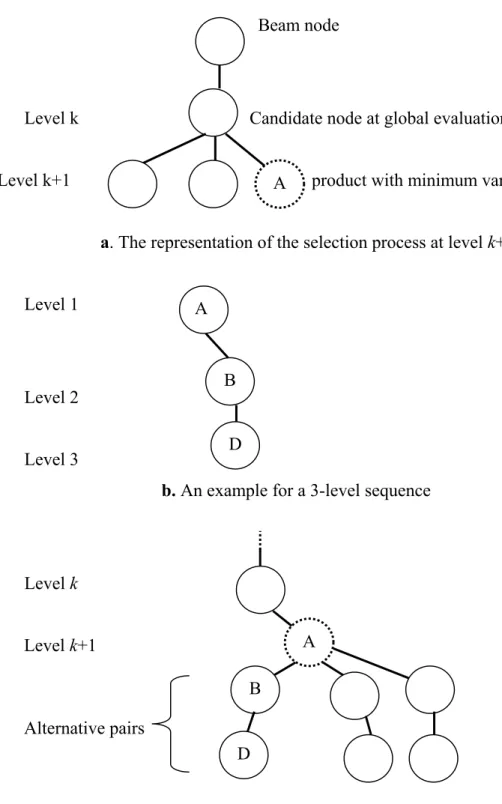
correspond to the full sequence of products. The value of local evaluation function is the parts usage variation, which is shown in Equation (1) on page 27. Global evaluation function is defined as the total parts usage variation, which is the sum of the parts usage variation at the current level (i.e., one level ahead of the beam node) and some subsequent levels. Hence, it estimates the solution quality of a partial solution, instead of full solution, which allows us to globally evaluate the candidate nodes quickly. It first selects the product (i.e., descendant of the evaluated node) with the minimum variation at the next level. Thus, for each of the subsequent levels, it schedules products so that the variability is kept as small as possible (this procedure is explained in Section 4.2.3.).
Differing from the traditional (BS) applications, the proposed algorithm incorporates various enhancement tools such as backtracking and information exchange (i.e, sharing). Backtracking is the process of going back to the previous solution states in the search tree with the expectation of obtaining better solutions. The motivation to implement this procedure stems from the fact that whenever two or more beams are equivalent in some sense, as explained below, some of the beams are further explored by going back to their previous solution states.
The other enhancement tool is the exchange of information (EOI) by which we take the part of the solution from one beam and transfer it to another beam, hoping that the resulting beam with this additional information will lead to better solutions. EOI is performed at certain predetermined levels, considering the possibility that the part of a beam that precedes and follows the same product will lead to better solutions if it is located just after the same product in another beam.
Before explaining these enhancement tools and other features of the proposed algorithm, the steps of the algorithm and related notation are introduced next.
Notation:
BL: beginning level for EOI I: interval for EOI
k: indicator for EOI DT : total demand
l: current level in the search tree
Steps of the Proposed Algorithm: Step 0. (Initialization)
Set k = 0 and l = 0.
Step 1. Generate descendant nodes. Step 2. (Determining beam nodes)
Select the best β beam nodes using global evaluation function, and set l = l+1. Step 3. (Search in the beam nodes)
Step 3.1. For each beam:
Step 3.1.1. Keep at most α nodes emanating from the current beam node, using the local evaluation function.
Step 3.1.2. Select the best node among w of them, using the global evaluation function.
Step 3.2. Set l = l+1.
Step 4. (Exchange of information)
Step 4.1.1. For each beam:
Step 4.1.1.1. Select the best beam among the alternative solutions generated by EOI procedure.
Step 4.1.2. Set k = k+1. Step 5. (Backtracking)
Step 5.1. If l =DT, then stop the algorithm.
Step 5.2. If equivalency is observed, then create an alternative beam for each inferior beam with backtracking procedure.
Step 5.3 Go to Step 1.
4.2.1. Backtracking procedure
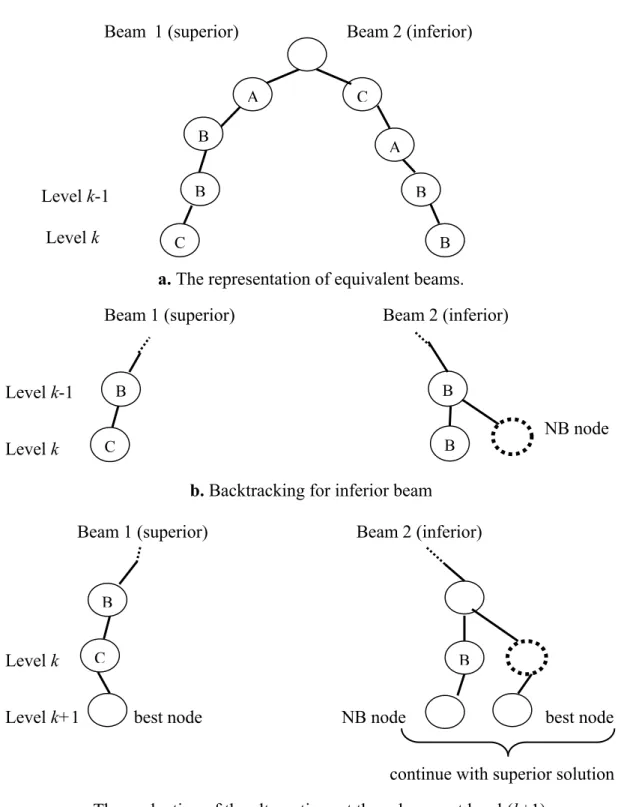
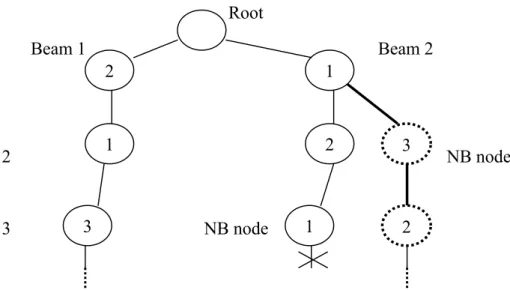
The backtracking procedure is applied whenever the equivalency is observed after the selection of beam nodes at any level. Beams are considered equivalent at a level whenever the number of each product sequenced up to that level at each beam are equal to each other. As an illustration, consider the following two beams in Figure 4: The products A, B, B, C are sequenced in Beam 1 and the products C, A, B, B are sequenced in Beam 2 (see Figure 4a). Since both of the beams have one A, two B’s, and one C, they are considered equivalent.
The cumulative variation of equivalent beams at the current level (i.e., level k < DT) is calculated and each of the inferior beams is backtracked by moving one level
up, and generating the next best (NB) child node. Hence, β+1 nodes are usually investigated. NB node is further sprouted by selecting the best node, using global evaluation function. The original node, however, is further sprouted by selecting the
evaluated in the sense that the one having the minimum value of global evaluation function plus the variation at the current level is selected.
The backtracking procedure is shown by considering two equivalent beams represented in Figure 4a. After comparing the cumulative variation values of the two beams at level k, Beam 2 is found to be inferior. Then, NB child node of Beam 2 at level k is further branched by choosing the best node at level k+1; whereas the original node (i.e., product B) at level k is further branched by selecting the NB node at level k+1. Hence, at level k+1 we have two alternative beam nodes; after evaluating these nodes, we continue the search procedure by selecting the superior one.
4.2.1.1. Equivalency Theorem:
The notation is introduced before the detailed explanation and proof of the theorem.
Notation:
i k
σ : partial sequence at level k on beam i, k = 1,…,DT-1
V ( i k
σ ) : parts usage variation for i k
σ at level k CV ( i
k
σ ) : cumulative parts usage variation for i k σ (
∑
= = k j i j i k V CV 1 ) ( ) (σ σ ) GE j (σki) : the value of global estimation obtained by completing σki up tolevel j, j= k+1,…, DT
Theorem: Let σkiand σkj be two equivalent sequences belonging to beam i and beam j, respectively. If the result of global and local evaluation functions only depend on remaining products at level k-1, and CV(σi)<CV(σj), then the
following inequality holds (as long as the same BS parameters are used in the remaining levels of search tree):
) ( ) ( Di Dj T T CV CV σ < σ
This theorem implies that since beam j is inefficient under these circumstances, it is backtracked with the expectation of leading to a better solution than beam i.
Proof: First consider the case in which only the global evaluation function is invoked. Since the remaining products to be scheduled for beam i and beam j are identical, during global evaluation the same nodes are considered at level k+1 for each beam. Let the products chosen for beam i and beam j at level k+1 be m and n, respectively such that m≠n ; hence:
(
)
{
, :}
min arg t ki sk k s d x s s GE m= σ U < (17) where xsk : number of product s sequenced up to level kds : demand for product s
The following inequality is drawn by Expression 1: )
( )
( m GE n
GEtσkiU < tσkiU (18) After applying the same steps for beam j, the following inequality is obtained: GEt(σkjUn)<GEt(σkjUm) (19)
Since the values of global estimations are equal for the equivalent sequences (i.e., σki Ul and σkjUl), the following equality holds: